Explore the spiritual meaning of the Seven Successive Buddhas and their sacred mantras, carrying blessings of purification and awakening
In a world of constant noise, concern, and ceaseless activity, mantra is a quiet way to return to stillness. A mantra must be felt first and then understood by the intellect. It pacifies the body, softens the heart, and transforms wandering thoughts into a resting prayer. Mantra is not just sound; it is a living expression of refuge, wisdom, compassion, and awakening transmitted through the sacred syllables in the Buddhist tradition.
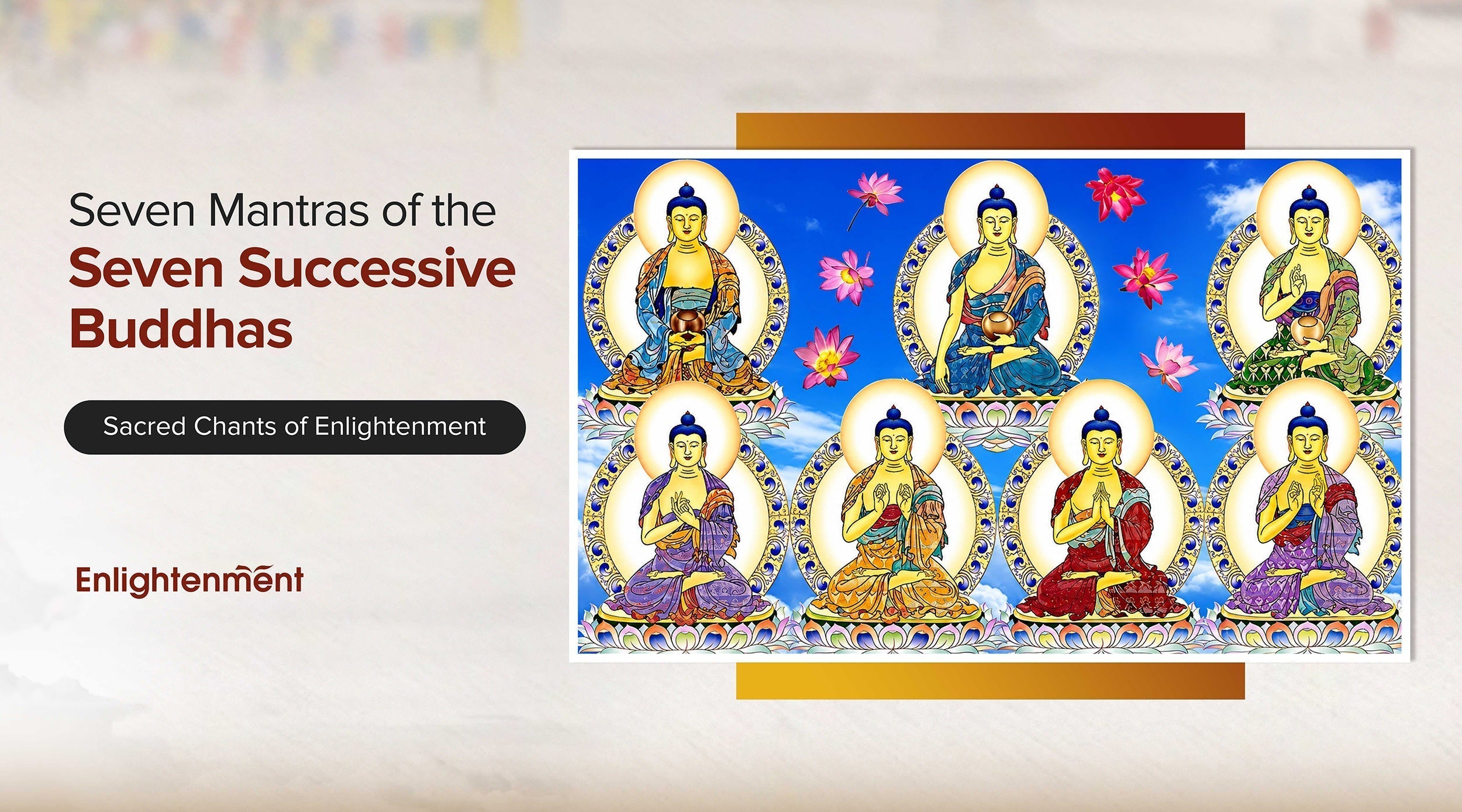
The Seven Mantras of the Seven Successive Buddhas are part of a deep tradition of Mahayana Buddhism, which spans seven enlightened masters: Vipaśyin, Śikhin, Viśvabhū, Krakucchanda, Kanakamuni, Kāśyapa, and Śākyamuni Buddha. The Buddhas embodied a sacred lineage of beings that came forth in many ages to teach sentient beings and uphold the radiant power of Dharma in the world. The first three Buddhas are said to belong to the previous eon, while the four Buddhas of the present Fortunate Eon are Krakucchanda, Kanakamuni, Kāśyapa, and Śākyamuni Buddha.
Reciting the mantras of these Seven Buddhas is not just about repeating old formulas. It is to join a long line of enlightened practitioners, running through generations for centuries. Each mantra brings purification, protection, wisdom, and spiritual transformation and is used to foster inner peace and devotion. As we recite from the text regularly, over time our mind becomes quieter, our heart becomes more compassionate, and we deepen our connection to the path of awakening.

Photo From Buddha Weekly
Who Are the Seven Successive Buddhas?
In Buddhist mythology, the Seven Successive Buddhas are a series of enlightened Buddhas who came to the world at various times and epochs to teach sentient beings the path of enlightenment. The use of them in Tibetan Buddhism is sangs rgyas rabs bdun, and their names are mentioned in many important Buddhist scriptures and Vinaya works. Due to their compassionate activity and spiritual strength, they are sometimes referred to as the Seven Heroic Buddhas.
These Buddhas are not spiritual rivals, but different aspects of the same enlightened wisdom that have come into existence over time. In each Dharma Age, Buddha appears to give him or her the responsibility of holding up the Dharma Wheel, reawakening the Dharma, and assisting beings in their release from suffering. Their presence also brings to the practitioners' minds the fact that enlightenment is eternal and constantly reconnects with the world at the times when it is most needed, and when compassion and guidance are required.
The Sacred Origin of the Seven Buddha Mantras
The Seven Buddha Mantras are derived from the Mahayana sutra called The Seven Buddhas or Saptabuddhaka. In this sacred text, Śākyamuni Buddha is with monks and bodhisattvas near Mount Kailāsa when a suffering monk gets sick and is afflicted with negative spirit forces. The bodhisattva Ākāśagarbha asks Buddha to teach a mantra to alleviate sickness, overcome obstacles, and protect beings, out of his compassion.
Thereupon, Śākyamuni Buddha shows the six Buddhas who existed before him in the sky, and he himself looks like the seventh Buddha. Each Buddha then utters a sacred dhāraṇī or vidyāmantra for the benefit of living beings. It confirms the mantras were not taught for personal power, but as the blessings of compassion for healing, purification, protection, and faith in the Three Jewels.

Photo From Buddha Weekly
What is a Mantra in Buddhist Practice?
In Buddhist practice, a mantra is a sacred sound, phrase, or formula that is used in the context of meditation, prayer, ritual, or devotion. Not only is it spoken with the mouth but carried on purpose, with faith and awareness. There are some mantra syllables that are not easily translatable into regular speech, but they have profound spiritual significance, passed through the lineage and practised. By repeating the mantra, the mind is calmed, the heart is opened, and the practitioner is united with refuge, wisdom, and compassion.
In the practitioner's hands, mantra can be a method of training the body, speech, and mind all at the same time. The body can be seated in meditation, bow, or walk, or hold a mala gently during recitation. Sacred syllables are chanted devoutly, and the mind is immersed in concentration and sincere prayer. When these three are combined, the mantra transcends repetition; it becomes a conduit between mundane thinking and the awakened presence.
It will be useful to learn about the individual blessings and symbolism of each Buddha in this sacred chain of Buddhas before exploring each mantra.
Vipaśyin Buddha: The Mantra of Clear Seeing
Vipaśyin Buddha is the first among the Seven Successive Buddhas. His name has a sense of depth perception or clarity of vision. He is the first in this hallowed series of initiates who open the door to the ancient continuity of awakened wisdom. He is from the last eon, and it reminds us that the Dharma is beyond the conventional span of history.
In the sutra, Vipaśyin’s mantra is taught to benefit beings, pacify illness, and remove harmful spirit disturbances. The traditional descriptions associate it with protection from weapons, fire, drowning, painful illness, poison, and unnatural death, while it is used in conjunction with faith and appropriate purposes. The mantra is a symbolic expression of the power of clear seeing: the ability to see dangers, to purify fear, to awaken from the blindness of confusion.

7 Buddhas: 1st Buddha Vipaśyin
Śikhin Buddha: The Mantra of Transforming Fire
The second among the Seven Successive Buddhas, as well as being a part of the previous eon, is Buddha Śikhin. He is often linked to a crest or a flame-like appearance, which imparts a sense of upward motion, radiance, and spiritual warmth to his presence.
Śikhin's mantra was traditionally associated with soothing diseases, driving away harmful influences, guarding meditation, subduing nightmares, and preventing premature death. Also used in connection with protection cords and ritual blessings. Spiritually, Śikhin's mantra is a purifying fire – not a fire that can destroy beings, but a fire that can ripen the mind, burn away obstruction, and guard the delicate lamp of practice.

7 Buddhas: 2nd Buddha Śikhin
Viśvabhū Buddha: The Mantra of Purification and Release
The third of the seven successive Buddhas is Viśvabhū Buddha, and the third of the three Buddhas of the previous eon. It sounds as if he has a big, enveloping quality. He is at the border of one cosmic cycle, a lamp, having gone through one age, before the next age begins.
The sutra ties together the mantra of Viśvabhū with the protection from weapons, poison, plague, drowning, unnatural death, and quarrels. It also refers to a method in which monks, nuns, or laypeople recite the mantra before a Buddha image to remove karmic obscurations. This mantra, on another level, is about releasing - releasing the negative forces, obsessive patterns, inner conflict, and the unseen burden of actions done.

7 Buddhas: 3rd Buddha Viśvabhu
Krakucchanda Buddha: The Mantra of Auspicious Rebirth
Krakucchanda Buddha is the first of the four Buddhas of the current fortunate eon. His role is significant since he is the initial character in the present cycle, whereupon Śākyamuni Buddha emerges.
The sutra says that the mantra of Krakucchanda is a joyous root mantra. Traditional benefits are purification, avoiding quarrels and bondage, enriching one's wealth, mitigating obstacles of hostile beings, and rebirth in Sukhāvatī, the Pure Land of Amitabha, when recited with faith, offerings, and recitation. Krackucchanda's mantra symbolizes a door opening to favourable rebirth, peaceful conditions, and a more auspicious path of Dharma Practice.

7 Buddhas: 4th Buddha Krakucchanda
Kanakamuni Buddha: The Mantra of Golden Blessing
Kanakamuni Buddha is the second Buddha of the current "Fortunate Eon". He is referred to as the “Golden Sage”, and so he has a halo of illumination, fullness, and blessing.
The Kanakamuni mantra is traditionally associated with fearlessness, long life, prosperity, and protection from danger. The sutra teaches how to ward off weapons, fire, drowning, lightning, poison, unnatural death, and cleansing karmic obscurations by reciting it regularly. This is the mantra of golden resilience symbolically. It reminds the practitioners that there is wealth other than material wealth in the world, it is merit, clarity, ethical stability, and the conditions for the growth of wisdom.

7 Buddhas: 5th Buddha Kanakamuni
Kāśyapa Buddha: The Mantra of Ancient Refuge
In the traditional sequence, Kāśyapa Buddha is the third Buddha of the current eon and the immediate predecessor of Śākyamuni Buddha in the succession of the Seven Buddhas. He is one of those of us who are not that much older, but the one whose spirit is still alive and singing along the way.
The sutra introduces Kāśyapa's mantra as a heart mantra, associated with purification, dream visions of the Tathāgata, healing rites, and in a variety of ritual contexts. It is said that it can be recited three times a day and three times a night to assist in the purification of karmic obscurations, but it is acknowledged that the process of purification of karmic obscurations is rather complex. The mantra is Kāśyapa's refuge, the past, the stability, the patience, the roots.

7 Buddhas: 6th Buddha Kāśyapa
Śākyamuni Buddha: The Mantra of the Present Teacher
Śākyamuni Buddha is the seventh of the Seven Successive Buddhas and the Buddha who existed in our world. He is the teacher whose Dharma is the basis of the Buddhism of today. His life demonstrates the human potential to wake up: birth, giving up, meditation, enlightenment, teaching, and parinirvana.
The mantra used in the sutra is the very mantra of Śākyamuni himself, and it can be used in various ritual contexts for the benefit of beings. It is the last of the mantra series, which collects up the previous mantras and brings them to the person of the Buddha of our time. The mantra of Śākyamuni is the bringing down of the great cosmic lineage into human life, spiritually. It teaches us that enlightenment is not just old and heavenly, but also near and earthly, attainable in this very world.

7 Buddhas: 7th Buddha Sakyamuni
The Deeper Symbolism of Seven
Seven is a number that completes, blesses, and sanctifies this practice. These Seven Buddhas are a link between two great eons, the past age and the current “Fortunate Eon”. The first three Buddhas form an enormous round, the next four represent the current round of which we are a part.
For this reason, the 7 mantras are like 7 lamps illuminating through time. The blessing that is offered in each lamp is distinct, for example, clarity of vision, purification, protection, auspicious rebirth, golden abundance, old residence and refuge, and the living Dharma of Śākyamuni Buddha. In combination, they remind us that the way of awakening is never blocked.

Photo From Buddha Weekly
How to Practice the Seven Buddha Mantras Respectfully
A simple practice might start with taking refuge in the Buddha, Dharma, and Sangha and then wishing that the recitation could benefit all beings. A practitioner can light a lamp and present flowers or incense, sit with a Buddha image beside him, and recite the mantras using a mala. Some traditions say each mantra three times; a greater number of recitations is practiced, such as 108 recitations, depending on one's intention and guidance. Several ritual practices are described in the sutra, such as recitation, offerings, protection cords, and bathing rites.
The key is that it is a matter of intent. Don't use Mantra as a way to be selfish. It's best combined with humility, shelter, morals, sympathy, and effort of merit. Following the recitation, the practitioners usually offer merit for the well-being, healing, protection, and awakening of all living beings.
Conclusion: Seven Lamps of Sacred Sound
The 7 Mantras of the 7 successive Buddhas are more than old songs. They are sacred vehicles for refuge, purification, healing, protection, and awakening. Every mantra is the blessing of one Buddha, but gathered together, they are like one river of enlightened compassion.
Every Buddha is a different source of illumination on the path. The clear seeing is taught by Vipaśyin, the protection of the flame of practice is given by Śikhin, the removing of the karmic obstruction is done by Viśvabhū, and the opening of the auspicious rebirth is done by Krakucchanda. Kanakamuni imparts golden merit, Kāśyapa instills the refuge of the past, and Śākyamuni brings the living Dharma into our human realm.
These seven mantras are like the light of lamps that are lit across the sky of time in a distracted age. Their sound is a reminder that enlightenment has not passed and gone and is not far distant. It still exists, it remains compassionate, and it is still spoken in the breath of sincere practice.
Click Here To View Our Collection Of Hand-Painted Buddha Thangkas