
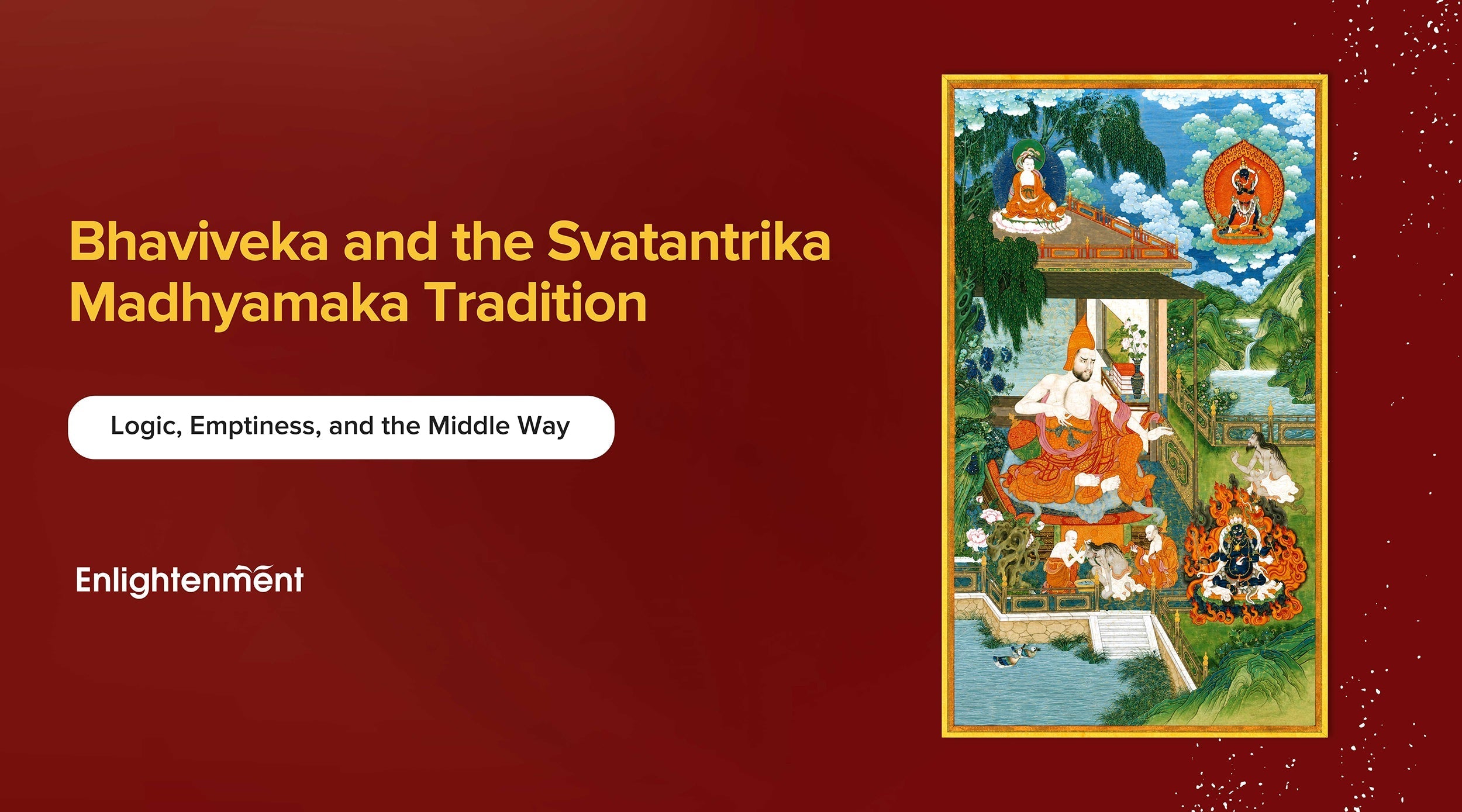
Explore the life and philosophy of Bhāviveka, the 6th-century Buddhist master who shaped Madhyamaka thought through reasoning, debate, and the two truths
Bhāviveka, Bhāvaviveka, or Bhavya is one of the most important voices in the Madhyamaka tradition in the history of Buddhist philosophy. The 6th-century Indian Buddhist philosopher is sometimes identified in the later Buddhist traditions of Tibet as an adherent of the Svātantrika Madhyamaka school. Amongst his major works are the Madhyamakahṛdaya, the Tarkajvālā, and the Prakārabhāva, a commentary on Nāgārjuna's foundational Madhyamaka text Madhyamakakārikā. His greatest work was to use logical reasoning, independent inference, and a structured debate to explain the meaning of emptiness, or śūnyatā.
The central theme of Bhāviveka's philosophy is the middle path: All things work in ordinary life, but none has an independent, fixed nature. It is presented in the form of two truths: conventional truth, in which things exist, act, and have an impact on us; and ultimate truth, in which things are perceived as having no intrinsic being. Bhāviveka's Svātantrika method focused on using reasoning to clear this up, particularly when debating this with other Buddhist and non-Buddhist schools. Logic for him was not abstract intellectual performances, but the lamp that dispels erroneous perceptions so that other, more penetrating ones might emerge.
Who was Bhāviveka?
Bhāviveka's own era was an era of great activity in Indian Buddhist philosophy, during which Buddhist philosophers engaged in deep discussions with Yogācāra philosophers, Brahmanical philosophers, Jain teachers, and others. According to the traditional sources, he is a South Indian scholar, and later accounts remember him as a philosopher who went on travelling and came in contact with the great intellectual currents of his age, and met in Andhra Pradesh.

Photo from Mandala Life
He did not simply "repeat" Nāgārjuna's philosophy. The world was one of razor-thin debate in which every statement was expected to be backed up with a certain precision. From his writings, it is evident that he was educated in both Buddhist doctrine and logic. As such, Bhāviveka served as a link between insight gained in meditations and understanding in philosophy.
What is Madhyamaka?
Madhyamaka translates to Middle Way. The Buddhist philosophical tradition that is most closely linked to Nāgārjuna is the doctrine of emptiness of svabhāva, which he taught. That doesn't mean that things aren't there. It does not mean that they are not independent, permanent, or on their own side.
The conventional existence of a cup. It can contain tea, be handled, broken, and can be used. However, if thoroughly analyzed, it relies on various elements: clay, fire, water, space, time, hands, perception, and name. It does not contain an independent "cup essence" within. This is emptiness.
It was Bhāviveka's genius to demonstrate that this subtle idea can be supported with careful reasoning. He wanted Madhyamaka to be strong in its meaning or content, not weak or ambiguous.
The Two Truths: Appearance and Ultimate Reality
The two truths are fundamental in the comprehension of Bhāviveka. The conventional truth is that of the world that looks and works like this: people, objects, ethics, karma, suffering, compassion, and practice. The other side of this appearance is what is called the ultimate truth; it is empty of fixed independent existence.
This distinction is quite significant in Bhāviveka's Svātantrika work. No conventional truth is discarded; it is the level where language, reasoning, causality, and spiritual practice work. The ultimate truth shows that none of what is found at the level of the conventional one has an inherent existence.
This balance will keep Madhyamaka away from the two extremes. We must avoid solid attachment by holding onto conventional reality alone. When we take the final truth in one of its negative senses as nothingness, we end up in the nihilistic trap. The Middle Way is neither one nor the other.
What is the Svātantrika Madhyamaka Tradition?
Svātantrika is derived from the word svatantra, which means independent. Bhāviveka is considered in later Tibetan classifications to be the founder or one of the major representatives of the Svātantrika tradition of Madhyamaka. The method is referred to as independent syllogistic argumentation.
Prāsaṅgika Madhyamaka, which is linked to thinkers like Buddhapālita and Candrakīrti, is contrasted with Svānantrika. The Prāsaṅgika style mainly uses consequence arguments to show contradictions in an opponent’s view. Bhāviveka, however, felt that Madhyamaka philosophers too should provide clear independent arguments to prove that the phenomena have no inherent nature.
This distinction is seemingly technical, but it has had a profound influence on the philosophy of Tibetan Buddhism for centuries. The question was basic, but profound: Should Madhyamaka just expose false beliefs, or should it offer its own logical arguments? Bhāviveka took the route of argument.

Photo from Mandala Life
Bhāviveka’s Use of Logic
Bhāviveka emphasized the use of formal logic in Buddhist philosophy. Contrary to other Madhyamaka teachers who generally criticized the inadequacies of their opponents' views, he developed a systematic approach to logical analysis that clearly stated a thesis, provided supporting reasons, and gave examples. He felt that the ultimate truth can never be acquired by ideas, but that logic is essential to dispel confusion and to refute false views.
Thought for Bhāviveka was not the substance itself but a means to an end. With careful use of logic, reasoning became the way to liberation. Like a blade cutting away the vines in a path, reasoning cuts away misunderstandings, enabling practitioners to see into insight better with the heart of Madhyamaka philosophy.
Emptiness without Nihilism
The most common misconception of emptiness is “there is no one.” This is an error Bhāviveka avoids. He teaches that things exist conventionally but not ultimately.
A medicine is a healing remedy, although it has no inherent existence. A compassionate action may bring about less suffering, but it has no content. A teacher can lead a student, but neither of them is self-generating and has an independent permanence. There is no lack of meaning in emptiness. It unlocks the meaning from entombment.
The Middle Way is not cold philosophy; therefore, for this reason. It's a drug for sticking together. With a sense of dependency, change, and relation, pride melts, attachment eases, and compassion flows.
Bhāviveka and Nāgārjuna
Bhāviveka’s work is based on the Madhyamaka of Nāgārjuna. The truth is that all things arise dependently, and they do not have an independent nature, Nāgārjuna argued. This he accepted, but he came up with a more formal way to explain it in a philosophical debate.
His Prajñāpradīpa, or “Lamp for Wisdom,” is a commentary on Nāgārjuna's Mūlamadhyamakakārikā. Bhāviveka used organized arguments in this work to argue for the Madhyamaka view. His intent was not to supplant Nāgārjuna, but to clarify the implications of the teachings of Nāgārjuna in a logical debate context.
It is an appropriate name, “Lamp for Wisdom.” Bhāviveka's style is like a lamp held in the precarious chamber of emptiness, not one of direct realization, but one that is required for those who are still walking through conceptual darkness.
Madhyamakahṛdaya and Tarkajvālā
One of Bhāviveka's most significant works is his Madhyamakahṛdaya, or “Heart of the Middle Way.” It expands its arguments in its commentary, Tarkajvālā, “Blaze of Reasoning.” In these writings, not only is Madhyamaka explained, but many of the other philosophical schools are also included, whether Buddhist or non-Buddhist.

Bhāviveka is one of the significant early figures in Buddhist comparative philosophy. He was not alone in his teaching. He put Madhyamaka in the context of other views and also investigated them. He discussed Śrāvaka, Yogācāra, Sāṃkhya, Vaiśeṣika, Vedānta, Mīmāṃsā, and Jain perspectives and presented evidence of the active and wide-ranging Indian philosophical discussion at his time.
Debate as Spiritual Practice
Debate for Bhāviveka was a means of purification and not a means to victory. He shared the view that one should carefully examine false views and that one should not believe in something just because it doesn't make sense. When there is much to discuss, caution must be taken in removing the false notions out of the way, and caution must be taken so as not to say that reason is the final truth.
The reason is preparation for direct insight for Bhāviveka. As dust is swept out of a mirror, logic clears the way in the mind, revealing its clearness. Rather than conflicting with meditation, disciplined reasoning is the basis for non-conceptual wisdom.
The Difference Between Svātantrika and Prāsaṅgika
The Svānantrika/Prāsaṅgika distinction was particularly relevant to the study of Tibetan Buddhism. In Svānantrika, emptiness is explained independently. Prāsaṅgika requires more of the presentation of the inconsistencies in the opponent's position.
Bhāviveka reacted against the previous commentators for failing to extract the Madhyamaka arguments from the texts in a clear manner. Later, Candrakīrti attacked Bhāviveka's method, claiming that independent syllogisms can lead to the conventional solidity of the terms used in the argument. This dispute came to be a great intellectual treasure of Tibetan scholasticism.
Both of these approaches play the Middle Way in various styles. One constructs a bridge, builds it by one's own judgment. The other exposes the false bases of false opinions. They make it clear together the richness of Madhyamaka thought.

Why Bhāviveka Matters Today
Bhāviveka is surely relevant for today's times, as it has to face the world of today's people who are saturated with rigid opinions and extreme attachment to personal identity, ideology, and social status. Individuals tend to adopt the conviction that their beliefs are the only true ones, and arguments tend to escalate into "right or wrong" conflicts. In this kind of setting, miscommunication and conflict thrive, and clarity and insight are limited.
There is another way with Bhāviveka. He does not call us to stop thinking, but to learn to control and sharpen thinking. When used properly, reason is a tool not to build up the ego, but one to dissolve the illusion and uncover what is already clear. When debate is done with sincerity, it is not an argument; it is a spiritual exercise to increase understanding, but without pride. Rather than a vague or abstract spiritual slogan, the emptiness is a principle to be carefully examined, deeply understood, and ethically lived, and a guide for navigating the complexity of today's thought and relationships.
The Ethical Power of Emptiness
The realization of emptiness is of an ethical nature. Without a fixed self, there will be no foundation for pride. Compassion is more natural when others are not outside of causes and conditions. If it is suffering dependently, then it can also be stopped dependently.
That is how Madhyamaka does not claim to be nihilistic. It doesn't mean that nothing is important. It states that there is no such thing as being alone. All is knitted together from relationship, cause, perception, and name.
Once this is recognized, the heart is less stiff. The world is not the place of solid selves. It is an arena of those who are subordinate and conditioned, each good to be pitied.
Conclusion: The Lamp of Reason on the Middle Way
The most significant legacy that Bhāviveka left is his ability to combine logic and awareness of emptiness. He taught that the Middle Way should be subtle and clear and that reasoning should be used to liberate the mind from false views, rather than to ensnare it in concepts. His method is pragmatic, leading to the mind's clarity and liberation.
Bhāviveka takes wisdom to be unafraid of thoughtful consideration. The profound insight that embraces investigation is he who wishes to be free, yet is humble. Reason is made into a servant of understanding, to detect and eliminate errors of perception, and to preserve the ultimate truth beyond conceptual grasp.
Bhāviveka demonstrated that emptiness is not an idea, but the freedom of the living reality at the core of dependent arising, through his Svātantrika method. Logic and debate were considered to be a preparation of the mind, a method of removing obstacles, and an opening to direct knowledge. His Middle Way stands out among the world's rigid opinions, providing a quiet guide for thoughtful reflection and ethical living.
