
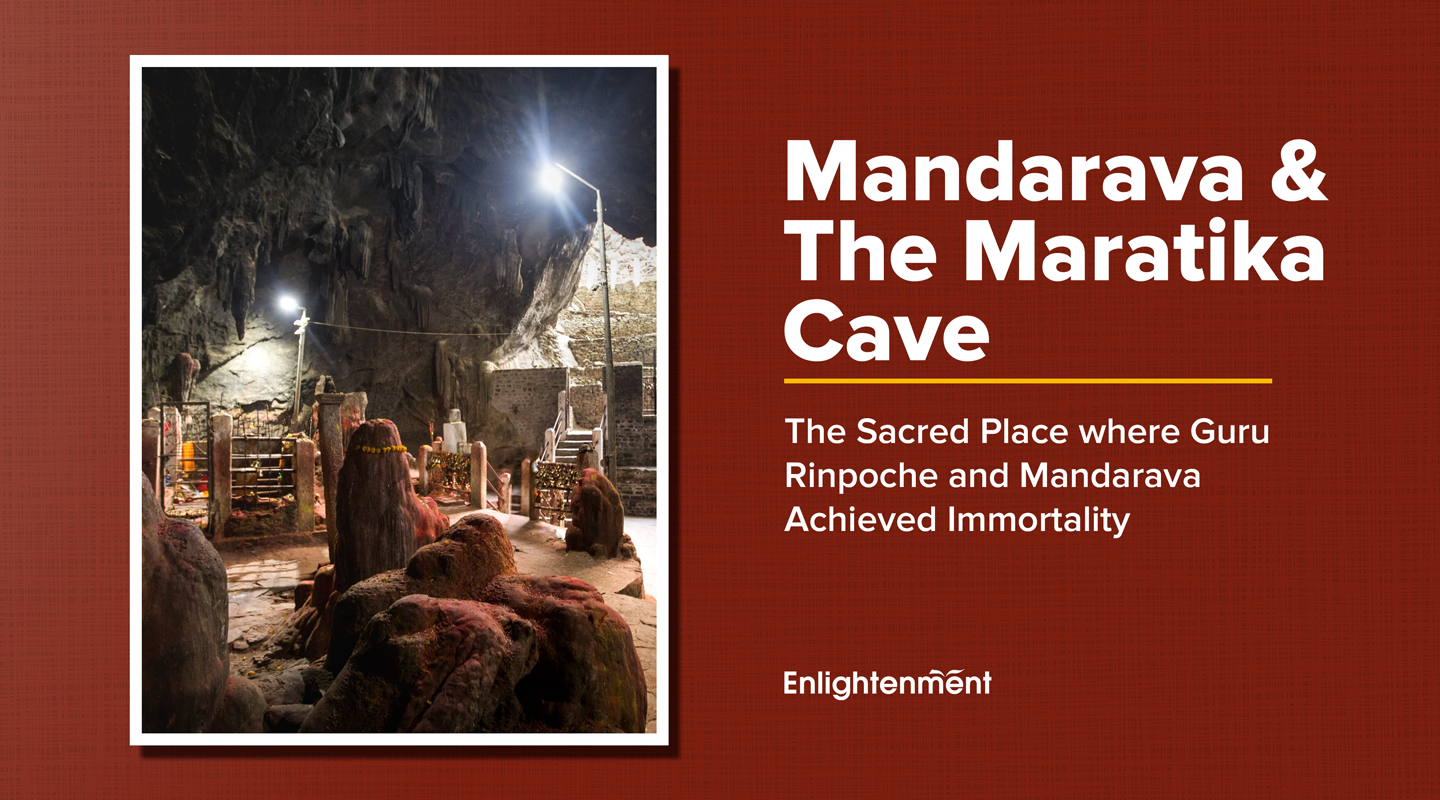
The Sacred Story of Mandarava and Maratika Cave, Nepal: Birthplace of Immortality Practice
The Maratika Cave, also called Halesi, on the remote mid-hills of Nepal, is one of the most potent power places in the Buddhist world. It is venerated as the exact site upon which the master of the 8th century Guru Padmasambhava and his main consort, the wisdom dakini Princess Mandarava, achieved immortal life through the intensive practice of Buddha Amitayus. This "Treasury Cave" was mentioned in Tibetan literature as early as the twelfth century, and is reported in the sources as somewhere that the eighteen tantras of Long Life were hidden, and then the scene where the Guru Rinpoche and his consort Mandarava transform themselves into immortal holders of pure awareness (vidyadharas). Pilgrims nowadays visit this holy site to connect with the blessing of the stone long-life vase (tse bum), an object believed to have been placed directly on the heads of the Guru Rinpoche and his consort by Amitayus himself, marking Maratika as the eternal birthplace of immortality practice.
Introduction: The Wisdom Dakini Mandarava

Princess Mandarava is the principal Indian consort of the eighth-century master Padmasambhava, even before he introduced tantric Buddhism to Tibet. Being one of the central figures in the Nyingma school, she is seen as the Indian equivalent of the legendary Tibetan mistress Yeshe Tsogyal. The sources indicate that Mandarava was not just a figure in history but a manifested enlightenment (nirmanakaya) who intentionally emanated into the world of ordinary existence to lead beings toward liberation.
She is essentially an emanation of the female Buddha Pandaravasini, the consort of Buddha Amitabha. In her final lifetime as the Princess of Zahor, Mandarava was an essential partner in Guru Padmasambhava’s achievement of immortality. Consequently, she is traditionally depicted in iconography holding a long-life vase and an arrow, symbols of her mastery over the longevity practices. The character of her life story is defined as a real deliverance story, where the woman is involved in a difficult journey of her self-development, breaking the social norms regarding marriage and female roles in the society of the eighth century. By showing the example, she illustrated how the worldly pleasures, high status, and money could be thrown away to have a perennial journey that does not recognize gender boundaries.
Read more about The Divine Wisdom of Mandarava: Exploring the Spiritual and Artistic Essence of a Sacred Thangka
The Gateway to Immortality: Maratika Cave

Situated in the remote mid-hills of Khotang District of eastern Nepal, Maratika Cave, also known locally as Halesi, stands as a profound monument to the spiritual heights attainable through dedicated practice. This sacred site is primarily celebrated as the location where Guru Rinpoche (Padmasambhava) and his consort Mandarava achieved immortal life through the practice of Amitayus. For practitioners, Maratika is not just a geographical place but also it is a "Treasury Cave" that is mentioned in the Tibetan literature as far back as the twelfth century, being one of the eighteen tantras of Long Life that dakinis had buried at the request of the Bodhisattva Avalokiteshvara.
The scenery of Maratika is filled with divinity. Hills to the southeast and southwest are named Manjushri Hill and Vajrapani Hill, respectively, forming a trinity of hills represented by the ”Three Protectors.” The main Treasury Cave is a place of deep pilgrimage where the most holy object is the stone long-life vase (tse bum). It is believed that Buddha Amitayus himself placed this vase on the heads of Guru Rinpoche and Mandarava while bestowing immortality upon them. Practitioners believe that any prayer made at this tse bum will be fulfilled.
The Early Years: From Zahor to Renunciation
The journey to Maratika began in the kingdom of Zahor, where Mandarava was born to King Viharadhara and Queen Anandakara. She was born as the fulfillment of a prophecy by Kashyapa, and her coming was prophesied by miraculous signs, such as a rainbow light in the palace and a shower of falling flowers. Even from within the womb, Mandarava was said to have spoken in poetic verse, describing her mother's body as a blissful paradise and a palace of the conquerors.
By the age of eight, Mandarava began to display a profound aversion to samsara. While gazing from the palace roof, she witnessed the suffering of birth (a sow and her piglets), old age (a man struggling in his own filth), sickness (lepers), and death (a mourning family). These sights filled her with a deep repulsion for worldly existence, and she implored her parents for permission to practice the Dharma. Although initially resisted by her father, who wished for her to marry a royal suitor to satisfy the political demands of neighboring kingdoms, Mandarava remained steadfast.
The Meeting with Guru Padmasambhava

Click Here To View Our Collection of Lotus Born Master Guru Rinpoche Thangkas
The pilgrims not only go to meditate, but also to touch the sacred marks left in the cave, including the long-life vase (tse bum) which is thought to have been
Mandarava’s path changed irrevocably when she escaped her royal confines and received ordination from a great abbot, taking the name Bodhisattva Yeshe Zangmo. Living in a secluded palace garden with five hundred ordained attendants, she eventually had a vision of an emanation of Avalokiteshvara who promised to bestow instructions for liberation in one lifetime.
Shortly thereafter, Vajra Guru Padmasambhava arrived in the garden in a mass of rainbow light. Mandarava, recognizing him as a heart-son of the buddhas, invited him to her palace. There, he began to transmit the three outer and three highest tantras, including the generation and completion stages of the secret mantra. Their spiritual association, however, was misinterpreted by a cowherd who spread slanderous gossip that the princess was living with an ordinary layman.
This rumor led the King to attempt a horrific execution: he ordered Guru Padmasambhava to be burned alive and Mandarava to be thrown into a pit of thorns for twenty-five years. However, the Guru displayed his enlightened power by transforming the pyre into a lake of sesame oil, in the center of which he sat upon a magnificent lotus flower. Witnessing this miracle, the King was struck with unbearable remorse, prostrated before the Guru, and offered his entire kingdom and his daughter to the master.
The Immortal Accomplishment at Maratika
After being reunited, Guru Padmasambhava and Mandarava went to the Maratika Cave to perform the particular practice of longevity. According to the sources, this cave is a holy power center where the mandalas are complete and beyond all the others in India in attaining spirituality.
They spent three months in the depth of meditations on Bodhisattva Amitayus for three months. They also observed the Hayagriva Mechar circle to expel demoniac obstruction. In these practices, they were able to attain the state of immortal pure awareness holders (vidyadharas). According to the sources, they became free from the process of birth, old age, sickness, and death until the end of the current age. They gained the power to transcend ordinary elements, leaving impressions on solid matter and manifesting rainbow light.
The Legacy of the Cave and its Surroundings
Maratika is not limited to a single cavern. The area includes:
- The Cave of the Eight Means of Attainment: A cave on the lower side where Guru Rinpoche is said to have slain a demon. Inside, the emanation of the demon, both of his flesh and blood and of stone, is visible indoors, as it is a sky door, a hole in the roof, through which the Guru flew.
- The Dakini Gathering Place: This is a hidden cave that can be reached by way of a bamboo ladder, where a large number of crystals grow out of the rock.
- Guru Rinpoche's Hat: This is a deep-slit rock with a hole in it which is said to emit warm vapours and has curative powers.
- The Garuda Cave: This is a site which has been recommended by Lama Zopa Rinpoche and would be beneficial to individuals with cancer.
- The Cave of Mandarava: This is a cave a few hours walk along the main Treasury Cave, and is specially connected with the retreat of the consort herself.
Why Maratika Cave Is a Major Buddhist Pilgrimage Site

(Photo From Alchetron.com)
The Place of Immortality Practice and Realization
Maratika is revered as the exact location where Guru Padmasambhava and his consort, Princess Mandarava, practiced long‑life and longevity sadhanas under Buddha Amitayus and achieved the state of immortal awareness (vidyadhara mastery). This extraordinary attainment beyond birth and death is central to Vajrayana practitioners who see Maratika as a living witness to what committed tantric practice can achieve.
One of the Six Most Sacred Places in the World
Within the Tibetan Buddhist tradition, the Maratika Cave is listed as one of the six most sacred pilgrimage places in the world due to its association with the immortal life of Padmasambhava and its blessing by the family of three protectors: Avalokiteshvara, Vajrapani, and Manjushri. This makes it a focus not just for individual devotees, but for the wider Vajrayana lineage across cultures and generations.
Powerful Confluence of Sacred Geography and Practice Potential
Its spiritual importance is also enhanced by the holy topography around Maratika. The three hills which bear the names of the "Lords of the Three Families" are called Avalokiteshvara, Vajrapani and Manjushri, which constitute a natural mandala. The practitioners believe that offering such practices within this sacred mandala is believed to be many times more effective than doing the same practice elsewhere.
Hidden Teachings and Treasure Tradition (Terma)
Tibetan sacred literature and biographies of Guru Rinpoche describe how eighteen Long Life Tantras were encoded and hidden by dakinis inside the Maratika caves on the request of Avalokiteshvara. All these teachings of the Terma are thought of as very sacred and they are believed to be very potent in long-life practices, which makes Maratika a very potent location to individuals who want to gain profound Dharma realizations.
Physical Implements and Spiritual Relics
The pilgrims not only go to meditate, but also to touch the sacred marks left in the cave, including the long-life vase (tse bum) which is believed to have been placed by Buddha Amitayus on the heads of Padmasambhava and Mandarava, as well as natural rock imprints and other auspicious formations that are interpreted as blessings or relics.
Ongoing Blessings and Modern Practice
Many contemporary Buddhist masters, including lamas from the Nyingma and other lineages, continue to undertake annual pilgrimages and pujas at Maratika to pray for longevity, world peace, and the benefit of sentient beings. Long‑life prayers, meditation retreats, and rituals held at the cave reflect its enduring spiritual power and relevance for modern practitioners.
Intersection of Tradition, Meditation, and Devotion
Maratika is not a historical site but instead is a living practice location. It is recommended that the practitioners have meditation, prayers, and practice of long life there not to visit there, but to turn their karmic obscurations and enhance spiritual realization. This renders Maratika a place of worship as well as a seat of Vajrayana meditation.
Spiritual Significance for the Modern Practitioner
The sources emphasize that visiting Maratika is not a site to pay a visit to and see something, but it is a place to actively practice. Great lamas, such as Kyabje Trulzhig Rinpoche, have visited annually to perform life prayers for His Holiness the Dalai Lama, believing that the cave helps to get rid of life hindrances.
Practitioners are urged to consume the nectar of immortality, which is sacred water collected in the caves, which are believed to prolong their lifespan and cleanse negative karma. The bats even within the cave are thought to be auspicious with their sound being attributed to the long-life syllable HRIH. The sources offer the conclusion that anyone who reads the account of the lives of Mandarava will be safe against contagious disease, war, and untimely death.
Conclusion
The divine legend of Mandarava and Maratika Cave is an everlasting reminder of the strength of the Vajrayana practice and the possibility of gaining immortality. Through her renunciation of a royal life and her arduous cultivation alongside Guru Padmasambhava, Mandarava became a wisdom dakini whose fame encompasses the three realms. Maratika remains a place of attainment (siddhi) where the nectar of immortality continues to flow for those with the faith to seek it. As Guru Rinpoche himself noted, this story was revealed so that future generations might realize their own precious buddha nature and be placed on the path to perfect enlightenment.
