
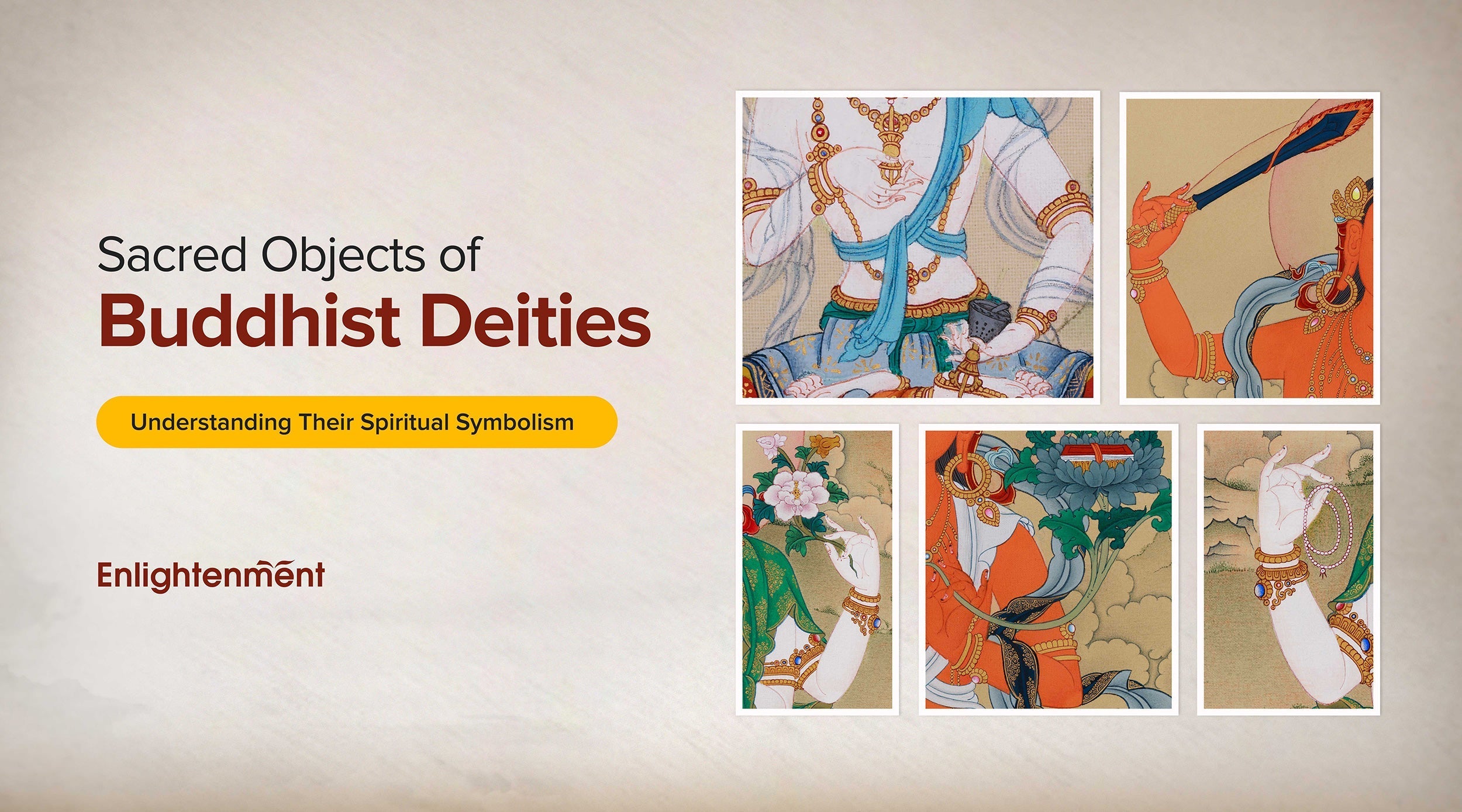
Explore Buddhist deity attributes and their sacred meanings, from wisdom and compassion to protection and enlightenment.
None of what is held by a deity in Buddhist art is incidental. A lotus is not just a flower, a sword is not just a weapon, and a skull cup is not just a tantric mystery item! Every sacred object has a deeper meaning, developed over centuries of devotion, meditation, ritual practice, and sacred philosophy.
At first sight of a thangka painting or a Buddhist statue, one is struck by its outer beauty, the splendor of colors, the gold ornaments, its calm expression, flowing robes, and its graceful details. But behind this beauty is a visual teaching. Each of the objects in the possession of a deity has a special enlightened quality, for example, wisdom, compassion, protection, healing, purification, long life, abundance, or the removal of obstacles.
The sacred objects are far from decorative; they are symbols of awakening. They teach us the deity's purpose and the blessings they bring. These striking characteristics make Buddhist art a silent scripture, leading the viewer along the path to inner peace, enhanced awareness, and enlightenment.

1000 Armed Chenrezig holding various Sacred Objects
Sacred Signs of Wisdom and Compassion
The attributes of the Buddha serve as sacred symbols that help us gain insight into the essence of each enlightened person. Some objects have peaceful attributes like compassion, purity, healing, and longevity; others have fierce attributes like wisdom, protection, transformation, and cutting through ignorance. Every item is imbued with a spiritual message: whether gentle or wrathful, it invites the viewer to go beyond outward appearance and into the Dharma's message. To better comprehend this sacred language, let's examine the significance of some of the most significant objects that are sacred to the Buddha.
The Vajra: Indestructible Wisdom
One of the most important sacred objects in Vajrayana Buddhism is a vajra, or dorje in Tibetan. It is known as a diamond and a thunderbolt. It is a symbol of unbreakable truth and the powerful wisdom that overcomes ignorance.
With deities like Vajrasattva, Vajrapani, and Vajradhara, the vajra symbolizes indestructible enlightenment, spiritual power, and skillful means. Reminds practitioners that wisdom is steadfast and clear and undisturbed by fear, confusion, or suffering.
The Bell: Wisdom and Emptiness
In tantric Buddhism, the bell is frequently linked to the vajra. The vajra is the symbol of method and compassionate action, while the bell is wisdom and the recognition of emptiness. They illustrate the sacred bond of compassion and wisdom at the heart of Vajrayana Buddhism.
The sound of the bell echoes up, rings, and fades out into the night sky, like the signs of impermanence. It is not the case that all things exist without cause or condition, but it is not the case that they do not exist forever. The bell is more than a ritual tool; it is a subtle reminder to the mind to go toward consciousness, wisdom, and awakening.

Vajrasattva holding Vajra and Bell
Click Here To View Our Collection Of Hand-Painted Vajrasattva Thangka
The Lotus: Purity Rising from the Mud
One of the most popular symbols used in Buddhist art is the lotus. It comes up from dirty water, but rises above it pure and beautiful, opening into beautiful flowers. Therefore, it symbolizes purity, compassion, spiritual awakening, and transformation.
If deities like Green Tara, White Tara, Chenrezig, or Padmasambhava are associated with the lotus, they reveal that the path to enlightenment can emerge out of ordinary suffering. The lotus is not repelled by the mud; rather, it stands in it and thereby symbolizes hope, purity, and awakening.

The Wish-Fulfilling Jewel: Blessings and Inner Wealth
The Wish-Fulfilling jewel is a symbol of blessings, generosity, abundance, and spiritual fulfillment. It symbolizes not only material abundance, but also the abundance of wisdom, compassion, merit, and the practice of Dharma in Buddhist art. It reveals the power of enlightened ones to provide what is useful for the heart and mind.
The jewel symbolizes the realization of pure aspirations when it is carried by deities like Chenrezig, Dzambhala, and other compassion and wealth deities. It reminds practitioners that the greatest treasure is not what one possesses, but one's inner peace, kindness, wisdom, and the capacity to help all beings.
The Sword: Cutting Through Ignorance
The flaming sword is the most common symbol of Manjushri, the bodhisattva of wisdom. This sword is a symbol of Buddhism, not a sword of war. It is the sharp sword of wisdom that penetrates the ignorance, ego-clinging, false beliefs, and darkness of the mind.
The light of wisdom is seen in the flames around the sword, which is powerful, bright, and changing. The sword in the hand of Manjushri conveys the message that compassion, to be effective, must be supported by wisdom; and that wisdom can eradicate illusion and bring clarity and insight to the human heart.

Click Here To View Our Collection Of Manjushri Thangka
The Dharma Book: Sacred Knowledge and Perfect Wisdom
The Dharma book or sacred scripture is an important symbol that is related to the wisdom deities, particularly bodhisattva Manjushri. It is commonly seen as symbolizing the Prajnaparamita, the Perfection of Wisdom teachings, which teach two truths: emptiness, compassion, and the true nature of reality. The sacred scripture teaches us that wisdom is not just something that we learn and know, but something that changes our hearts and minds.
In many thangka paintings, the Dharma book is placed on a lotus, indicating that worldly knowledge should be pure, compassionate, and devoid of ego. It instructs us to see that one can attain enlightenment through devotion as well as study, reflection, meditation, and direct realization. The scripture is then a symbol of the path itself, leading the practitioner from confusion to clarity, insight, and awakening.

The Alms Bowl: Renunciation and Spiritual Simplicity
The alms bowl is a simple yet powerful symbol in Buddhist art. It is tightly intertwined with monasticism, simplicity, discipline, and renunciation. It reminds us of the Buddha's life as a teacher with few possessions, walking the path of Dharma, and accepting with humility the offerings they provide.
If placed in the hand of the Shakyamuni Buddha, Amitabha Buddha, or Medicine Buddha, the bowl signifies inner wealth or richness, not outer wealth. It can be filled with healing nectar in Medicine Buddha's hands to symbolize spiritual and physical healing. It symbolizes meditation, peace, and freedom from attachments in the hands of Amitabha.

The Dharma Wheel: The Teaching in Motion
One of the most significant symbols in Buddhism is the Dharma wheel or Dharmachakra. It symbolizes the Buddha's wisdom and the auspicious occasion of the Buddha's first turning of the wheel of Dharma after attaining nirvana. This is the first time in which he has taken on the role of the wheel to teach others, for the benefit of all beings.
Like a wheel that rolls forward, the Dharma too should be practiced, shared, and passed down. It transits through teachers and students, monasteries, thangka paintings, rituals, and everyday spiritual practice. The Dharma wheel is a reminder that wisdom must be made known and is meant to be lived by, and propel us toward enlightenment.

The Mala: Mantra and Mindful Devotion
The prayer beads, or mala, count the mantras, prayers, and rites recitations. It is frequently held by a blessing deity, such as Chenrezig, who is peaceful and compassionate. The mala is a symbol of devotion, consciousness, and the balanced relationship between the practitioner and the sacred sound of mantra.
Every bead has an intention and serves as a reminder of the need for repetition in spiritual development. The restless mind calms, softens, and purifies, bead by bead and mantra by mantra. Awakening may not be an abrupt transformation; it can also be a slow and steady process of patience, repetition, and sincere devotion, the mala teaches.

Click Here To View Our Collection Of Mala Beads
The Damaru: Sacred Sound and Tantric Energy
A small ritual drum in tantric Buddhism. With its sharp, rhythmic sound, it signifies awakened energy, sacred movement, and the potent vibration of spiritual transformation. It is related to the tantric deities, dakinis, and wrathful forms, which embody enlightened activity that penetrates blockages and illuminates the mind.
The damaru is a sacred drum symbol, representing the power of sound. To the Vajrayana community, sound isn't just ordinary noise; it can be a mantra, an invocation, a blessing, and spiritual energy. It reminds practitioners that awakening is not just in silent meditation, it's in living ritual, devotion, movement, and in the potent rhythm of enlightened awareness.

The Treasure Vase: Abundance and Long Life
The treasure vase is a sacred symbol of abundance, Prosperity, blessings, long life, and spiritual wealth. It is sometimes associated with longevity deities, wealth deities, and ritual offerings, in which it symbolizes the ability to boost positive energy, merit, and auspicious fortune. The vase is typically depicted as full and overflowing in Buddhist art, symbolizing the boundless compassion of the enlightened.
There are other kinds of treasure in Buddhism besides material wealth. It also implies wisdom, compassion, life force, merit, and the blessings of Dharma. A deity with or associated with a treasure vase demonstrates the power of enlightened action to feed life, eliminate scarcity, and create abundance and spiritual greatness.

The Skull Cup: Transformation of Attachment
The skull cup or kapala is particularly used for tantric and wrathful forms of Buddhist iconography. To the casual watcher, it can be terrifying or enigmatic, but it has profound spiritual significance. It is a reminder of impermanence and death and the need to change attachment, the ego, and fear into wisdom for practitioners.
The skull cup is often used to hold nectar in the hands of wrathful deities or dakinis, which symbolizes purified awareness and the dissolution of negative emotions. It reveals that desire, fear, anger, and confusion are not barriers to wisdom anymore, but a practice can transform them into wisdom. The skull cup is not a symbol of darkness; it's a vessel of transformation and awakening.

The Curved Knife: Cutting Ego-Clinging
In tantric Buddhist art, the curved knife or kartika is frequently held by dakinis and wrathful deities. The pointed, hooked form represents the severing of the mental attachments to ego-clinging, attachment, ignorance, and obstacles within the mind.
This sacred blade doesn't represent violence or harm. Rather, it is a fierce compassion and fearless wisdom. The curved knife penetrates the illusion of self and eliminates the confusion that stands in the way of freedom. Tantric iconography helps remind tantric practitioners that sometimes, awakening entails powerful, direct, and courageous wisdom.

The Phurba: Subduing Obstacles
The phurba, also known as the ritual dagger, is a formidable tantric object to overcome hindrances and stabilize sacred space. It is particularly linked to protective practices and to the wrathful deities in which it denotes the power of the enlightened overcoming negative energies, negativity, and confusion.
The phurba symbolically strikes the inner and outer obstacles. Its three-sided blade is said to have the power to vanquish the three poisons: ignorance, attachment, and anger. The protection of this sacred object teaches that the protection is not only against external forces, but also a discipline of the mind, and turning negative emotions into wisdom.
The Victory Banner: Triumph of Dharma
The victory banner symbolizes the triumph of the Dharma, wisdom, and enlightened awareness over ignorance and inner obstacles. It's not a sign of conquest or control over others. Rather, it demonstrates the triumph of spiritual values of truth, compassion, and clarity over the forces that bind the mind to suffering.
The biggest fight is not with someone else, it's with anger, pride, jealousy, craving, and delusion, according to the Buddhist way of thinking. The victory banner is lifted like a pillar of sacred remembrance of awakening. It explains that practice, knowledge, and devotion can help the enlightened mind put an end to suffering and attain liberation.

The Khatvanga: Tantric Power and Spiritual Union
The khatvanga is a tantric staff that is sometimes linked with Padmasambhava, Vajrayogini, and other potent Vajrayana figures. It can be adorned with symbolic features like skulls, a trident, ribbons, and ritual ornaments. Buddhist art associates the khatvanga with the tantric power, spiritual authority, and profound insight.
This sacred staff is also the symbol of the combination of wisdom and method, one of the principal teachings of Vajrayana Buddhism. It can also symbolize the presence of a spiritual companion or the full embodiment of enlightened attributes. The khatvanga is mysterious and powerful, and a reminder to practitioners of transformation, sacred energy, and the great path of tantric awakening.

The Bow and Arrow: Focused Intention and Spiritual Aim
From the Buddhist and Himalayan viewpoint, the bow and arrow symbolize intention and direction, as well as the power of aspiration. The bow is calm and controlled, and the arrow is clearly aimed. As they work together, they remind practitioners to lead the mind with purpose and not to become lost in distraction, hesitation, or confusion.
The arrow is a sign of direct spiritual intent, and the bow is a sign of strength, patience, and discipline in releasing it correctly. The bow and arrow are a lesson in sacred art about the need for both stillness and clarity to awaken. They remind us to focus our hearts and minds on wisdom, compassion, and liberation.
Why These Sacred Objects Matter Today
These sacred objects are important because they make Buddhist art a teaching. A thangka painting or deity statue can be very beautiful but distant without knowing its meaning. Learning this language of symbols, each object brings us into a world of Buddhist wisdom, devotion, and spiritual practice.
There's a lesson in each object. The vajra conveys strength, the bell teaches emptiness, the lotus teaches purity, the sword teaches clarity, and the bowl teaches simplicity. In the mala, it is a reminder of devotion, the skull cup teaches the concept of transformation, and the Dharma wheel indicates that the Buddha's teachings need to keep rolling forward.
These sacred objects illustrate the beauty of Buddhist art but also convey its meaning, which is far beyond decoration. It is a dynamic symbol of philosophy, ritual, meditation, and cultural memory. There is a blessing, a lesson, and a path in each object that leads the mind to wisdom, compassion, and enlightenment.
Conclusion: Sacred Objects as Vessels of Awakening
The sacred objects of the Buddhist deities are much more than details of art. They are ships of knowledge, empathy, healing, safety, bountiful, cleansing, and freedom. Buddhist art is a symbolic language that is used to lead the heart toward deeper understanding, through flowers, flames, bowls, blades, drums, bells, wheels, and jewels.
The understanding of these objects is a better understanding of thangka paintings and deity statues. All things become intentional, all things become purposeful, all deities are living teachers. The lotus symbolizes purity, the sword signifies wisdom, the bowl signifies simplicity, and the wheel symbolizes that the Dharma is still in constant movement through practice, devotion, and time.
Even in our distracted society, these sacred objects have a message that is always the same. They question us about what is visible and ask us to delve into the inner meaning of the art. They are not just decorations for the deity, but tools to awaken us to the wisdom, compassion, and potential for inner transformation.
