
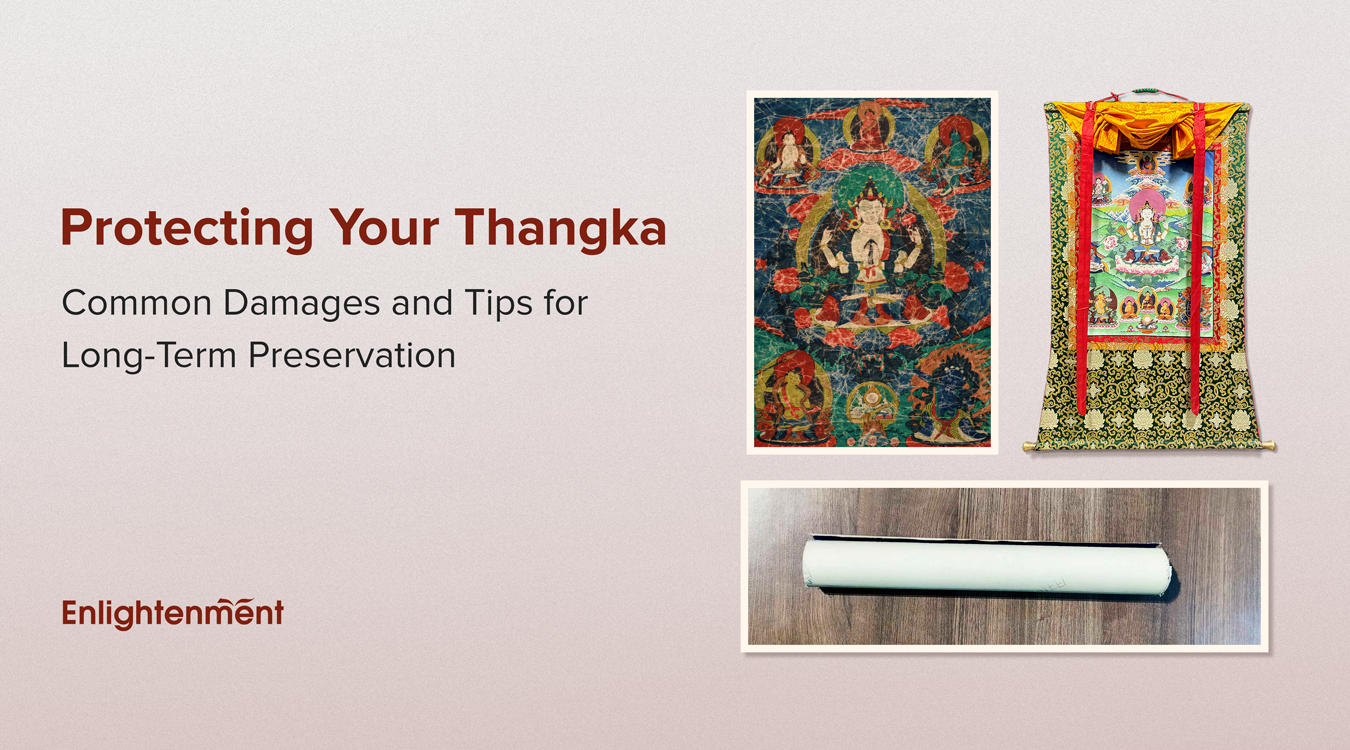
Understand the common causes of damage to Thangkas and practical steps for preserving the integrity and beauty of these sacred artworks
Thangka paintings are not just ordinary paintings, but rather spiritual tools that are created through piety, devotion, and disciplined work. A Thangka is supposed to be meditative, educative, and spiritually effective - invoking the teachings, lineage, and presence of enlightened beings. Due to this reason, both the materials and methods applied are very symbolic and also very technical.
Traditionally, Thangkas are painted on handwoven cotton using sizing, gesso, and natural pigments fastened in animal glue. Every material employed, including the fabric, primer, pigments, etc., is in itself vulnerable, and natural pigments are sensitive to light, and the fabric may lose its shape in fluctuating humidity. The process of creation is concerned not only with the material but also with the spiritual meaning it carries.
This blog describes the typical kind of damage that Thangkas suffer and gives practical advice, based on technique, to conserve them, using the traditional methods of painting and modern principles of preservation.

Click Here To View Our Hand-Painted Green Tara Thangka
The Vulnerable Structure of a Thangka
Thangka starts with a support, which is typically a hand-woven piece of cloth made of cotton, that gives it stability and flexibility. Cotton can be rolled and stored without damage, and it is also prone to the effects of humidity. The changes in the humidity may lead to the stretching or shrinking of the fabric, and this may distort the artwork. In order to avoid warping or tearing, it is important to store it in a controlled environment.
The next step is sizing, a mixture of animal glue, which, when applied to the fabric, covers it and makes the paint stick to the surface. A layer of gesso is applied over the sizing, and this gesso is composed of chalk or clay mixed with sizing, and a smooth layer of gesso. This ground layer is vital in establishing the correct texture of the painting, and it is prone to cracking in case it is subjected to dryness and excessive heat. When the gesso layer becomes weak, the whole Thangka may suffer damage, as it may ruin the paint layers as well as the fabric underneath.
After the gesso is dry, the underpainting is done with opaque distemper paint, and fine details are added with mineral and organic pigments, with 24K Gold or gold powder commonly used as highlights to add vibrancy and richness to the work. Nevertheless, these pigments and highlights are very sensitive to environmental changes like UV lighting, smoke, and physical abrasion. The layers make the Thangka beautiful but also expose it, as any damage to one of the layers can affect the whole image.
Common Types of Damage to Thangkas
Although Thangkas are made to be durable, they are susceptible to the environment and poor handling. The following are the most widespread forms of destruction of Thangka paintings and materials.
Fading and Color Loss
Air pollution and exposure to heat and UV light cause fading and loss of color in Thangkas. Sunlight and bright artificial lighting produce UV rays that destroy organic pigments such as saffron and plant-based dyes, which are more susceptible to UV rays than mineral-based pigments. The surface can become discoloured in the long-term due to smoke and other airborne pollutants settling on the surface.
Thangkas have natural pigments, which are normally organic and biodegradable, and more sensitive to heat and light. The binding agents applied, e.g., glue, are soluble in water and will degrade under exposure to UV radiation, causing them to fade. The colors of the Thangka become uneven with organic pigments losing their vibrancy more than mineral pigments.
To avoid fading, Thangkas should not be displayed in direct sunlight or in the framing process; UV-filtering glass should be used. Light intensity should be kept low and indirect in order to reduce the effect of light. Frequently change the side of the Thangka so that no side spends excessive time in light and hence does not fade unevenly.

Water Damage
The most significant threat to Thangkas is water damage, which can be caused by excessive humidity or unintentional exposure to moisture. This may distort the fabric support, bend the paint, and break up water-soluble glues such as animal glue. The moisture blurs or becomes unclear and thus may permanently harm the painting.
It is possible that the fabric support will wrinkle when it becomes moist, and the layers of paint can become soft. The water-soluble adhesives dissolve and result in loss of sharp edges, and the paint may sink into the material and lose its shine. Relined thangkas are especially sensitive, especially when they have adhesives that are soluble in water.
In order to prevent damage to Thangkas caused by water, it is necessary to store them in a cool and dry place with a humidity level ranging between 40 and 60 percent. Protective wraps or sealed boxes should be used to cover them to prevent too much moisture, and should not be subjected to wet conditions or exposed to direct moisture, particularly when being transported.
Improper Handling
Thangkas can be damaged easily by improper handling, especially rolling them in the wrong way or touching the painted part. The classical rolling technique, when executed incorrectly, may cause the compression of pigments, abrasion, and loss of paint. The paint layers may also develop pressure points, creases, or even cracks due to rough storage or handling.
The Thangkas are created in such a way that they can be rolled upwards, starting at the bottom with the painted surface facing inwards. The excessive or inappropriate rolling or rough handling may result in abrasions on the surface of the painting or pressure points that may cause permanent damage. When Thangkas are stored flat or with heavy objects at the top, the paint may crack, or the cloth may wrinkle.
In order not to get damaged, Thangkas should be rolled upwards and downwards with the painted side facing inside. They should be touched using clean hands or cotton gloves to avoid passing oils and dirt. Keep them in wraps or "squeezy tubes" (do not pile one on the other) or wrap them in butter paper or soft cloth material so the paint or cloth does not press against the surface.
Accretions from Butter Lamps and Incense Smoke
Thangkas can be sooted and greasy with butter lamps and incense used in Tibetan Buddhism rituals. With time, the surface is coated with soot, darkening it, and grease spread by the lamps may yellow and even stain, particularly the silk mountings. The gold may also be tarnished by the smoke and become oxidized, losing its lustre.
Incense and grease of the lamps found on the surface of the Thangka darkens the painting, and makes the image weak. The gold and metallic portions are particularly susceptible to oxidation, and as it accumulated, it could cover the most detailed parts and change the overall appearance of the artwork.
When possible, do not expose oneself to incense or butter lamps to avoid damage; exhibit Thangkas in a smoke-free place. Protect them with a covering or glass to protect them against air pollutants. When Thangkas are involved in rituals, make sure that there is plenty of ventilation and that butter lamps are not placed too near the artwork in order to minimize the amount of soot and grease.

Physical Damage from Abrasion
Thangkas are also prone to physical damage, especially abrasion caused by rough handling or improper storage. When the artwork is mishandled, scratches, scuffs, or tears might appear. The gold and the fine details of the paint are particularly sensitive to abrasion, and the artwork loses its color and brightness.
The gold, which is delicate and applied to emphasize some parts, can easily flake or get scratched when subjected to pressure. Even a slight abrasion of handling or inappropriate storage may be irreversible. Failure to store Thangkas properly may cause them to be in contact with other surfaces, and this process may continue to damage the paint layers and fabric.
In order to avoid abrasion, place Thangkas in soft, padded bottles or protective tubes. UV-protective glass should also be used to minimize damage during framing. Do not pile Thangkas or keep them under heavy objects, as it may produce pressure lines that permanently damage the surface.
Tips for Long‑Term Preservation of Thangkas
Since we have discussed the usual methods by which Thangkas are destroyed, it is important to highlight the practical, easily implemented measures towards their protection.
Display with Care: To preserve Thangkas, place them in UV-filtered glass or acrylic frames and hang them somewhere they are not subjected to direct sunlight and bright artificial lighting. They should not be exposed to heat sources, windows, or fireplaces, and should also be rotated after some time to avoid long-term exposure to environmental stress.
Store Properly When Not in Use: Thangkas are not to be folded but rolled. Place the painted surface side up, wrap with acid-free tissue or soft muslin, and roll around a support tube. Keep in a cool and constant humid place that is not close to a vent or a window and higher than the floor to eliminate pests and flooding.

Gentle Cleaning and Inspection: Clean Thangkas with a soft brush made of natural hair regularly so as to check any damage. It is best to always brush gently in one direction and never with water, solvents, or detergents. The cracks, discoloration, loose threads, and mold signs should be checked every 6-12 months.
Professional Conservation Support: In case of worth or damaged Thangkas, a professional conservator who has worked with Asian/Tibetan art is recommended. Do not do the restoration yourself, as the wrong treatment will make the damage worse. To preserve the work, conservators are able to stabilize pigments, reline canvases, and deal with biological problems.
Conclusion: A Living Tradition Worth Protecting
Thangka paintings are not only beautiful but are also sacred and endowed with spiritual meaning. They are composed of organic and natural resources that are prone to environmental conditions such as light, humidity, dust, and physical damage. To preserve and protect such valuable artworks, it is possible to find out how these factors influence the Thangka.
In order to maintain a Thangka, it is necessary to provide stable and secure conditions of display and storage. Keeping it out of direct sunlight, excessive humidity, and dust also provides long life. The preservation of the Thangka through the careful and respectful handling of the Thangka using tender practices keeps the integrity intact and respects the spiritual intention of the Thangka creation.
Preservation does not just stop at the surface; it is a matter of taking care of the lineage and the spiritual meaning behind the Thangka. In taking care of it, you become a part of a centuries-old tradition with not only the beauty but also the consideration, reverence, and intent towards preserving something of great cultural and spiritual importance.
Explore Our Collection of Hand-Painted Tibetan Thangka
