
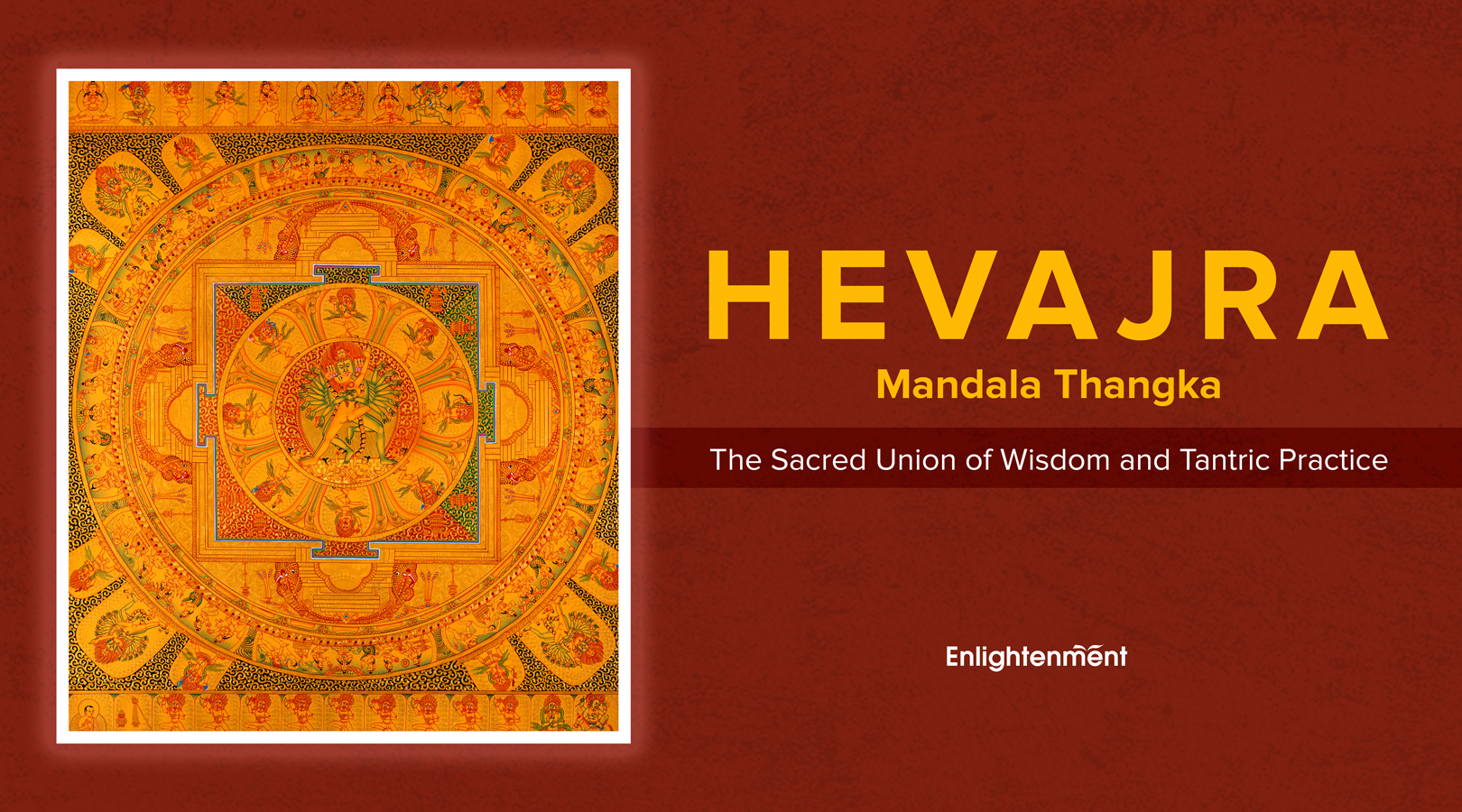
Explore how the Hevajra Mandala reflects enlightenment, transformation, and the sacred wisdom of Vajrayana Buddhism
Hevajra Mandala Thangka is one of the most meaningful and detailed forms of Vajrayana Buddhist art. It is not designed for mere ornamental purposes, but it is designed as a sacred spiritual guide for meditation and inner transformation. Its intricate patterns, vibrant hues, symbolic figures, and harmonious composition embody the illuminated cosmos and guide practitioners on the journey toward wisdom.
Hevajra, a potent tantric deity, is at the centre of the mandala and is depicted in a wrathful yet meaningful manner. He is usually depicted in pairs with his consort Nairatmya, representing the combination of wisdom and method and the attainment of emptiness. Practitioners are reminded in this central image that enlightenment is achieved through depth of insight, compassion and spiritual discipline.
Each of the items in the circular palace, geometric divisions, the surrounding deities, and the sacred spaces in the mandala also has special symbolic meanings. Every detail is designed to facilitate meditation and visualisation. The Hevajra Mandala encourages practitioners to contemplate, to dive into the sacred world that surrounds us, and to see beyond what is perceived to what is realised.

Click Here To View Our Hevajra Mandala Thangka
Who is Hevajra in Vajrayana Buddhism?
Hevajra is an important tantric deity in the Vajrayana tradition of Buddhism, particularly in the Sakya sect. He is considered a ‘yidam’ (meditation deity) that aids practitioners in focusing on their spiritual practice. Hevajra's fierce and wrathful appearance is not an ordinary wrath, but rather a wrath without anger. Rather, it represents the mighty annihilation of ignorance, ego, attachment and other impediments to enlightenment.
Emotions are not simply to be rejected, as taught in the Hevajra Tantra. Rather, they can transform into wisdom by engaging in tantric practice. This is the transformation that is embodied in Hevajra. There are numerous layers of symbolism in his many faces, arms, skull decorations, magical equipment and dancing stance. They reveal the union of compassion, wisdom, emptiness and enlightened energy.
Hevajra appears in the central square of the mandala, sometimes accompanied by his consort, Nairatmya. This is a central place, and it indicates that enlightenment is the core of reality. Spiritual energy radiates from Hevajra within the realm of the sacred palace and the surrounding deities, thus forming a full picture of the enlightened universe.
Understanding the Structure of the Hevajra Mandala
The Hevajra Mandala is painted with meticulous attention to detail and embodies the sacred geometry principles. It's not arbitrary – there are meanings behind each shape, direction and layer. The mandala symbolises the outer world and the inner path of the practitioner towards enlightenment.
The central part of the mandala is the principal deity chamber where Hevajra is seated, the main deity. Inside, there are four circular enclosures, four square enclosures, and four directional gates. These parts are the foundation of a sacred palace, representing a kingdom of light. Each section takes the practitioner further into meditation and spiritual insight.
In the thangka painting, the mandala goes outwards in concentric circles from Hevajra in the centre. This demonstrates that enlightenment starts from the heart level and spreads down all levels. The building encourages the journey from the outer world of ordinary experience to the inner world of wisdom, compassion and emptiness.
The Central Deity: Hevajra and Nairatmya
Hevajra and his consort Nairatmya are both standing in the middle of the Hevajra Mandala. The union of this sacred is called Yab-Yum and is one of the most important symbols in the Vajrayana Buddhist art. It is the combination of all the wisdom, all the compassion, all the methods, all the insight, all the bliss, all the emptiness.

The title of Nairatmya translates as 'No-Self' and refers to the Buddhist principle that the 'ego' does not have a fixed or permanent existence. Hevajra and Nairatmya demonstrated in tandem that enlightenment comes from the profound understanding of emptiness. It is not that there is nothing, but that there is nothing that has its own unchanging existence.
In the thangka, Hevajra is depicted with a lot of energy, with flames and strong dynamic movement. His wild form exemplifies the change of ignorance and attachment into wisdom. The central image conveys the message that true awakening is achieved when wisdom, compassion, emptiness and enlightened action are all one.
The Mandala Palace: Sacred Architecture of Enlightenment
The mandala palace is depicted around the centre of the Hevajra Mandala symbol in the form of a square. This palace is not an ordinary building, but a symbol of the enlightened mind. Its well-balanced form and thoughtful design reflect harmony, order and spiritual perfection.
The gateway on either side of the palace symbolises entering a higher level of consciousness. These gates represent the purification, initiation and transition from ordinary sight to enlightened awareness. These are also connected with the four cardinal directions, and they draw attention to the fact that there is no particular direction in which wisdom can be gained; rather, the path to gain wisdom can be approached from all directions when the mind is appropriately prepared.
The palace is adorned with intricate and ornate designs, including a series of levels or borders, and is also surrounded by other elements such as floral patterns, symbolic guardians, and sacred representations. These facts reveal the richness, complexity and meaning of the spiritual journey. The four gates can also be interpreted as connected to the Four Immeasurables and the overcoming of mental impediments, thus making the palace a full symbol of enlightenment.

The Circular Layers: Cosmos and Consciousness
There are numerous circular layers around the central palace of the Hevajra Mandala, containing deities, dakinis, and symbolic forms. These circles are different levels of consciousness, cosmic energies and the deep connection of all beings. They demonstrate that the mandala is a sacred form and also a map of the mind and the universe.
Vajrayana Buddhism has a special significance attached to the shape of the circle. It represents wholeness, infinity and non-duality. From the enlightened wisdom perspective, opposites (samsara and nirvana) do not exist separately. The circle is a reminder for the practitioners of the fullness and unlimitedness of awakened awareness.
The deities surrounding the mandala are perfectly positioned with specific roles. They are particular spiritual energies, the change of feelings and various facets of enlightenment. The mandala unfolds as the viewer traverses through these circular layers, providing a glimpse into a path that leads from the ordinary to the profound, from wisdom to compassion, and from emptiness to awareness.
Symbolism of Hevajra’s Form
The form of Hevajra is one of the most powerful and symbolic elements of the Hevajra Mandala. Many faces, arms and legs were designed to reveal his enlightened qualities, rather than his normal physical form. The many arms represent the many good works he does; the many faces represent his transcendence of the duality and limitation of perception.
His fierce face can be terrifying, but it is the wisdom of piercing through ignorance, illusion, ego and attachment. In certain ancient depictions, Hevajra has 8 faces, 16 arms and 4 legs. He is presenting to us in this complex form, the total expression of his power to turn negative emotions into awakened awareness.
Hevajra holding skull cups also has a profound tantric significance. The skull cups and ritual knife represent method, wisdom, emptiness, impermanence and spiritual transformation. All of this confirms that Hevajra's ferocious expression is a divine expression of compassion, wisdom and enlightened energy.
Sacred Colours in the Hevajra Mandala
In Vajrayana Buddhist art, colours are profound with spiritual significance: Gold is particularly significant as it represents enlightenment, sacred purity and the radiant nature of the awakened awareness. Red is the colour of transformation and strong tantric energy, and blue is the colour of wisdom and awareness of emptiness.
White represents purity, clarity and a state of peace. The use of these colours is not solely for the purpose of making the thangka beautiful; they are also ways of conveying significant Buddhist ideals and concepts in visual terms. The image is characterised by its vibrant and sacred atmosphere, achieved through the use of gold and other elements. The image has a vibrant and sacred quality, with the use of gold and other elements, evoking a sense of the light of enlightenment.
Mandala as Meditation Practice
The Hevajra Mandala is mainly used as a meditation tool in Vajrayana Buddhism. It is not just seen as an artwork; it is a sacred space that practitioners enter in the visualisation. They envision themselves entering through the gates of the mandala and slowly moving towards the central deity.

This is referred to as deity yoga. It is not to worship but to transform the inner person. Meditation leads the practitioner to transcend the normal self and to diminish the bondage to the self and to cultivate enlightened qualities like wisdom, compassion, and clarity.
The significance of the mandala is absorbed by the practitioner through the visualisation, recitation of mantras and ritual activity. The mandala turns into a route to enlightenment, a reflection of inner consciousness and a sacred space for spiritual change.
The Role of Dakinis and Supporting Deities
Numerous figures surround the central mandala, each playing a significant role, such as dakinis, guardians, and other symbolic figures. None of these creatures is randomly placed. They can help reveal the mandala's abundance of sacred energy and spiritual significance.
Dakinis are particularly significant as exemplars of wisdom embodied, spiritual inspiration and transformative awareness. They are dancing poses that represent freedom from attachment and limitation. In the picture, these beings seem to be part of a larger cosmic dance, symbolising enlightenment as a living and dynamic force that is deeply interconnected with the surrounding world.
Hevajra Mandala in Tibetan Art Tradition
It takes more than artistry to create a Hevajra Mandala; it also requires an understanding of the Buddhist scriptures, sacred geometry, correct forms of the deities and their symbols.
The mandala is painted according to the very traditional rules of artists. Each deity, colour, form and location has a specific meaning. Hence, the Hevajra Mandala not only serves as a sacred object for practice but also as a visual scripture that brings enlightenment through art.
Conclusion: The Hevajra Mandala as a Sacred Path
The Hevajra Mandala Thangka is much more than a beautiful work of art. It's a sacred place of sacred spirit manifested through symbols, colours, deities and geometric patterns. All details serve a purpose and lead the practitioner to wisdom and enlightenment.
Hevajra in the centre of the mandala symbolises the strong transformation taught within the Vajrayana Buddhism. All the wrathful images, presence of Nairatmya, and other deities around convey significant lessons in compassion, emptiness and awakening.
In this manner, the Hevajra Mandala is not just a visual object but also a way of accessing it via meditation and comprehension. It turns into a blessed path that enables practitioners to shift from normal perception to enlightened awareness.
