Explore how the elephant, monkey, rabbit, and bird became a powerful Buddhist symbol of cooperation, humility, and peaceful coexistence
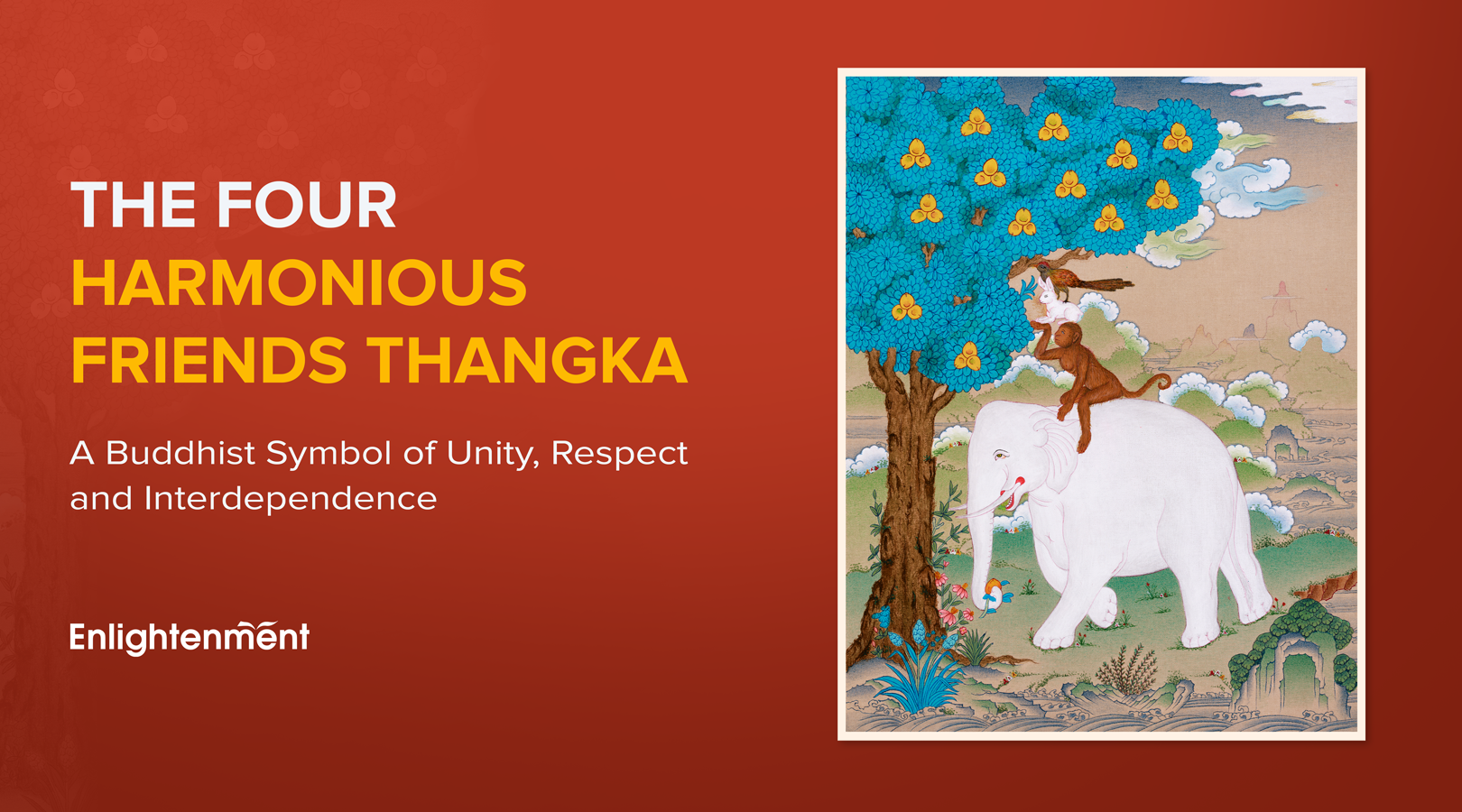
In a world where strength is often defined by size, speed, wealth, and dominance, the Four Harmonious Friends provides a softer and wiser Buddhist teaching. On initial viewing, the image is soothing and easy: a white elephant is standing under a fruit tree; a monkey is sitting on the elephant's back; a rabbit is sitting on the monkey's back; and a bird is perched on the rabbit's back. The natural world around them seems quiet and rich, and harmonious relations with people are harmonious relations with life.
However, this is not just an adorable picture of animals in a group. The Four Harmonious Friends Thangka is a profound work of respect, humility, and interdependence. The elephant is a gift of strength, the monkey is a gift of movement and skill, the rabbit is a gift of gentleness, and the bird is a gift of vision and wisdom. None of them attempts to dominate the others. Rather, they help each other.
This is a Buddhist principle that demonstrates that harmony is not found when everyone is the same. Times when each being sees the importance of the other. Each animal will be limited on their own, but when combined, they can attain the fruit. The Four Harmonious Friends thus serve as an everlasting symbol of unity, cooperation, respect, and peaceful coexistence.

Click Here To View Our Four Harmonious Friends Thangka
The Story Behind the Four Harmonious Friends
The story of the Four Harmonious Friends, or Four Harmonious Brothers, or Four Harmonious Animals, is a significant Buddhist moral story. It is related to the Tittira Jataka and is frequently used to teach people to respect their elders, cooperate, and behave well. It is believed that the story was told by the Buddha Shakyamuni and is remembered as a teaching of harmony that starts with respect.
It's a story set in a forest, where a bird, a rabbit, a monkey, and an elephant lived near each other. One day, they realized that there was no proper respect between the young and the old. They decided to determine who was the oldest of them by measuring using a large tree.
The elephant recalled the tree as huge, the monkey recalled the tree as smaller, and the rabbit recalled the tree as a small sapling. But the bird said that it had brought with it the very seed from which the tree had been grown. As a result of this, the bird was known as the oldest bird. The elephant is placed at the bottom, while the monkey, rabbit, and bird are at the top, indicating that wisdom is not determined by how big the thangka is, this is a reflection of how old, experienced, and respected they are.
A Thangka That Teaches Through Beauty
Beauty and simplicity are how the Four Harmonious Friends Thangka teaches its message. The image shows a white elephant, likely a symbol of wisdom or salvation, standing tall and serene, with the other animals in its saddles. The monkey adds to the movement and intelligence; the gentle rabbit sits on top; and the small bird stands by the fruiting tree as the wise elder.
The tree plays a significant role in the teaching. The beautiful blue-green foliage and golden fruit represent plenty, growth, and mutual benefit. No competition or fighting among the animals for the fruit. Rather, they help each other and demonstrate how cooperativeness can enable everyone to get what is impossible for one person.
A thangka is not just a decoration in the art of the Himalayas; it is a symbol that carries deeper meaning. Carefully painted, with devotion and traditional skill, it is a sacred visual teaching. The artist maintains a dharma lesson through canvas, color, gold, and fine lines: true beauty is not just the beauty we see on the surface, but the wisdom that lies within the image.
The Elephant: Strength Without Pride
The elephant is the solid base in the Four Harmonious Friends Thangka. It possesses a large and stable body to serve as a base for support for the monkey, the rabbit, and the bird, calmly and patiently. Painted white, the elephant evokes a sense of purity, peace, and gentle strength. It is the strongest and largest animal, but it is not above the others. Rather, it is not where it is highest, but rather lower.

It is an important lesson in Buddhism. The elephant might have been able to dominate the others or take the fruit for itself because of its size. However, in this tale, strength is valuable only if it promotes harmony. The elephant teaches that power is not evil, but it turns to evil when it is not humble. How strength protects others and raises them is compassion.
The elephant tells us that greatness is not in pride, control, or dominance. It's observed in tolerance, support, and caring for others. In family, community, work, and spiritual life, we all need strong foundations, but we need gentle and wise foundations. The elephant demonstrates that strength comes in strengthening others.
The Monkey: Intelligence and Adaptability
The monkey is above the elephant, alert, active, and moving around. The elephant symbolizes strength and stability, while the monkey symbolizes intelligence, agility, and adaptability. It can climb, reach, search, and quickly respond. The monkey brings energy to the group in the Four Harmonious Friends Thangka, which helps the friends attain what they could not attain by themselves.
The monkey is clever but not for his own glory or self-interest. It does not compete with the elephant, the rabbit, or the bird. Instead, its ability is a part of the joint effort. This is a great Buddhist teaching: intelligence is truly valuable when it leads to co-operation and helps others.
In human life, knowledge can be a source of ego from time to time. Intelligence can be used for winning, controlling, or being superior. But the monkey shows them a gentler way. It reminds us that “all things are made beautiful when shared”. Wisdom is not just about what we know, but how we can help others with what we know.

The Rabbit: Gentleness and Humility
The small, calm, and gentle rabbit rests above the monkey. The story of the Four Harmonious Friends also portrays the important role of the rabbit as a gentle and fragile soul with profound knowledge and memory. The impression it creates is of softness throughout the image.
The rabbit is a symbol of humility, sensitivity, and caring. The elephant is strong, and the monkey is smart, but the rabbit is gentle. In the modern world, softness is considered a weakness, but in Buddhist teaching, softness is a trained strength of the heart.
It's a reminder from the rabbit about the need to be aware of harmony. We must know the needs, restrictions, and emotions of others if we want to live in harmony with them. We need to know our time for talking, listening, and stillness. It isn't power or cleverness, it is stillness, awareness, and caring sensitivity that the rabbit gives.

The Bird: Wisdom, Vision, and Seniority
The bird, the smallest animal in the picture, is the oldest in the story, positioned at the top of the living tower. The bird is in the highest place because it brought the seed that gave rise to the tree. This will result in the bird being the source of the shared abundance. If there were no fruit, there would be no tree; if there were no tree, there would be no blessing for the other people; without the bird, there would be no blessing for the other people.
This is a profound Buddhist lesson that is being taught. The greatest of men is not necessarily the biggest or strongest. In the Four Harmonious Friends Thangka, the bird symbolizes wisdom, vision, memory, and seniority. Being at the top of the list exemplifies that it is the experience, guidance, and ability to deliver a valuable contribution to others that earns respect.
The bird is also the symbol of guidance of Dharma. The story, it teaches the other animals a moral lesson, and it brings harmony to the world. It is not judged for its wisdom by its outward appearance but by the seeds that it sows, guards, and leaves behind. The bird is a reminder that no matter how small, any living being can be the bearer of the greatest wisdom.

The Tree: A Symbol of Shared Abundance
The tree is not just a background element in the Four Harmonious Friends Thangka. It's the voice in the back of the mind of the whole story. The tree turns into a symbol of blessing, growth, and abundance with its lush, blue-green leaves and golden fruit. The animals come under it, as inhabitants of the same world, rather than as owners.
The tree symbolizes the fruits of co-operation and good karma. After the seed was planted by the bird, over time, it became a fruit-bearing tree that provided sustenance to all. It is a reminder that no matter how simple good actions are, they can lead to blessings much greater than we can visualize in the beginning.
The tree is a symbol in Buddhist teachings that also symbolizes interdependence. The fruit is carried by the tree, the tree is carried by the seed, and the seed is carried by the bird. The animals also rely on each other to get the fruit. This tranquil scene demonstrates that all things are connected and that abundance comes from harmony, support, and cooperation.

Respect for Elders and the Dharma of Harmony
Respect for elders is one of the Four Harmonious Friends teachings. It is not about following blindly in Buddhism. It is the reverence of experience, moral discipline, and wisdom handed down through the ages. The story demonstrates how harmony starts when each being is aware and appreciates the role of the other.
The young value the old; the strong support the weak; the wise lead the group; the clever help solve problems; the gentle make their hearts soft. It is not a hierarchy of control/dominance. It is an order that is harmonious, in which each one of the beings has something valuable to offer to the collective.
It is still relevant today. There's a respect for the parents and grandparents, and an openness to listening to younger voices in families. At work, it translates to respecting and honoring experience while not stifling creativity. In spiritual practice, it is paying respect to teachers, lineages, and Dharma knowledge. The Four Harmonious Friends teach that each of us is unique in our roles, and that we all matter equally.
The Ethical Value of Preserving Thangka Art
Hand-painted thangka is more than just wall art. It is a sacred ship of the Buddhist memory, tradition, and teaching. The Four Harmonious Friends Thangka not only tells the narrative of unity and respect, but also the dedication and discipline of the artist who produces it with traditional techniques.
A hand-painted thangka is painted with a great degree of care and human intention, unlike factory-made images. The traditional thangka painting technique takes time, measurement, knowledge of the iconography, steadiness of the hands, and concentration to accomplish. All the lines, colors, and details are made with purpose and meaning, and the image becomes a visual Dharma teaching.
Supporting the traditional thangka art is preservation as well. It supports the preservation of the Himalayan artisanal tradition, memory, and cultural heritage of Buddhist art for future generations. When you purchase a hand-painted thangka, you're not just buying a beautiful painting; you're buying a legacy.
Conclusion: A Painted Bridge Toward Peace
The Four Harmonious Friends Thangka is strong because it conveys a fundamental reality of life: No person can thrive in isolation. Each animal, elephant, monkey, rabbit, and bird have their own gift, strength, intelligence, gentleness, and wisdom. They work together to demonstrate the harmony that is created when different qualities complement each other.
The tree that is bearing fruit embodies abundance, and the stacked animals symbolize respect and cooperation. They are not ranked according to size, pride, or power but according to the understanding of the value of each being. This image is a reminder that peace starts when we stop competing and acknowledge the interconnectivity we experience.
Ultimately, this thangka isn't just a lovely picture of animals under a tree. It is a lesson for the modern world – a Buddhist lesson in unity, through humility, care, and support. In this turbulent and divided world, the Four Harmonious Friends still have a gentle message: Peace emerges when beings rise.