
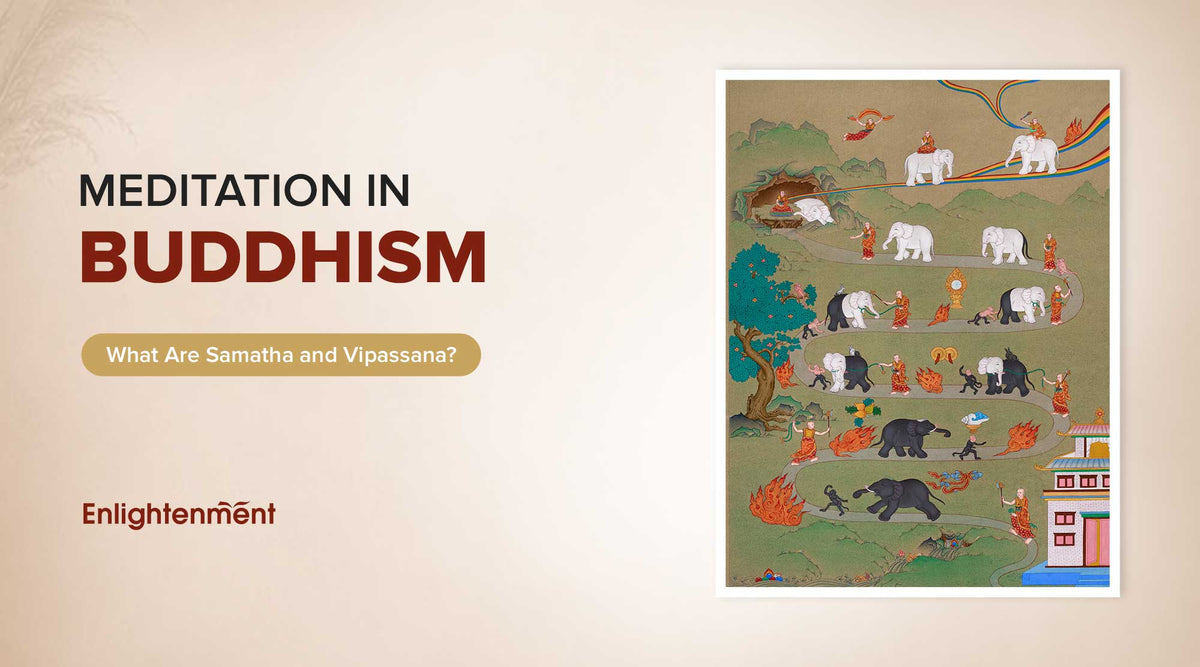
A clear guide to calm abiding and insight meditation
Ask most people what meditation is, and you'll get some version of the same answer: sitting quietly, breathing slowly, trying not to think too much. That picture isn't wrong, but it's incomplete, a bit like describing flight as "flapping." Buddhist meditation actually runs on two distinct engines, Samatha and Vipassana, each doing a different job, and each one is nearly useless for the deeper goal without the other.

Check Out Our Samatha Meditation Thangka Collection
This pairing isn't a modern wellness invention. It sits at the center of the Buddha's own teaching on meditation, described across the earliest Pali discourses and elaborated in nearly every Buddhist tradition since: Theravada, Zen, Tibetan Vajrayana, and the many secular mindfulness programs that have borrowed from them. Despite roughly 2,500 years of cultural change, the core instructions have barely needed updating, which is itself worth pausing on.
It's also worth understanding the terms themselves, since they carry meaning in translation. Samatha (Pali), also rendered as Shamatha in Sanskrit and zhi gnas in Tibetan, points to the development of peace or calm. Vipassana (Pali), or Vipashyana (Sanskrit), or lhag mthong in Tibetan, breaks down as "clear" (lhag) plus "seeing" (mthong): clear seeing. Between them, these two categories account for the whole of Buddhist meditation. For consistency, this article uses the Pali forms, Samatha and Vipassana, throughout.
Samatha and Vipassana at a Glance
Samatha and Vipassana are two complementary approaches in Buddhist meditation. One settles the mind; the other sees clearly into the nature of experience. The table below offers a concise comparison of their essential differences and how they support each other.
|
Samatha |
Vipassana |
|
|
Common translation |
Tranquility, calm |
Insight, clear seeing |
|
Main function |
Settles and unifies attention |
Investigates experience and its conditions |
|
What it weakens |
Agitation and the pull of the hindrances |
Ignorance and attachment to changing experience |
|
Relationship |
Provides the stability and clarity that make sustained investigation possible |
Uses that stability to see into experience, which in turn deepens and steadies the calm |
Together they form a balanced path: the calm of Samatha creates the stable ground on which the penetrating insight of Vipassana can arise and deepen.
What Exactly Are Samatha and Vipassana?
Samatha meditation develops tranquility. Attention repeatedly returns to a suitable Samatha meditation theme, often the breath, loving kindness, or awareness of the body, until it becomes less scattered. The practitioner isn't trying to become unconscious or force thoughts out of existence. Genuine calm remains bright, mindful, and responsive.

As the five hindrances (sensual desire, ill will, dullness, restlessness, and doubt) lose some of their force, the mind becomes more workable. This collectedness can deepen toward samadhi and jhana, but Samatha covers a broader range than absorption alone.
Vipassana, meanwhile, develops insight, or clear seeing, and comes in two forms: analytical and non-analytical. Bodily sensations, feeling tone, states of mind, and mental patterns are known as changing events rather than immediately taken as "me" or "mine." The investigation reveals impermanence, the insecurity of clinging to what changes, and not-self.
Vipassana is therefore more than noticing. Mindfulness keeps experience present; wise attention asks what conditions it, how it changes, and what happens when it's grasped or released.
In short: Samatha is the practice of settling the mind, training it to stay steady, quiet, and undistracted. Vipassana is the practice of seeing clearly, using that steadiness to look directly at the nature of experience itself. One stabilizes, the other reveals. Traditional texts often describe them as the two wings of a bird: a bird with only one wing doesn't fly straight; it doesn't fly at all.
With that distinction in place, it's worth looking more closely at how each practice actually develops.
The Qualities: How Samatha Works
At the heart of Samatha practice lies the cultivation of three qualities, developed in a specific sequence. Each builds on the one before, like the roots, trunk, and foliage of a tree.
Relaxation
This comes first, and it may be the most important thing to understand about Samatha, especially if you live a modern life. When I lead retreats, I often notice that people arrive incredibly tense. We come from a way of life that is driven, highly stimulated, goal-oriented, and always engaged.
So we start with relaxation: a profound easing of body and mind, a sense of looseness, comfort, and simply being allowed to be, without needing to do anything. This isn't sleepiness or dullness; it's a dynamic quality of being so deeply at ease that distractions don't capture you, not because you fought them off, but because you're too settled to be moved.
Stability
Once relaxation is established, stability can be cultivated. Stability is the ability to sustain focus continuously and voluntarily, without becoming fragmented or carried away. It also implies a quality of physical stillness: the capacity to sit without fidgeting, which in turn supports stillness of mind.
In practice, stability grows out of relaxation. Tools like counting the breath can help here, not as a permanent feature of meditation, but as a temporary support, like training wheels on a bicycle. You count to keep the mind from wandering off entirely, and once attention stabilizes, you let the counting go.
Vividness
The third quality is clarity: brightness, high definition, a mind that is sharp and lucid. This is cultivated once relaxation and stability are in place, because reaching for vividness too early simply creates tension.
The three qualities work together. As the roots of relaxation go deeper, the trunk of stability grows stronger, and the foliage of vividness reaches higher.
The Qualities: How Vipassana Works
Vipassana practice likewise rests on three interdependent qualities that build on one another.
Mindfulness
This is the starting point. Vipassana begins with continuous, clear, non-reactive awareness of present experience, whether of the body, feelings, mental states, or phenomena. In the Buddha's foundational instructions on the four applications of mindfulness (satipaṭṭhāna), this is the quality of knowing whatever arises just as it is, without adding conceptual overlays or emotional reactions.
As Alan Wallace emphasizes in Minding Closely, this isn't ordinary attention. It's a refined, discerning mindfulness that distinguishes between what's actually presented to the senses and the conceptual projections the mind habitually imposes. Without this steady, bare knowing, investigation has no reliable field in which to operate.
Investigation
Once mindfulness is established, the mind turns to investigation (dhamma-vicaya, one of the seven factors of enlightenment). This is the active, inquiring dimension of Vipassana. The practitioner examines the characteristics of experience: How does this sensation, thought, or emotion arise? On what conditions does it depend? Does it remain, or does it pass? Is there any solid "self," "I," or "mine" to be found within it?
In the Theravada tradition, this investigation reveals the three characteristics: impermanence (anicca), unsatisfactoriness (dukkha), and non-self (anattā). In the Mahayana and Dzogchen presentations taught by Wallace, the same spirit of inquiry probes the emptiness of inherent existence and the root of self-grasping. Investigation isn't mere intellectual speculation; it's a precise, experiential probing that uses the clarity and stability developed in Samatha as its instrument. A carefull chose Thangka masterpiece for meditation can serve as a quiet focal point that helps steady the mind before formal sitting begins.
Insight
The third quality is insight itself: the clear, liberating seeing that arises when investigation matures. At this stage the mind no longer merely observes change or conditionality; it directly knows the insubstantial, impersonal, and empty nature of all conditioned phenomena.
Classical texts describe a progressive series of insight knowledges (vipassanā-ñāṇa) that culminate in this realization. Wallace and other teachers note that when the stability and vividness of Samatha are unified with this penetrating insight, the deep-rooted ignorance and attachment that fuel suffering begin to loosen. What once seemed solid and personal is seen as a fleeting, dependent process, and the grip of reification weakens.
Continuous mindfulness provides the clear field; investigation probes the nature of what appears within it; and genuine insight arises as the natural fruition of sustained, precise inquiry. In this way, Vipassana doesn't merely calm the mind: it transforms the way experience itself is known.
Each of these qualities, in both practices, unfolds gradually rather than all at once. Tradition maps that unfolding in some detail: nine stages for Samatha, sixteen for Vipassana, and it's worth walking through both.
The Nine Stages of Samatha
Samatha develops gradually. The traditional map of this process is known as the nine stages of Samatha of calm abiding, describing how the mind slowly becomes more stable, clear, and effortless in its attention. They offer a practical roadmap for anyone training in concentration.
-
Placement of the Mind. The meditator learns to place attention on the chosen object (often the breath). At this stage, the mind stays only for very short moments before wandering.
-
Continual Placement. Attention remains on the object for slightly longer periods. The meditator begins to notice when the mind has drifted and brings it back more quickly.
-
Repeated Placement. Distraction is still frequent, but the meditator becomes better at recognizing it and returning to the object; subtle wandering still occurs.
-
Close Placement. The mind now stays with the object most of the time. Gross distraction has greatly decreased, though subtle wandering persists.
-
Taming. A sense of ease and joy begins to appear. The mind becomes more workable and less resistant to staying focused.
-
Pacifying. Subtle dullness and restlessness are reduced. The mind feels calmer and more refined.
-
Full Pacifying. Even the finer forms of distraction and dullness become much weaker. Attention feels clearer and more stable.
-
Single-Pointedness. Attention becomes stable and continuous, with only occasional, minor effort needed to maintain it. Gross and subtle dullness and agitation are no longer a real threat, though a light background effort is still present.
-
Balanced Placement (Equanimous Abiding). The final stage. Attention now rests on the object completely effortlessly, without any need for ongoing application or correction. The mind is naturally stable, clear, and calm on its own; this is the full development of Samatha.
Progress is rarely perfectly linear, but this map remains one of the clearest guides to developing genuine meditative calm, and it's this stability that Vipassana practice draws on.
The Sixteen Stages of Vipassana
Just as Samatha develops through nine stages, Vipassana unfolds through a progressive series of realizations traditionally known as the sixteen stages of insight. These stages describe how a meditator's understanding of reality gradually deepens. They aren't rigid steps that everyone experiences identically, but they do offer a useful map of the journey.
-
Knowledge of Mind and Body. The meditator begins to clearly distinguish between mental processes and sensations. What once felt like a solid "me" starts to appear as two interconnected streams of experience.
-
Knowledge of Cause and Condition. One sees that mind and body don't arise randomly; they condition each other. Thoughts influence the body, and bodily sensations influence the mind.
-
Knowledge of Comprehension. Impermanence, unsatisfactoriness, and non-self become more noticeable. The meditator starts recognizing these three characteristics in daily experience.
-
Knowledge of Arising and Passing Away. A major turning point. Experiences are seen arising and vanishing moment by moment with great clarity. Strong feelings of joy, light, or energy often appear here.
-
Knowledge of Dissolution. Attention shifts more toward the disappearing of phenomena. Everything seems to be constantly falling away.
-
Knowledge of Fearfulness. Seeing continuous dissolution can bring a sense of fear or insecurity. The usual solid world no longer feels reliable.
-
Knowledge of Danger. Conditioned existence begins to appear risky or burdensome. There's a clear recognition that clinging to changing experience leads to suffering.
-
Knowledge of Disenchantment. A natural turning away from attachment develops. Experiences that once seemed attractive lose their charm.
-
Knowledge of Desire for Deliverance. A sincere wish arises to be free from the endless cycle of arising and passing.
-
Knowledge of Re-observation. The meditator returns to careful investigation with renewed sharpness, examining the three characteristics more deeply.
-
Knowledge of Equanimity toward Formations. A balanced and peaceful observation develops. Experiences come and go without strong reaction. This is a mature and stable stage of insight.
-
Knowledge of Conformity. The mind aligns closely with the nature of reality and is prepared for a deeper breakthrough.
-
Change-of-Lineage Knowledge. A decisive shift occurs. The mind turns toward the unconditioned.
-
Path Knowledge. The moment of realization that marks entry into the first stage of enlightenment.
-
Fruition Knowledge. A peaceful, open state that follows the path moment.
-
Reviewing Knowledge. The meditator reflects on what has been realized and understands the change that has taken place.
These sixteen stages show that insight is a gradual unfolding rather than a single dramatic event, each stage building on the last and slowly transforming how the meditator relates to experience. Not everyone experiences every stage with the same intensity, but this remains one of the most detailed and respected guides to the progress of Vipassana practice.
Samatha is the Foundation for Vipassana.
These two maps are presented together for the sake of comparison. Mental focus is important because even if you have the information, the key is to have a quiet mind in order to have insight. See insight like a flame in the wind: when the mind is engaged, it is constantly blowing the flame out. There's no stability. Putting a glass cap over the candle is similar to what Samatha did.
When the mind becomes steady, relaxed, and focused, it is ready to be used for Vipassana. This is why Samatha is normally created initially in practice.

Check Out Our 15 Mandala Thangkas for Samatha Meditation Practice
In the absence of Vipassana, Samatha will bring tranquility, but the underlying patterns of the mind (reactivity, craving, misperception) will remain unaddressed. The mud calms down, but it’s always there when life gets hectic! Without Samatha, Vipassana more often results in a wobbly sort of "insight"; that is, when it actually occurs, it fades just as quickly as it arrives.
The mind, which is now ready to become almost a slave to sensory consciousness (seeing, hearing), follows along. Samatha practice is not enslavement to these senses (minds); it is about the sixth mind. The sixth mind's power is the power of concentration. This solid base makes analytical meditation possible: the wandering mind is studied until it is completely absorbed in single-pointed concentration; when this happens, the pure mind is used to investigate the nature of things.
In particular, in the suttas, the Buddha himself never says "Do Samatha" or "Do Vipassana. It's just one word: "Go meditate. One word: "Go meditate. In reality, Samatha (concentration) without Vipassana (insight) and Vipassana (insight) without Samatha (concentration) cannot work: It is like a bird with a broken wing! Don't have to worry too much about what you're doing being “Samatha” or “Vipassana”; the main thing is that you sit, and you're mindful.
Samatha, Vipassana, and the Nature of Mind.
This is interdependence, and it signifies deeper points about what each practice actually is doing with the mind. The four foundations of mindfulness include mindfulness of mind, and the four foundations as a whole are categories of Samatha, or mindfulness practice. Mindfulness of mind practice is about meditating on the mind itself, and the flow and movement of mind (thoughts, feelings, energy). Vipassana is more than mere mindfulness, more than observing the mind; in this practice, we look into the mind's true nature.

What is the nature of that true nature? The basic quality of insight can be understood, and to fully understand non-conceptual Vipassana, one has to experience it directly. Insight, or awareness, is not really created, but it comes.
In the sense of putting the mind one-pointedly, it's produced through effort and mindfulness, whether with an object or without. Awareness can't be made. Awareness practice is more about providing a conducive environment in the mind where awareness can come down.
The initial feeling of 'descending awareness' can seem abstract. But everybody has had an insight in normal life, when they are under the shower, or when they wake up out of their sleep, or when they are just spontaneously thinking about something; there's sometimes an opening there, there's some truth that wasn't seen before. In that meaning, awareness is given to us. Consciousness is that which experiences insights into itself: awareness.
Vipassana is not like Samatha, which leads to rebirth. This is Buddha's Way of teaching. Liberation is based on Samatha, but liberation from attachment to self, the wrong conceptions of self, and the wrong conceptions of reality is achieved through Vipassana.
How to Practice Samatha & Vipassana Together
With all these being so interwoven, they naturally combine together as advanced practice. Ideally, as you become more adept in meditation, Samatha and Vipassana are practiced together. Others say that one has to learn Samatha first and then Vipassana and then Samatha-Vipassana (which is briefly mentioned in the Journey to Well-Being). When properly practised, naturally, mindfulness and awareness go together.
Meditation on the out-breath during Mindworks meditation courses is specifically geared towards promoting both. Within a Samatha meditation, where you only focus on one thing such as counting in- and out-breath, there isn't much of a gap or space for insight. During the meditation on the out-breath, you concentrate on the breath while it is leaving, and release the mind. This allows space to naturally be experienced, what's called the gap. It is the space that is conscious. This practice is an introduction to the experience of Vipassana directly.
If Samatha and Vipassana are performed in the same manner, they merge into each other. You are now more familiar with the pause; you're more familiar with the emptiness of the out-breath, but you're more familiar with the spaciousness of the mind. This is Samatha and Vipassana's relationship. The Buddha mastered them at the time of enlightenment. They are both required, and they mutually inform one another.
