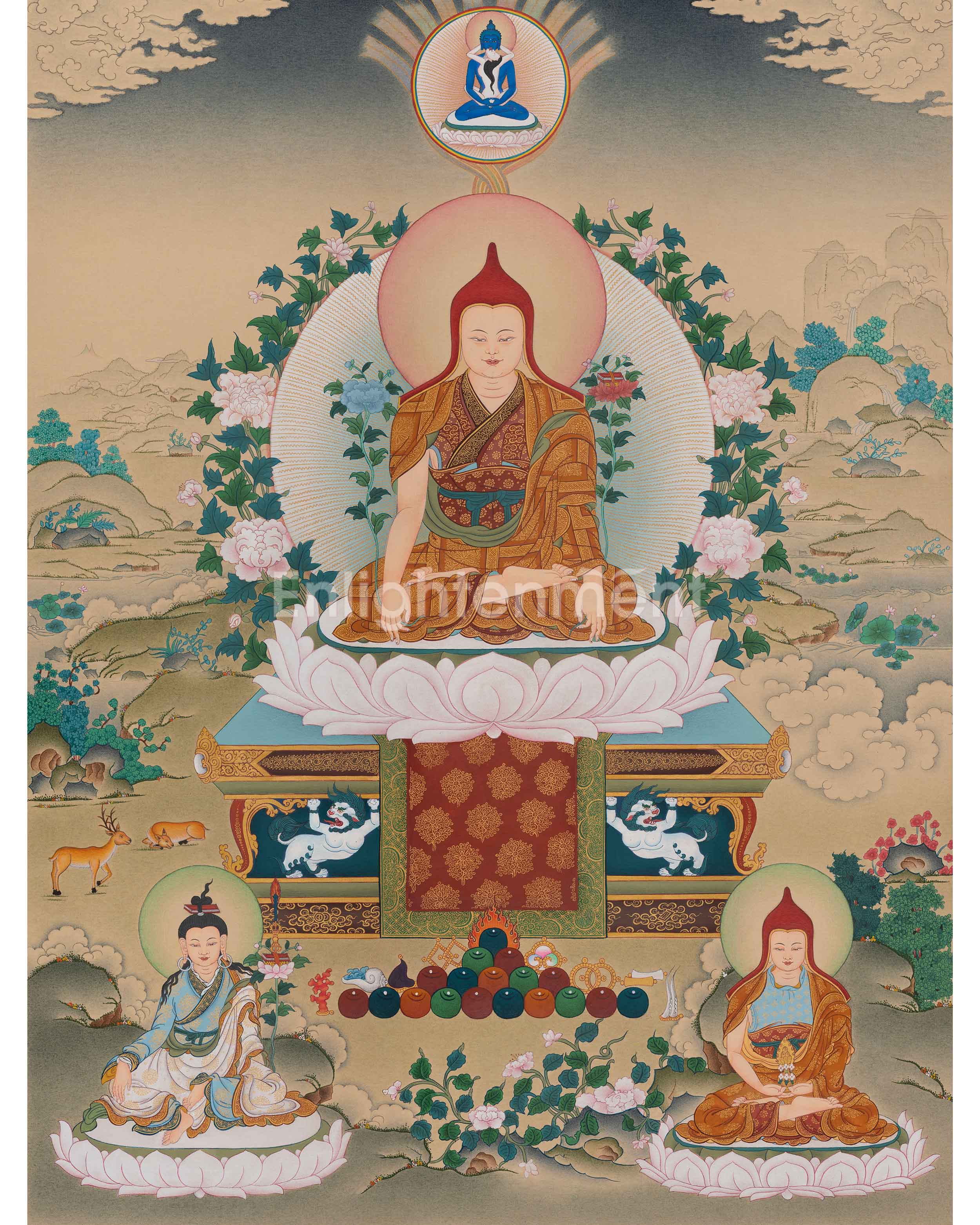
Guru Longchenpa Thangka Collection
1 product
Showing 1 - 1 of 1 product
Guru Longchenpa Thangka
Longchenpa, or Longchen Rabjam, is one of the most venerated and influential masters of Tibetan Buddhism. He was born in 1308 in the Upper Valley of central Tibet, in the noble lineage of the Rok and Drom families, who endowed him with a rich spiritual and cultural heritage. Longchenpa was a giant in the Nyingma school, the oldest of the four schools of Tibetan Buddhism, whose teachings influenced the development of Vajrayana philosophy for centuries.
Longchenpa is best known for his highly accomplished efforts in systematically organizing the teachings of Dzogchen, or the "Great Perfection". That waved and went into a coherent scholastic structure in the context of the general Tibetan Vajrayana Buddhist philosophical framework. His extensive writings, such as the renowned Seven Treasuries, are still regarded as fundamental texts in the practice or study of astrology. Longchenpa is considered a manifestation of enlightened wisdom and is considered to be second only to Padmasambhava within the Nyingma tradition. To remember this great Master, we use a Thangka that embodies his lineage and teachings, a direct and luminous object of his mind.
Spiritual Visions & Guidance
From a very early age, Longchenpa was very smart, talking with great lucidity as if he had lived many lives before. He was able to read and write by the time he was 5. When he was sixteen, he had the vision of dakini Sarasvati, who predicted that he would receive knowledge naturally and take him through the four continents and Mt. Sumeru, giving him a boost to his intellect and his future enlightenment.
He had a deep vision after five months during his eight-month darkness retreat. A beautiful girl gave him her crown of jewels and said that he would find his destined guru Rigdzin Kumaradza, which will confer siddhis on him. When Longchenpa saw Kumaradza, he knew him as Vimalamitra and was able to equalize his realization through the same practice.
During retreats, he also had many visions, where he met deities that were helping him in his pursuits. Longchenpa declared his accomplishments: "I am not attached to samsara, I have no hope, fear; I abide in the view and meditation of Dzogpa Chenpo.
His Legacy
The works and compilations of Longchenpa were extremely influential, particularly for the Nyingma tradition. And according to the Hermano, who’s a Tibetologist, Longchenpa’s work had an immediate impact, and in subsequent centuries was to serve as the explicit model for many Nyingma compositions. Specifically, his Seminal Heart writings were philosophical and contemplative, also of an architectonic nature. While the characteristic doctrine and terminology are found in earlier literature from the time of the great masters, the precision of their terminology, the eloquence of their style, the systematic scope and structure of their writing, and their ability to link it to the norms of Buddhist discourse are innovations in themselves.
Iconography and Symbolism
-
Guru Longchenpa is usually portrayed in the attire of a Buddhist scholar-monk, symbolizing both his status as a realized meditator and as a brilliant philosopher-teacher.
-
He is usually depicted sitting, meditative and relaxed, embodying the natural ease and simplicity of the essence of realization in the Dzogchen path.
-
His hands are often depicted in a teaching or meditation mudra, symbolizing his teachings.
-
He is often portrayed with a book or a tablet in his hand, representing his extensive knowledge and wisdom in the field of literature and Buddhist philosophy.
-
His face is calm and bright with the clear spaciousness of the Great Perfection teachings he lived.
-
He is usually depicted wearing a crown or a halo, which represents the light of wisdom and the purity of the mind. He is often accompanied by a halo or a crown, representing the light of wisdom and the purity of the mind.
-
His lineage figures or teachers might be depicted around him, placing him in the uninterrupted lineage of Dzogchen Masters.
-
The overall atmosphere of the painting is serene and contemplative, with a number of soft, radiant colors that evoke the qualities of wisdom, compassion, and spiritual illumination associated with his teachings.