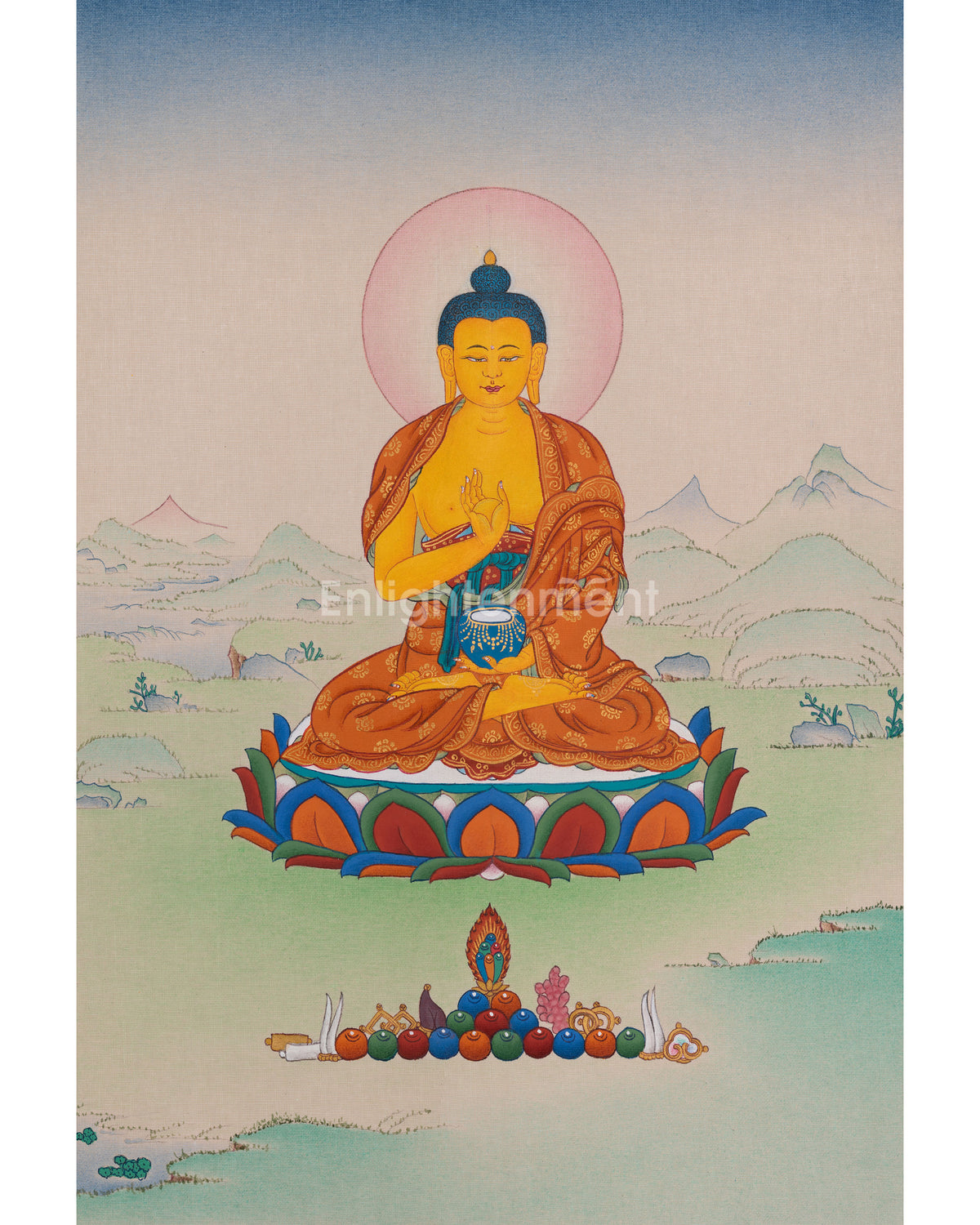
Ratnasambhava Buddha Thangka Collection
1 product
Showing 1 - 1 of 1 product
Ratnasambhava Buddha: One of the Five Dhyani Buddhas
Ratnasambhava, whose name means “Jewel-Born,” is one of the Five Dhyani Buddhas of Vajrayana Buddhism. He is the Buddha of the southern direction and the lord of the Ratna (Jewel) family. The Ratnasambhava Buddha Thangka Collection brings together hand-painted scrolls of this golden-yellow Buddha, each made with traditional proportions and mineral pigments.
Symbolism of Ratnasambhava
Ratnasambhava represents the wisdom of equality, the understanding that all beings and all experiences hold equal value. This wisdom is the remedy for pride, which comes from comparing oneself with others. In Buddhist teaching, pride turns into generosity and open-hearted equanimity when it is transformed through practice.
His main symbolic links are:
-
Direction: South
-
Family: Ratna (Jewel)
-
Element: Earth
-
Aggregate: Feeling
-
Color: Yellow or gold
-
Seed syllable: Tram
The jewel is the central image. It stands for the wish-fulfilling quality of an awakened mind, which gives freely and without measure. The yellow color supports this meaning. It reflects the richness of the earth and the warmth of giving. In practice, Ratnasambhava is often invoked to grow generosity and to reduce clinging and stinginess.
Ratnasambhava Iconography
Ratnasambhava is painted as a calm, youthful Buddha with golden-yellow skin. He wears the robes and ornaments of a Sambhogakaya Buddha, which include a crown, earrings, necklaces, and silk scarves. His face is peaceful and his eyes are lowered in a gentle gaze.
Key visual features include:
-
Right hand: Held in varada mudra, the gesture of giving, with the palm open and facing outward
-
Left hand: Resting in the lap in meditation, holding a wish-fulfilling jewel
-
Posture: Seated in the vajra (full lotus) position
-
Throne: A lotus seat resting on a platform supported by a pair of horses
-
Consort: Mamaki, who represents the quality of deep care
-
Halo: A radiant circle of light and a larger aura behind the body
The horse throne is easy to recognize. It links the southern Buddha with strength, speed, and generous activity. Painters set these details according to iconometric rules, so the proportions of the face, hands, and throne follow fixed measurements.
What the Collection Offers
Each thangka in the collection follows the classical standards of Tibetan painting. Artists use finely ground mineral pigments for lasting color and apply gold for the jewel, crown, and ornaments. Lines are drawn on a measured grid, then filled with layered washes. The scrolls are mounted in silk brocade so they can hang or be rolled for storage.
A Ratnasambhava thangka suits several purposes:
-
Meditation practice focused on generosity and equality
-
Altars and shrine rooms, especially those that display the Five Dhyani Buddhas together
-
Study of Vajrayana symbolism and the Five Buddha Families
-
Gifts for practitioners and collectors of Himalayan art
The collection includes different sizes and styles, from single-deity compositions to full mandala arrangements. A thangka that shows Ratnasambhava in the south of a mandala is read as part of a complete set, where each Buddha balances the others.
Why It Matters
A Ratnasambhava thangka serves as a daily reminder that pride can become generosity and that real wealth comes from giving. Its golden color, open hand, and jewel carry that message in a single image.