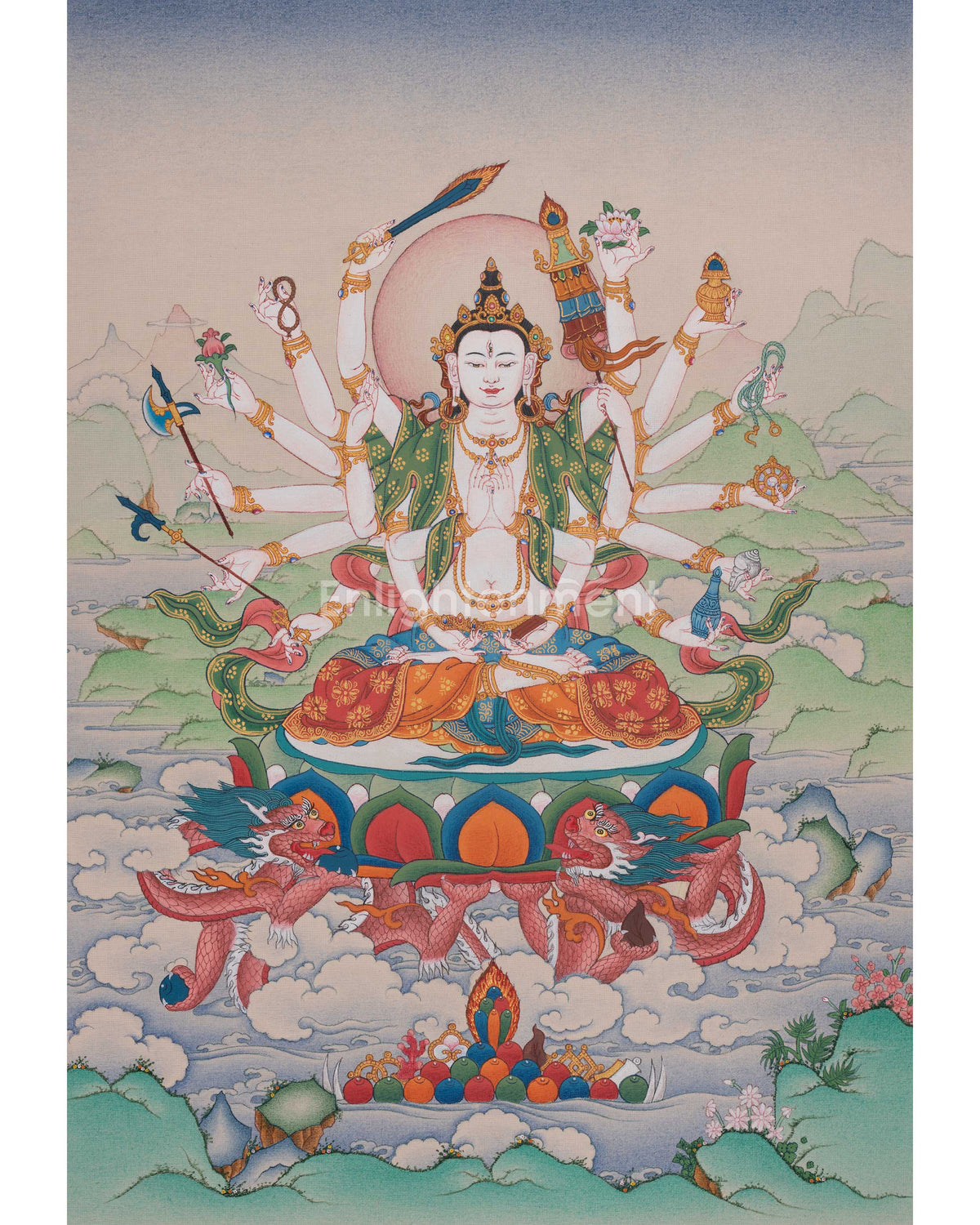
Cundi Thangka Collection
1 product
Showing 1 - 1 of 1 product
Cundi: The Mother of Seventy Million Buddhas
Some deities arrive in a painting with a single gesture. Cundi arrives with eighteen arms, a lotus throne, and a title that stops you for a moment: Mother of Seventy Million Buddhas.
That title is a clue to who she is. In Buddhist tradition, Cundi is a bodhisattva of great purity. Her name is often translated as “extremely pure,” and devotees turn to her to cleanse karma, remove obstacles, and invite protection into daily life.
She first appears in the Karandavyuha Sutra, a text centered on Avalokiteshvara. From there, her practice spread widely in Chinese and Japanese esoteric Buddhism, where she is also known as Cundi Guanyin. In Tibetan Buddhism, she is less common, which makes a well-painted Cundi thangka a rare and distinctive piece.
Our Cundi Thangka Collection brings together hand-painted images of her in the traditional style. Each one is made to follow the proportions and symbols that have guided sacred painters for generations. Because each painting is made by hand, no two are exactly alike, and the fine linework and mineral colors reward a close look.
Iconography and Symbolism
Every part of a Cundi thangka carries meaning. Once you know what to look for, the painting becomes something you can read as well as admire.
-
Eighteen arms: The most recognizable feature. The eighteen arms are commonly explained as eighteen qualities that distinguish a Buddha from a bodhisattva, or eighteen paths toward Buddhahood.
-
Three eyes: Her third eye stands for wisdom that sees beyond ordinary appearances.
-
Hand gestures and held objects: Her many hands carry sacred implements. Typical ones include a lotus, a vajra, a wish-fulfilling jewel, a rosary, a vase, a sword, a wheel, and a conch. Each one points to a different kind of help, such as protection, wealth of the spirit, or the cutting of ignorance.
-
Lotus and moon disc seat: She sits upright on a lotus resting on a moon disc. The lotus shows purity rising from the mud of ordinary life, and the moon disc points to compassion and calm.
-
Radiant halo: The light around her represents the clarity of an awakened mind and the blessing that spreads from it.
-
Serene face: Her expression is peaceful and welcoming. It tells the practitioner that this is a mother figure who protects rather than frightens.
-
Mantra link: Her practice is tied to a short dharani that begins with a salutation to the seven million fully awakened buddhas. Many practitioners recite it while looking at her image.
Together, these details describe one idea. Cundi is a source of purification and refuge, and her form shows every method she uses to help.
Best Places to Display Her Thangka
A thangka is a devotional object, so where you hang it matters. The goal is a place that feels clean, calm, and respectful.
A home altar or shrine. This is the most traditional choice. Hang the thangka at or above eye level, with a small table below it for offerings such as water, a lamp, or a flower. If you recite her mantra each day, this spot will quickly become part of your routine.
A meditation room or quiet corner. Cundi is often used as a focus for visualization. A thangka placed directly in front of your seat gives your eyes a steady point to rest on. Even a small corner with a cushion works well.
A study or home office. People who value her protective energy often place her where they work or read. Here she acts as a reminder to keep the mind clear and the work honest. Choose a wall that is calm and not crowded with screens or clutter.
A living room wall. If your home has no separate shrine, a living room can work, provided the thangka hangs on its own wall space. Avoid placing it near a television or in a spot where people walk past carelessly.
A few simple rules apply everywhere. Hang the painting above waist height, never near a bathroom or kitchen sink, and never on the floor. Keep it out of direct sunlight, since strong light can fade mineral pigments and dull gold over the years. A steady, dry wall will protect the painting for a long time.
A Cundi thangka is more than decoration. It is a daily reminder of purity, protection, and the patient work of clearing the mind. Placed with care, it gives a home a quiet center.