
A Gentle Expression of Compassion and Long Life
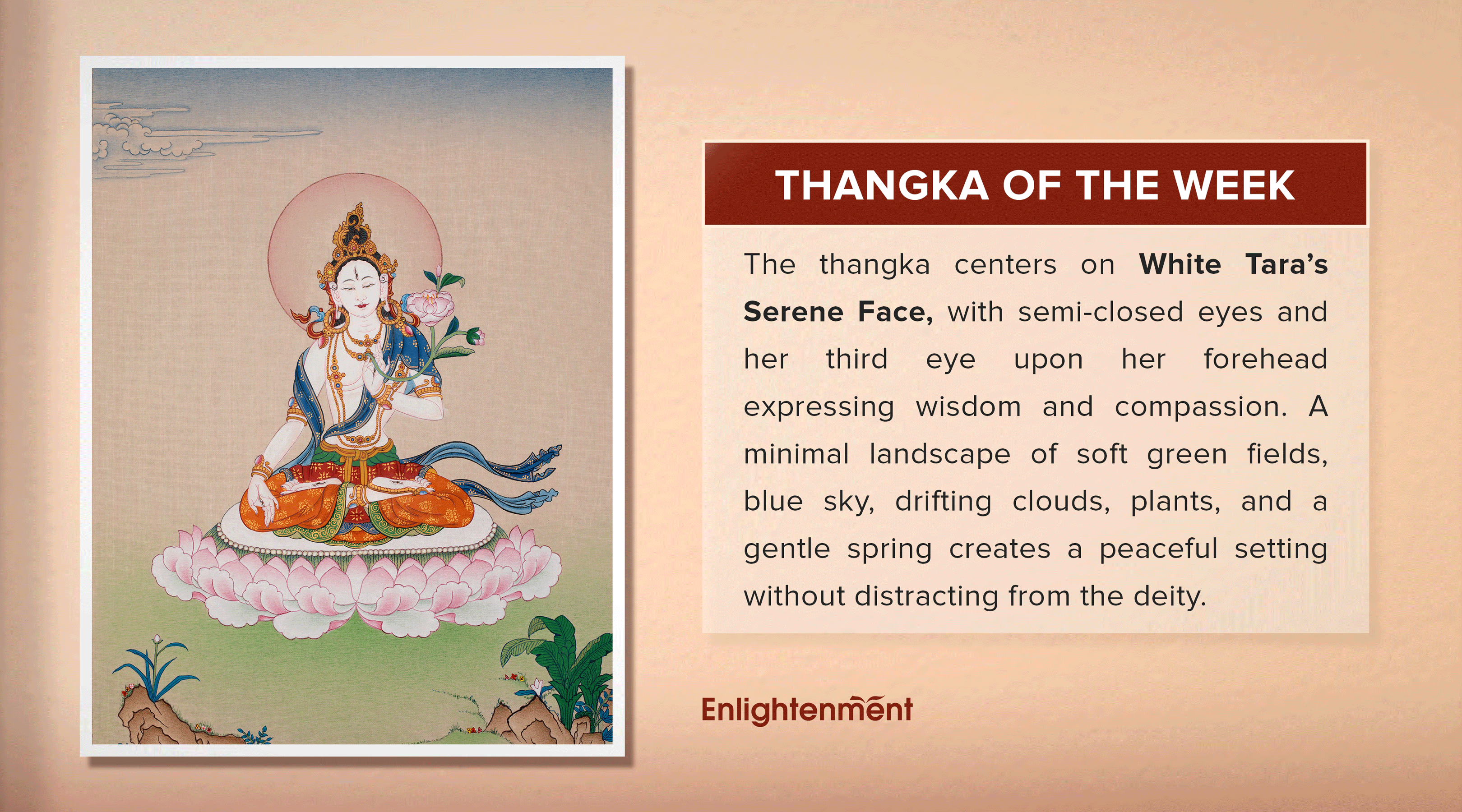
We are honored to feature a beautifully serene White Tara Thangka, a refined composition created around one simple yet powerful idea: allowing the peaceful presence of White Tara herself to become the heart of the painting. Unlike thangkas filled with elaborate landscapes, numerous figures, or rich decorative backgrounds, this artwork takes a more restrained approach. The artist has intentionally kept the surroundings simple so that the viewer's attention naturally rests upon White Tara's face.
And that simplicity is precisely what makes the painting so powerful. There is no need for a crowded composition when the expression of the deity carries so much meaning. Her gentle face, peaceful gaze, and subtle expression immediately create a feeling of calm. The longer one looks at her, the more the painting seems to slow everything down, inviting a quiet moment of reflection and stillness.
Who Is White Tara?
White Tara, known as Dolkar in Tibetan, is one of the most beloved female figures in Tibetan Buddhism.

Click here to view White Tara Thangka Art
She is particularly associated with compassion, healing, longevity, protection, and peaceful activity. Her gentle presence is often understood as a nurturing form of compassion, offering comfort and support to beings experiencing suffering and difficulty.
White Tara's imagery is especially recognizable because of her seven eyes. Two eyes are found on her face, one rests upon her forehead, and four additional eyes appear upon her hands and feet. Together, these seven eyes symbolize her all-seeing compassion and her ability to perceive the suffering of beings throughout the world. She does not simply look with ordinary eyes. Her eyes represent awareness. They remind us of a compassionate presence that remains attentive to the needs of all beings.
This idea is beautifully expressed in this particular thangka.
The Face That Becomes the Heart of the Painting
The most remarkable feature of this composition is undoubtedly White Tara's face. Everything else has been carefully arranged to support it. Her expression is soft, kind, and deeply peaceful. Her semi-closed eyes give the impression that she is resting in profound meditation, completely undisturbed by the world around her.
There is a wonderful stillness in her gaze. She does not appear to be looking outward in an ordinary sense. Instead, her expression suggests an inward state of awareness and contemplation. This creates a very intimate feeling between the viewer and the deity.
Rather than being overwhelmed by elaborate scenery, the viewer is encouraged to spend time with her expression. The subtle details become more noticeable.

Click here to view White Tara Thangka Art
- The shape of her eyes.
- The gentle curve of her features.
- The softness of her expression.
Together, these details create a sense of reassurance that feels almost immediate.
The Third Eye of White Tara
Resting upon White Tara's forehead is her third eye, one of the seven eyes that define her traditional appearance. This small but important detail carries profound symbolic meaning.
The third eye represents awakened awareness and the ability to perceive beyond ordinary appearances. It is a reminder that compassion is not simply an emotional response. True compassion requires seeing clearly. White Tara's seven eyes symbolize her ability to see in every direction and remain aware of the suffering of beings.
In this painting, the third eye becomes especially meaningful because the composition is so focused on her face. The viewer naturally notices it while observing her calm expression. It quietly reinforces the central message of the artwork: compassion that sees, understands, and responds.
The Power of Semi-Closed Eyes
White Tara's semi-closed eyes are another particularly beautiful feature of the painting. They give her an appearance of deep meditation without making her feel distant. There is a delicate balance between inward contemplation and outward compassion.
Her eyes appear relaxed, yet her presence remains fully aware. This is one of the reasons the image feels so calming. When we look at a face that appears completely relaxed and undisturbed, our own minds can begin to slow down. The artist has captured that quality beautifully.
Rather than using dramatic expressions, the painting communicates through subtlety.
- The calmness is quiet.
- The compassion is gentle.
- The wisdom is expressed through stillness.
A Background Designed for Stillness
The background of this thangka has been intentionally kept simple. At first, this might seem like a small artistic choice, but it has a major effect on how the painting is experienced.
- There are no elaborate palaces competing for attention.
- There are no large groups of figures surrounding White Tara.
- There is no complicated scenery pulling the eye in different directions.
Instead, the landscape gradually opens behind her.
A gentle green field extends into the distance before softly blending into a light blue sky. The transition is subtle and natural. The green of the earth provides a sense of grounding, while the blue sky creates openness and spaciousness. Together, they form a quiet environment that allows White Tara's presence to remain the clear focus.
The Meaning of Simplicity
This simplicity does not mean the background is empty. Quite the opposite. Every detail has been carefully considered. The artist has included only those elements necessary to give the composition life and balance. It is a beautiful example of how restraint can become an artistic strength.
Sometimes, adding more does not make a painting more meaningful. Sometimes, removing distractions allows the central subject to speak more clearly. That is exactly what happens here. The landscape exists quietly around White Tara rather than competing with her. The viewer's eye always returns to her face.
Clouds Drifting Across the Sky
In the upper right portion of the composition, delicate clouds drift gently across the light blue sky. They add a small amount of movement to an otherwise peaceful scene. The clouds prevent the sky from feeling completely static while maintaining the quiet atmosphere of the painting. Their soft forms also create a sense of openness and distance.

Click here to view White Tara Thangka Art
They seem to move naturally through the sky, giving the impression that the landscape continues beyond the boundaries of the canvas. This is a subtle detail, but it contributes greatly to the feeling of spaciousness. The artist has found the right balance between stillness and movement.
Small Plants and the Gentle Spring
At the base of the thangka, small plants emerge from the earth alongside a gentle spring. These details may be easy to overlook at first, especially because White Tara's face commands so much attention. But when viewed carefully, they become an important part of the composition.

Click here to view White Tara Thangka Art
The plants introduce a touch of natural life. The flowing spring introduces movement. Together, they help ground the painting within the natural world. Water has long been associated with purity, renewal, and the continuous flow of life.
Here, the small spring quietly complements White Tara's associations with healing and compassionate care. It does not need to be large or dramatic.Its presence is enough.
The Harmony Between Deity and Nature
One of the most beautiful qualities of this thangka is the relationship between White Tara and the landscape. She does not appear separated from nature. Instead, the simple field, sky, plants, clouds, and spring create a peaceful environment around her. The natural setting supports her presence without distracting from it. This creates a sense that White Tara is sitting within a world that is already calm and harmonious.
- The landscape becomes an extension of her qualities.
- The green field suggests life and renewal.
- The clear blue sky suggests openness.
- The flowing spring suggests purity and continuity.
- The clouds introduce gentle movement.
And at the center of it all is White Tara, embodying compassion and peaceful awareness.
A Different Kind of Beauty
This thangka demonstrates that sacred art does not always need complexity to create depth. Sometimes the most powerful paintings are those that give the viewer room to breathe. Here, the artist has deliberately reduced visual distractions so that the emotional character of White Tara becomes the primary experience.
The painting asks very little from the viewer. There is no complicated story that must be understood immediately. There is simply a peaceful face inviting quiet attention. For someone looking at the thangka after a busy day, that can be surprisingly powerful.
A few moments spent observing her expression can become a small pause from everything else.
A Quiet Reminder of Compassion
This White Tara thangka is ultimately a painting about presence. Not dramatic presence. Not overwhelming presence. But quiet, compassionate presence.
The artist has created a composition where every element has a clear purpose. White Tara's gentle expression remains the center. Her semi-closed eyes communicate meditation and inner calm. Her third eye reminds us of awakened awareness and all-seeing compassion.
Around her, the simple landscape provides just enough beauty to create a sense of life and openness. The green field, blue sky, drifting clouds, small plants, and gentle spring all work together without competing for attention.
The result is an artwork that feels remarkably peaceful. It reminds us that compassion does not always need to arrive with great force. Sometimes it appears quietly. Sometimes it is simply the feeling of being seen, understood, and cared for. And that is what makes this White Tara Thangka so special, a gentle visual reminder to slow down, breathe, and return to the quiet compassion that is always waiting within.
