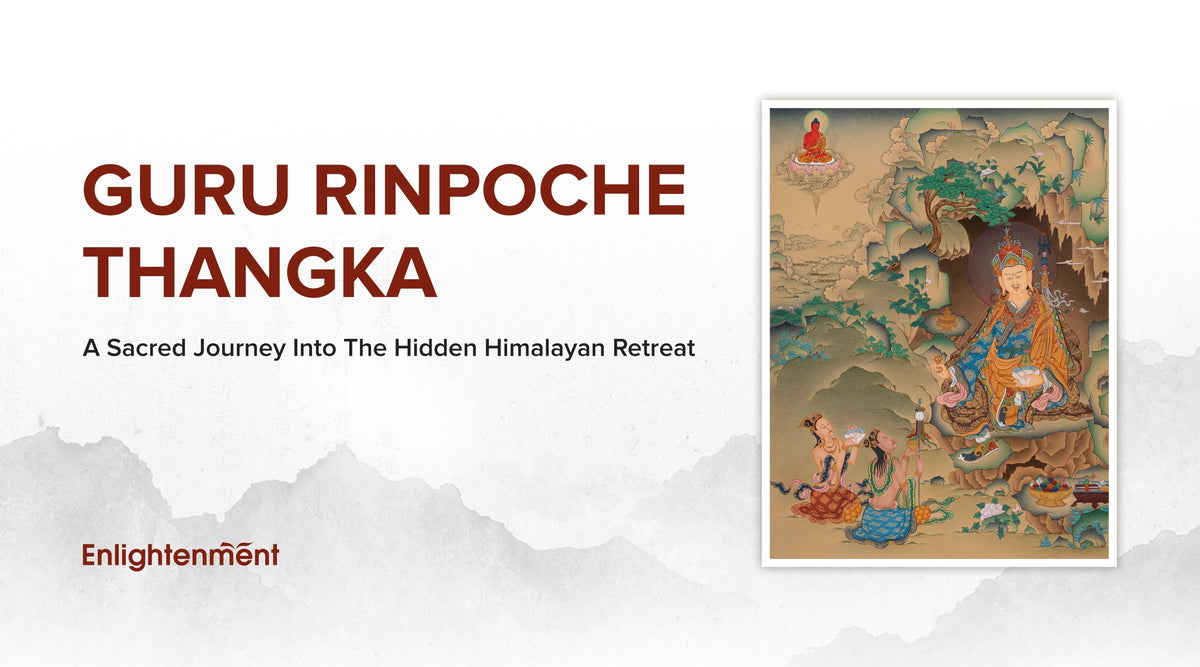
Beautifully composed Guru Rinpoche Thangka, a sacred work of Himalayan art that brings together Guru Rinpoche, Yeshe Tsogyal, Mandarava, and Amitabha Buddha within a secluded mountainous landscape.
Rather than presenting Guru Rinpoche against a simple background, the artist has created an entire sacred world around him. Mountains rise into the distance, flowers and plants grow across the landscape, and soft clouds drift behind the hills. At the center of this remote setting is the cave retreat associated with Guru Rinpoche, where he is depicted together with his two principal consorts.
The composition gives the viewer a feeling of quietly approaching a hidden Himalayan sanctuary. There is a sense of distance and mystery, but also profound peace. Every element has been carefully arranged to tell a story, not only of a sacred place but of meditation, devotion, wisdom, and spiritual accomplishment.
Who Is Guru Rinpoche?
Guru Rinpoche, also known as Padmasambhava, is one of the most important masters in the history of Tibetan Buddhism, particularly within the Nyingma tradition. His name, Guru Rinpoche, means "Precious Guru," reflecting the extraordinary importance he holds for Tibetan Buddhist practitioners.

Click here to view Guru Rinpoche with his Consorts Thangka
According to tradition, Guru Rinpoche came to Tibet in the eighth century and played a central role in establishing and spreading Buddhist teachings. He is especially remembered for his profound meditation practices, teachings, and spiritual accomplishments. He is also closely connected with remote sacred places throughout the Himalayas, where he is believed to have undertaken intensive meditation and practice.
This thangka focuses on that aspect of his life. Instead of simply showing Guru Rinpoche as an isolated sacred figure, it places him within the landscape of retreat and meditation, allowing the viewer to experience something of the environment in which his spiritual practice unfolded.
Entering the Sacred Retreat
The first thing that makes this thangka special is its setting. Guru Rinpoche and his two consorts are nestled within a secluded mountainous hillside, creating the impression of a hidden retreat far away from ordinary life.
- The mountains appear distant and peaceful.
- There is no crowded village or busy human environment.
- Instead, nature surrounds the sacred figures on every side.
- This creates a feeling of solitude that is perfectly suited to the subject.
- A meditation retreat is traditionally a place where distractions are reduced so that the mind can turn inward.
- The artist communicates this idea visually.
- The farther the eye travels into the landscape, the more remote the sacred retreat seems to become.
It feels as though the viewer is leaving behind the ordinary world and slowly approaching a place dedicated entirely to spiritual practice.
Guru Rinpoche With His Two Principal Consorts
At the heart of the retreat sits Guru Rinpoche, accompanied by his two principal consorts, Yeshe Tsogyal and Mandarava. Their presence gives the painting a deeper spiritual meaning.

Click here to view Guru Rinpoche with his Consorts Thangka
Yeshe Tsogyal is one of the most important female figures associated with Guru Rinpoche and Tibetan Buddhism. She is remembered as a great practitioner, teacher, and spiritual disciple who attained profound realization.
Mandarava, an Indian princess and accomplished practitioner, was another of Guru Rinpoche's principal consorts. She is revered for her devotion, spiritual discipline, and accomplishments on the Buddhist path.
Together, the three figures create a powerful representation of spiritual practice and realization. The composition does not portray them simply as historical personalities. Their presence represents the relationship between teacher, practitioner, wisdom, devotion, and enlightened activity. The three figures appear naturally integrated into the surrounding landscape, reinforcing the idea that the retreat itself was part of their spiritual journey.
The Importance of the Mountain Landscape
The mountains are among the most important elements of this composition. They create both physical and symbolic distance between the sacred retreat and the ordinary world. Their layered forms lead the viewer deeper into the painting, making the central retreat feel secluded and difficult to reach.

Click here to view Guru Rinpoche with his Consorts Thangka
This sense of remoteness is important. Throughout the Himalayan Buddhist tradition, mountains and caves have long been associated with meditation and spiritual practice. Their isolation provides an environment where practitioners can dedicate themselves fully to contemplation.
In this thangka, the mountains communicate that feeling beautifully. They do not simply provide scenery. They help tell the story. The viewer can almost imagine traveling through the hills, following a quiet mountain path, and eventually discovering the hidden retreat where Guru Rinpoche and his companions are practicing.
A Cave Connected With Meditation
Within the mountainous landscape is the sacred cave retreat associated with Guru Rinpoche. The cave becomes a quiet focal point within the larger environment. Caves have a special significance in Buddhist practice because they offer natural places for solitude and meditation. Their enclosed spaces create a sense of separation from ordinary distractions, allowing practitioners to dedicate themselves to spiritual practice.
In this painting, the cave is not presented as something grand or luxurious. Its simplicity is part of its meaning. The surrounding mountains, plants, and quiet landscape emphasize the humble nature of retreat life.
The focus is not on material comfort. It is on practice.
Nature Surrounding the Sacred Figures
Abundant plants and delicate flowers surround the retreat, adding softness and life to the mountainous setting. These details are beautifully balanced throughout the composition. The vegetation grows naturally across the hillsides, creating a feeling that the retreat exists within a living Himalayan environment.
The flowers introduce small touches of color and beauty, while the greenery gives the landscape a sense of freshness. This relationship between nature and spiritual practice is one of the most beautiful qualities of the thangka. Guru Rinpoche is not separated from the natural world. He is shown within it. The landscape becomes a peaceful companion to the spiritual story being told.
Clouds Creating Depth and Distance
Behind the mountains, soft layers of clouds roll gently across the landscape. These clouds add an extraordinary sense of depth to the painting. Rather than ending abruptly behind the figures, the landscape appears to continue far beyond them. The distant clouds create the impression of an immense Himalayan environment stretching toward the horizon.
They also add movement to an otherwise peaceful scene. The mountains remain solid and still, while the clouds drift gently behind them. This creates a beautiful balance between stability and movement.

Click here to view Guru Rinpoche with his Consorts Thangka
The result is a landscape that feels alive without disturbing the tranquility of the retreat.
The Feeling of Approaching a Hidden Place
Perhaps the most powerful quality of this thangka is how immersive it feels. The composition almost places the viewer on the journey toward Guru Rinpoche's retreat.
- The distant mountains create space.
- The layers of vegetation guide the eye.
- The flowers bring the foreground to life.
- The clouds create distance.
- And the sacred figures remain peacefully seated within the hidden landscape.
Everything works together to create the feeling that this is a place one has discovered rather than simply a scene being displayed. That makes the artwork particularly engaging.
The viewer is encouraged not only to look at the thangka but to imagine entering its world.
Amitabha Buddha Above
At the top of the composition appears Amitabha Buddha, adding another important spiritual dimension to the painting. Amitabha, the Buddha of Infinite Light, is associated with boundless compassion, wisdom, and the Pure Land of Sukhavati.

Click here to view Guru Rinpoche with his Consorts Thangka
His presence above Guru Rinpoche creates a beautiful vertical relationship within the composition. The viewer's gaze can travel from the secluded earthly landscape upward toward Amitabha, connecting the world of Guru Rinpoche's practice with the greater realm of enlightened wisdom.
Symbolically, this creates a sense of spiritual continuity. The retreat below represents practice and realization. Amitabha above represents enlightened wisdom and the ultimate spiritual aspiration. Together, they make the composition feel complete.
A Story Told Through Landscape
One of the greatest strengths of this thangka is that the landscape itself becomes part of the story. In many paintings, mountains, trees, flowers, and clouds simply fill the background.
Here, they do something more.
- They communicate the experience of retreat.
- The distant mountains suggest isolation.
- The cave represents meditation.
- The plants and flowers show the peaceful natural environment.
- The clouds create depth and remoteness.
- The sacred figures bring the entire landscape together.
- This is why the thangka feels so immersive.
- The viewer is not simply looking at Guru Rinpoche.
- The viewer is being introduced to the world in which his practice took place.
The Relationship Between Guru and Wisdom
The presence of Yeshe Tsogyal and Mandarava also adds an important dimension to the painting. Their inclusion reminds us that the Buddhist path is not only about the individual teacher. It is also about transmission, devotion, practice, and the realization of wisdom.
Both women are revered as accomplished practitioners in their own right. Their presence beside Guru Rinpoche therefore represents a spiritual relationship grounded in practice and realization. The composition becomes a beautiful reminder that wisdom is transmitted through teachings, devotion, discipline, and lived experience.
More Than a Historical Scene
Although the thangka draws upon the sacred history of Guru Rinpoche, it is not simply a historical illustration. It is a meditation on the spiritual path. The remote landscape reminds us of the importance of creating space for contemplation. The cave reminds us of the value of turning inward.
Guru Rinpoche represents the teacher and enlightened master. Yeshe Tsogyal and Mandarava represent accomplished practitioners and the transformative power of devotion and wisdom. Amitabha above reminds us of the ultimate goal toward which spiritual practice leads.
The entire composition therefore, becomes a visual journey from the ordinary world toward realization.
A Masterful Himalayan Landscape
The artistic skill required to create such a landscape is considerable. The artist must maintain the correct balance between the sacred figures and their environment while creating enough detail to make the setting feel alive.
The mountains must have depth. The vegetation must feel natural. The flowers must complement rather than overwhelm the figures. The clouds must create distance without becoming distracting. And throughout all of this, Guru Rinpoche and his consorts must remain the spiritual center of the painting.
This careful balance is what gives the thangka its remarkable sense of harmony. Every element feels connected.
A Sacred Invitation to Pause
Like traditional thangkas, this artwork can serve as more than a beautiful piece of decoration. Its imagery invites contemplation.

Click here to view Guru Rinpoche with his Consorts Thangka
One can spend time observing the mountains, following the landscape toward the retreat, noticing the flowers and plants, and eventually resting one's attention upon Guru Rinpoche and his two consorts.
The painting encourages a slower way of looking. There is no need to understand every detail immediately. The landscape itself creates an opportunity to pause.
In a world filled with constant movement and noise, the image of a secluded mountain retreat offers a very different experience. It reminds us of the value of stillness.
A Journey Toward Realization
This Guru Rinpoche Thangka beautifully brings together Guru Rinpoche, Yeshe Tsogyal, Mandarava, and Amitabha Buddha within one sacred landscape.
Every part of the painting contributes to its story.
- The mountains create remoteness.
- The cave represents meditation.
- The flowers and greenery bring life to the retreat.
- The drifting clouds create depth and mystery.
- The three central figures express devotion, practice, wisdom, and spiritual accomplishment.
- Amitabha Buddha above completes the composition with his presence of infinite light and compassion.
The result is more than a beautifully detailed thangka.
It feels like an invitation to enter a hidden world of meditation and practice, to leave behind the noise of ordinary life for a moment and quietly approach the sacred retreat of Guru Rinpoche.
"Perhaps that is the greatest beauty of this painting. It does not simply tell us about a place of practice. It allows us to imagine being there."