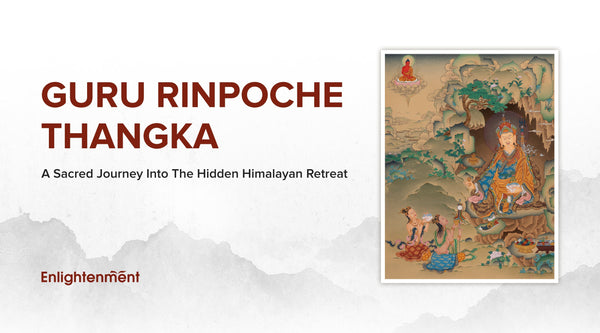
There is something deeply peaceful about seeing Shakyamuni Buddha beneath the Bodhi tree. The scene immediately brings the mind to the moment of awakening, when the Buddha remained seated in stillness and realized the truth that would become the foundation of his teachings.
At the heart of the painting, Shakyamuni Buddha sits peacefully beneath a graceful Peepal tree, surrounded by the quiet beauty of nature. Delicate leaves hang above him, forming a soft natural canopy, while the roots of the tree seem to embrace the space around his meditation seat. His peaceful face, with gently half-closed eyes, becomes the quiet center of the entire composition. There is no sense of movement or disturbance. Instead, the painting invites us to slow down and simply remain with the Buddha's presence.
Below him, the landscape gently meets the water, and Buddha appears seated upon a radiant pink lotus. Earth, water, tree, lotus, and sky come together in a harmonious composition, creating a sacred natural environment around the enlightened figure.
Painted with natural Lhasa stone colors, this Thangka has a rich yet gentle quality. The natural pigments bring depth to the landscape while maintaining a sense of softness and warmth. Measuring just 9 × 13 inches, it is a small and intimate painting, yet it carries the same sense of devotion and careful craftsmanship found in larger traditional Thangkas.
More than simply an image of the Buddha, this painting offers a quiet place for the eyes and mind to rest.
Who Is Shakyamuni Buddha?
Shakyamuni Buddha is the historical Buddha who lived in ancient India and attained complete awakening. Born as Prince Siddhartha Gautama in Lumbini, in present-day Nepal, he left behind the comforts of palace life in search of an answer to the suffering experienced by all living beings. After years of searching and practicing, Siddhartha eventually came to the place now known as Bodh Gaya. There, beneath a Peepal tree, he entered deep meditation.
According to Buddhist tradition, he remained in meditation through the night and ultimately attained enlightenment. He became known as the Buddha, meaning "the Awakened One." The image of Shakyamuni Buddha beneath the Bodhi tree therefore represents much more than a peaceful person sitting in nature. It represents the moment when the mind awakened to the nature of reality.
The Buddha's awakening is at the heart of the Buddhist path. His realization became the basis for teachings on suffering, its causes, its cessation, and the path leading toward liberation. When we look at a Shakyamuni Buddha Thangka, we are therefore looking at an image connected with one of the most important moments in Buddhist history and practice.
The Peaceful Presence Beneath the Tree
The central feature of this Thangka is the calm presence of Shakyamuni Buddha seated beneath the tree. His posture is steady and composed. His body does not appear tense or forceful. Instead, everything about his presence suggests stability and inner stillness.
His eyes are gently half-closed, creating the familiar meditative expression associated with the Buddha. They are neither completely closed nor fully open. This quiet gaze suggests a mind that is turned inward while remaining awake and aware.

Click here to view the beautiful Shakyamuni Buddha Thangka
His face is especially important within the composition. There is a natural softness in the expression, but it is not simply a smile or an expression of happiness. It is the peacefulness that comes from deep understanding. The face communicates a sense of freedom from disturbance, allowing the viewer to feel the stillness of meditation.
The Buddha does not need to speak within the painting. His presence itself becomes the teaching. As we spend time looking at his face, the surrounding landscape seems to become quieter. The leaves, water, earth, and sky all support the same feeling of calm.
The Peepal Tree and the Memory of Enlightenment
Above Shakyamuni Buddha, delicate Peepal leaves hang gracefully from the branches of the tree. The Peepal tree is deeply connected with the Buddha's enlightenment. The tree under which Siddhartha Gautama attained awakening became known as the Bodhi tree, or Tree of Awakening.

Click here to view the beautiful Shakyamuni Buddha Thangka
In this Thangka, the leaves are not simply decorative details. They help establish the sacred setting of the painting. The hanging leaves create a natural canopy over the Buddha. Their fine shapes bring movement to an otherwise quiet scene, while their placement gently frames the central figure.
There is also something beautiful about the relationship between the Buddha and the tree. The tree rises above him, while its roots descend around him. Buddha sits peacefully within this natural environment, appearing completely at home in the landscape.
The composition reminds us that his awakening did not take place in an isolated world separated from nature. It happened beneath a tree, surrounded by the earth, water, sky, and living world.
The tree therefore becomes part of the story. Its leaves suggest life and continuity. Its roots suggest stability and connection with the earth. Its branches create shelter above the Buddha. Together, these elements create a quiet visual reminder of the place where awakening unfolded.
From the Roots of the Tree to the Lotus
One of the most captivating aspects of the painting is the way the Buddha appears to emerge from among the roots of the tree. The roots create a natural foundation around the central figure. They connect the tree above with the earth below, giving the composition a strong sense of depth.
From this grounded setting, the eye moves naturally toward the water. There, Shakyamuni Buddha is beautifully seated upon a radiant pink lotus. The lotus is one of the most recognizable symbols in Buddhist art. Growing from water while opening above its surface, it has long represented purity, spiritual growth, and awakening.
Its presence beneath the Buddha creates a meaningful contrast.
The Buddha sits firmly within the natural world, beneath the tree and among its roots, while the lotus raises him gently above the water.
- Earth and water come together around him.
- The tree reaches upward.
- The lotus opens outward.
- The Buddha remains peacefully in the center.
This creates a visual balance that makes the entire composition feel connected rather than divided.
The Lotus as a Symbol of Awakening
The pink lotus beneath Shakyamuni Buddha adds both color and symbolism to the painting. A lotus begins its life in muddy water, yet rises above the surface and opens into a beautiful flower. For this reason, the lotus is often used in Buddhist art to express the possibility of spiritual awakening despite the difficulties and confusion of ordinary existence.

Click here to view the beautiful Shakyamuni Buddha Thangka
The Buddha's placement upon the lotus reminds us of this journey. Awakening does not require escaping the world. Instead, Buddhist teachings speak of understanding the causes of suffering and developing wisdom and compassion within our lived experience.
The lotus therefore becomes a quiet image of transformation. It grows from the water, rises toward the light, and opens. In the same way, the practitioner gradually develops awareness, understanding, compassion, and wisdom.
The radiant pink color also brings warmth into the composition. Against the natural greens and earthy tones of the landscape, the lotus becomes a gentle focal point without overpowering the Buddha.
Where Earth Meets Water
The landscape in this Thangka has been carefully composed so that the land gently meets the water. This transition creates an especially peaceful atmosphere. There is no dramatic mountain scene or overwhelming background competing for attention. Instead, the natural environment unfolds quietly around the Buddha.

Click here to view the beautiful Shakyamuni Buddha Thangka
The water gives the lower portion of the composition a sense of openness and reflection. The earth provides stability, while the tree creates a vertical connection toward the sky. These three elements, earth, water, and sky, help establish a sense of spaciousness.
The Buddha sits within this balance. The landscape does not merely surround him. It supports the emotional and spiritual atmosphere of the painting. When viewed slowly, the eye can travel through the scene from the delicate leaves above, down toward the Buddha's peaceful face, then toward the lotus and the water below.
This gentle movement makes the painting feel almost meditative in itself.
A Landscape That Encourages Stillness
Nature has always played an important role in representations of the Buddha. Forests, trees, mountains, rivers, lakes, flowers, and open skies often appear in Buddhist paintings because they help communicate qualities of solitude, simplicity, and contemplation.
In this particular Thangka, the natural environment is intentionally peaceful.
- The tree provides shelter.
- The roots provide grounding.
- The lotus provides a symbol of purity and awakening.
- The water provides openness and reflection.
Together, these details create a landscape that feels suitable for meditation. The scene encourages us to imagine sitting quietly beneath the tree alongside the Buddha. There is no busy architecture, no crowded gathering, and no distracting activity. There is simply the Buddha, the tree, the lotus, the water, and the quiet landscape.
That simplicity is part of the strength of the painting.
The Beauty of Natural Lhasa Stone Colors
Another remarkable quality of this Shakyamuni Buddha Thangka is its use of natural Lhasa stone colors. Traditional Tibetan Thangka painting has a long history of using carefully prepared mineral and natural pigments. Natural stone colors can give a painting a distinctive richness while maintaining a grounded, organic appearance.
In this work, the colors contribute greatly to the peaceful atmosphere. Rather than relying on harsh or overly bright contrasts, the tones work together naturally. The landscape gains depth through subtle changes in color and shading, while the central figure remains clear and luminous.
The natural quality of the pigments also complements the subject beautifully. A painting depicting Shakyamuni Buddha beneath the Bodhi tree benefits from a sense of connection with the natural world. The stone colors help reinforce this feeling.
The result is a Thangka that feels warm, refined, and deeply connected to the traditional artistic language of Himalayan sacred painting.
Small in Size, Rich in Presence
At 9 × 13 inches, this Thangka has a wonderfully intimate scale. Large Thangkas can create a powerful presence within a shrine room or meditation space, but smaller paintings have their own special character. A painting of this size can be placed easily within a personal shrine, on a meditation table, beside a collection of sacred objects, or in a quiet corner of the home.
It can also travel with you. Because of its compact size, the Thangka can become a personal companion rather than something that exists only in one permanent location. Its small dimensions do not diminish the significance of the subject.
- The same story of awakening is present.
- The same peaceful face of Shakyamuni Buddha is present.
- The same Bodhi tree, lotus, water, and sacred landscape are present.
The artist has carefully preserved these essential elements within a compact format, allowing the painting to retain its sense of depth and detail.
This makes it especially meaningful for someone who wants to keep a representation of Shakyamuni Buddha close during personal practice or travel.
The Art of Creating Stillness
One of the most difficult things for a sacred artist to portray is stillness. A painting can contain beautiful colors, intricate ornaments, detailed landscapes, and carefully painted figures, but stillness requires something more. It comes through the relationship between all the elements.
In this Thangka, the artist has created that stillness through balance.
- The Buddha's half-closed eyes establish inner quiet.
- The Peepal leaves establish a gentle rhythm above him.
- The roots anchor the composition.
- The lotus introduces softness and purity.
- The water creates openness.
- The natural colors bring warmth and depth.
Nothing appears to compete with anything else. Instead, every element supports the central presence of the Buddha.
This is what allows the painting to feel peaceful rather than simply beautiful.
More Than a Representation of the Buddha
A Shakyamuni Buddha Thangka is traditionally much more than an artistic representation. For many practitioners, sacred images serve as supports for contemplation, meditation, devotion, and remembrance.
When the mind becomes busy, looking toward a peaceful Buddha can provide a simple point of focus. The Buddha's expression reminds us of calmness.
- His posture reminds us of stability.
- The Bodhi tree reminds us of awakening.
- The lotus reminds us of transformation.
- The natural landscape reminds us of simplicity.
In this way, the meaning of the painting can unfold slowly through repeated viewing.
The first time we see it, we may simply notice the beauty of the composition. The next time, we may notice the Buddha's expression. Later, our attention may move toward the leaves, roots, lotus, water, or subtle colors. Each detail can become an opportunity to pause and reflect.
This is one of the qualities that makes sacred art different from ordinary decoration. It can become part of a person's daily environment and quietly influence the atmosphere of that space.
A Portable Companion for Practice
Because of its 9 × 13-inch size, this Shakyamuni Buddha Thangka is especially suited to personal practice. It can accompany someone who travels frequently or who does not have a large space for a traditional shrine. Placed within a small shrine, it can become the central image around which other sacred objects are arranged.

Click here to view the beautiful Shakyamuni Buddha Thangka
Placed on a meditation table, it can provide a visual point of concentration. Even when not being actively used for meditation, its presence can serve as a gentle reminder of the Buddha's path. The painting can quietly remind us to return to awareness, patience, compassion, and understanding.
Sometimes a small sacred image can become meaningful precisely because it is close enough to see every day.
This Thangka gives those ideas a visual form.
We do not need to know every detail of Buddhist philosophy to appreciate the peacefulness of the scene.
- We can simply look.
- We can breathe.
- We can allow the eyes to rest upon the Buddha's face.
And perhaps, for a brief moment, our own busy mind can become a little quieter.
A Quiet Expression of Awakening
This Shakyamuni Buddha Thangka may be small in physical size, but its subject carries an immeasurable depth. Beneath the graceful Peepal tree, the Buddha sits in peaceful meditation, surrounded by the natural elements of earth, water, lotus, and sky. His half-closed eyes and serene expression communicate a quiet confidence born from awakening.
At 9 × 13 inches, it is an intimate work that can easily find a place within a personal shrine, meditation space, home, or journey.
Yet wherever it is placed, its essential message remains the same.
- Slow down.
- Be present.
- Look inward.
The Buddha beneath the Bodhi tree does not appear to be searching anymore. He has awakened.
And in the quiet presence of this Thangka, we are gently reminded that the path toward peace begins with the simple act of becoming present.