
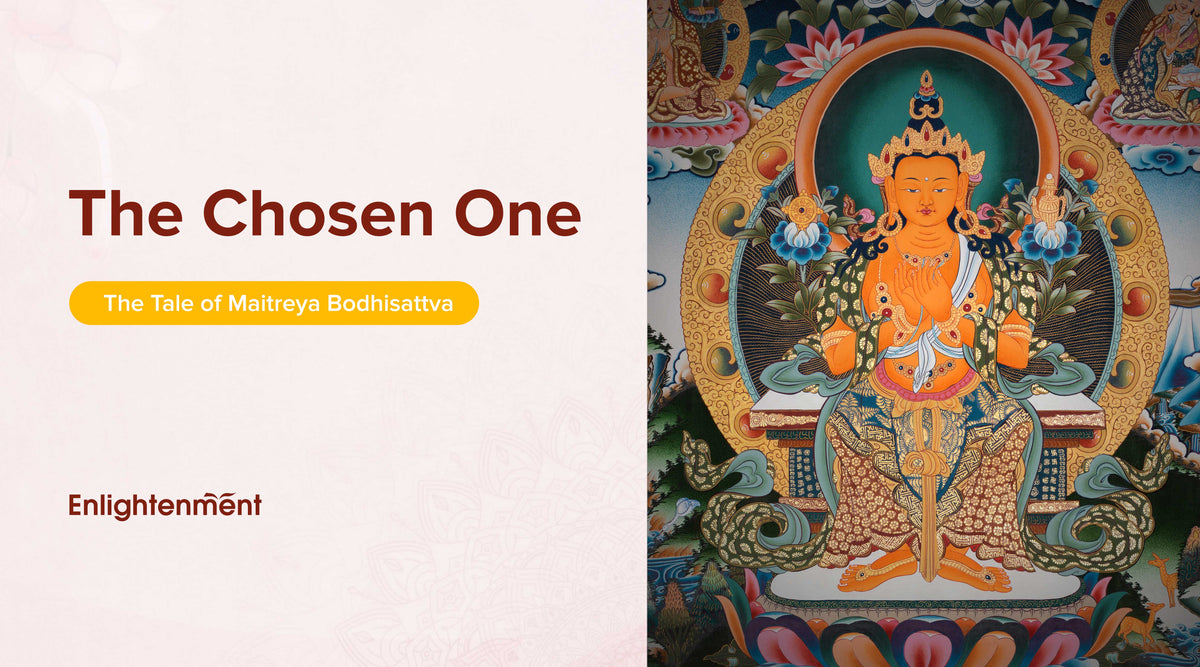
The strange, precise prophecy of Maitreya Bodhisattva, the next Buddha, and the golden light that never fades
Somewhere above the world we can see, in a realm called the Heaven of Joy, a being is waiting. He has already done the hardest part: he made the vow, generations of lifetimes ago, to walk the long road toward awakening. He has already earned the right to become a Buddha whenever he chooses. And yet he waits, patiently, deliberately, watching the ages turn beneath him like weather passing over a mountain.
His name is Maitreya. In the sutras, he is called a bodhisattva, an "awakening being," but he carries a title no other bodhisattva holds: the next Buddha. Not a possible one. Not a hoped-for one. A promised one, foretold by Shakyamuni Buddha himself, with a level of narrative detail that is almost unnerving in its precision: a lifespan, a birthplace, a father's name, a tree he will sit beneath, a moment when the world will finally be ready to hear him.

Check Out Our Maitreya Buddha Thangka Collection
This is the tale of the Maitreya Bodhisattva. In this, we will discuss how he came to be chosen. And what the old texts say is waiting for him in Tushita heaven, and why his statues were stupas in their crowns. And the reason, across two and a half thousand years of Buddhist history, so many different cultures have looked up at the same golden light and called it hope.
Who Is Maitreya Bodhisattva?
Strip away the mythology for a moment, and the core idea is simple enough to hold in one hand. In Buddhist cosmology, a Buddha is not a single, unrepeatable figure. Buddhahood is a role that different beings fill across immense stretches of time. With each one rediscovering and re-teaching the same liberating truth after the previous teaching has faded from memory. Shakyamuni Buddha, the historical Buddha, born Siddhartha Gautama, was the most recent to fill that role. And Maitreya is the one who fills it next.

Check Out Our Shakyamuni Thangka in Vajra Posture with Disciples
His name comes from the Sanskrit word maitrī, meaning loving-kindness, itself rooted in mitra, "friend." In Pali, he is Metteyya. In Tibet he is Jampa, "the Loving One." In China he is Milefo; in Japan, Miroku. Wherever Buddhism traveled, the name traveled with it, and it always meant the same thing: the friend who is coming.
What makes Maitreya unusual among bodhisattvas is how early and how widely he was accepted. He appears in the earliest layers of Buddhist scripture, is named in Theravada, Mahayana, and Vajrayana traditions alike, and remains, to this day, the only bodhisattva broadly venerated within Theravada Buddhism. A tradition that otherwise gives relatively little devotional attention to bodhisattvas as a category.
Long before elaborate Mahayana cosmologies filled the sky with buddhas and bodhisattvas beyond counting, Maitreya was already there, singular and specific, quietly waiting his turn.
The Waiting God, Maitreya Bodhisattva: Life in the Heaven of Joy
Every great story needs a place where the hero is gathering strength before the real events begin. And Maitreya’s story is no exception. That place is Tushita, literally the “Heaven of Joy,” which is one of the heavenly realms of Buddhist cosmology and, by tradition, the residence of every bodhisattva journeying, destined to become a Buddha in their next life.
One of the texts devoted almost entirely to this waiting period is The Sūtra on Maitreya's Birth in the Heaven of Joy, preserved in the Tibetan Kangyur and made available in English through 84000: Translating the Words of the Buddha. The scene it sets is intimate rather than cosmic. The setting is Śrāvastī, in the quiet hours of early evening, with the Buddha seated among his retinue. Among those present is a monk still known by his earlier name, Ajita, "the Invincible," the very being who will one day be Maitreya Bodhisattva.
It is the elder monk Upāli who asks the question that opens the whole account: what will become of Ajita, and where will he go after this life?
The Buddha's answer is unhurried and vivid. Ajita, he says, will be reborn in the Heaven of Joy, and he describes that realm at length: its wonders, its inhabitants, and, crucially, the causes and conduct that lead a being to be born there at all. It is less a travelogue than a teaching wrapped in a promise; to understand Tushita is also to understand what kind of life earns a place near the future Buddha.
By the sutra's end, everyone present is moved to make the same aspiration, to be reborn in that same joyful heaven, close to the one who will one day return to teach them again.

Check Out Our Tushita Heaven Maitreya Buddha Statue
Read alongside its companion text, Maitreya's Setting Out, which recounts the distant past life in which Ajita first gave rise to the awakening mind under a Buddha remembered as Pure Golden Light, the picture becomes even richer. These are not disconnected legends but chapters of a single unfolding story: a bodhisattva's beginning, his long middle, and the heavenly waiting room before his final act.
The Prophecy: What the Buddha Foretold About Maitreya Bodhisattva
If the Heaven of Joy is where the story pauses, the prophecy points forward, and this is the part of the Maitreya Bodhisattva legend that has always struck listeners as remarkably exact for something set so far in the future.
The earliest mention of the coming of Maitreya Buddha appears in the Pali Canon's Cakkavatti-Sīhanāda Sutta, part of the Dīgha Nikāya, where the Buddha tells his followers that after his own teaching has fully decayed, a new teacher named Metteyya will arise, one who will guide not hundreds, but thousands of disciples to awakening.
Centuries later, as Buddhism moved from Pali into Sanskrit and new communities began composing their own accounts, a much fuller narrative emerged: the Maitreyavyākaraṇa, or Prophecy of Maitreya, which fills in the details the earliest texts had left blank.
-
According to this later tradition, Maitreya's Buddhahood is not a vague future event but a scripted one, arriving only after human civilization has cycled through its darkest and its most golden extremes.
-
Humanity's moral decline will bottom out in an age of violence and confusion, when the average human lifespan shrinks to a mere ten years.
-
From that low point, human conduct and lifespan will gradually recover, climbing all the way to an almost unimaginable eighty thousand years, in a world remembered as prosperous, peaceful, and just.
-
It is into this golden, settled world, not the broken one, that Maitreya Bodhisattva will be born, to a father named Subrahmāṇa, a respected minister in the service of a righteous king.
-
He will renounce the world exactly as Shakyamuni once did, achieve enlightenment beneath a tree, and turn the Wheel of Dharma anew for a civilization finally ready to hear it clearly.
-
What ties every version of the prophecy together, from the terse line in the Dīgha Nikāya to the elaborate Sanskrit narrative, is the same underlying promise: that the truth the Buddha taught does not simply vanish when memory of it fades. It waits, embodied in one being, for the moment the world can receive it again.
Whether read as literal history-yet-to-come or as a symbolic map of moral cycles. The prophecy of Maitreya Buddha has functioned the same way for over two thousand years: not as a countdown to dread, but as a quietly radical assurance that decline is never the end of the story.
Faces of the Future Buddha: How Cultures Imagined Maitreya
A promise this old, carried across a continent and then an ocean, never stayed in one shape. In many Mahayana devotional schemes, Maitreya is counted among the eight great divine embodiments, the principal bodhisattvas of the tradition, standing alongside figures such as Avalokiteshvara and Manjushri as an equal in stature though singular in his promise.

Check Out Our Vajrapani with Manjushri and Avalokiteshvara Thangka
India and Gandhara
In the Greco-Buddhist art of Gandhara, in the early centuries of the common era, Maitreya was already one of the most frequently carved figures alongside Shakyamuni himself. Here he appears princely and human, adorned like Indian royalty, holding a small water vessel in one hand, a detail tied to his identity, in some accounts, as a Brahmin in his final birth. This is the Maitreya Buddha still on the way: seated but alert, dignified rather than distant.
China
By the fourth to sixth centuries, Maitreya Bodhisattva devotion had become so central in China that, remarkably, artisans of the period sometimes used the names of Shakyamuni and Maitreya Buddha almost interchangeably in temple inscriptions. A sign of how thoroughly the future Buddha had woven himself into present-day devotion. Over time, a very different popular image also emerged in Chinese folk tradition: the laughing, big-bellied Budai. Later folded into Maitreya's identity as a symbol of abundance and joy, a far cry from the composed princely figure of Gandhara but carrying the same promise underneath the humor.
Tibet and the Himalayas
In Tibetan and Himalayan art, Maitreya's iconography grows more codified and symbolic. He is shown seated on a lion throne, legs often pendant rather than crossed, a visual cue that he is not lost in timeless meditation but literally ready to stand and descend into the world the moment his hour arrives. A small stupa rests in his crown, representing the relics and teachings of Shakyamuni that he honors as his predecessor. In sites like Mulbekh in Ladakh, colossal rock-carved images of Maitreya Bodhisattva have watched over trade routes for over a thousand years, growing new details over the centuries: prayer beads, flowers on his water flask, as devotion added its own layers to the original form.
Japan and East Asia
In Japan, Maitreya Buddha became Miroku, rendered in some of the most serene devotional sculpture in Buddhist art: seated figures, chin resting lightly on one hand, lost in a contemplation that seems to belong equally to the far past and the far future. Across East Asia more broadly, the Lotus Sutra and other Mahayana texts kept Maitreya's coming firmly on the horizon of religious life, sustaining centuries of ritual, pilgrimage, and hope built around a Buddha nobody living had yet seen.
What is striking, moving from region to region, is not how differently Maitreya was imagined but how consistently the essentials survived the translation: the vase, the stupa, the readiness in his posture, the patience in his face.
The Golden Light That Never Fades

There is a reason "golden light" belongs in the same sentence as Maitreya, and it is not just poetic decoration. In Maitreya's Setting Out, the sutra that recounts the very first stirring of his aspiration to awaken, the Buddha under whom that vow was made bears the name Pure Golden Light.
A being whose light, the text says, poured from every pore, filled countless world systems, and rendered the very words "sun" and "moon" unnecessary in his presence. It is under that radiance that the seed of Maitreya's path was planted, long before Tushita, long before any prophecy was spoken aloud.
That imagery of light never really leaves him. It survives in the golden gilding of nearly every Maitreya statue carved from Gandhara to Kyoto. It survives in the yellow-gold coloring iconographic manuals prescribe for his form. It survives, most of all, in what the light is made to represent: a continuity of awakening that does not switch off when one Buddha's era ends.
But simply changes hands, passed forward like a flame from one lamp to the next so that the world is never, even in its darkest ten-year age, left permanently without a source of light.
His attributes reinforce the same idea from different angles. The stupa in his crown holds the relics and teachings of Shakyamuni, a visible acknowledgment that Maitreya's future glory rests on what came before him, not in place of it. The vase, in some readings holding the nectar of immortality. A gesture toward the Dharma as something that nourishes and does not run dry.
The dharmachakra mudra, the teaching gesture his hands so often form even now, is a kind of promise made in advance. The wheel he will one day physically turn, already rehearsed. Even the flowers he holds, the nagapushpa blossoms under which tradition says he will attain enlightenment, root the entire prophecy in a specific, waiting tree.
Nowhere is that lineage of transmitted light clearer than in an inspiring story of Buddha and Asanga, the fourth-century master whose years of solitary retreat are said to have ended only when Maitreya himself appeared and carried him bodily into Tushita. And there he transmitted the teachings that would become the foundational texts of the Yogācāra school.
None of these details are accidental. Buddhist art rarely wastes a gesture, and in Maitreya's case, every ornament on his body is a small piece of the same larger sentence: the light did not go out; it only stepped back to wait for its moment.
Why Maitreya Bodhisattva Still Matters Today

Maitreya Buddha Statue, Ladakh
It would be easy to file the story of Maitreya Bodhisattva away as ancient prophecy and nothing more, a myth for a world that no longer measures time in cosmic ages.
But that undersells what the story has actually done, quietly, for over two millennia. Just as the Enlightenment of Shakyamuni Buddha reshaped how an entire era understood suffering and liberation, tradition holds that Maitreya's own awakening will do the same for a civilization that, by then, will have nearly forgotten what came before.
Maitreya's prophecy has never really been a countdown clock. Communities across Asia, and increasingly beyond it, have returned to it in eras of war, famine, colonization, and social upheaval, not to calculate an arrival date, but to hold onto a structural idea. And that moral decline is cyclical rather than terminal, and that compassion, in the end, outlasts collapse. Millenarian movements across Chinese, Tibetan, and Southeast Asian history have drawn on his name precisely because it offered something rarer than comfort. It offered continuity, a guarantee that the story does not simply stop when things fall apart.
There is also something quietly instructive in the shape of the character himself. Maitreya Buddha is, by definition, the bodhisattva who could become a Buddha immediately and chooses, instead, to remain in the role of teacher-in-waiting, cultivating loving-kindness a little longer before stepping fully into the role the world is not yet ready to receive. In a culture that often prizes speed and immediate results, a figure defined almost entirely by patient, deliberate readiness is a strange kind of role model, one built less around arrival than around preparation.
And perhaps that is the real reason the golden light in his stories never fades. Maitreya is not a promise that suffering will end on a particular date. He promises that someone, eventually, will be ready to answer it, and that in the meantime, the practice of loving-kindness his very name describes is not a placeholder while we wait, but the actual substance of the path itself.
Maitreya Bodhisattva: Story Still Being Told
Every religious tradition keeps a handful of stories that function less as historical record and more as a compass, something you check yourself against rather than simply read once and set down. The Maitreya's Setting Out is one of Buddhism's clearest examples: a monk named Ajita, seated among a crowd in Śrāvastī, quietly told that he will one day be the friend the whole world is waiting for.
He is still waiting, by tradition, in the Heaven of Joy: patient, radiant, unhurried by centuries the way mountains are unhurried by weather. And every statue carved in his likeness, every stupa set into a crown, every scrap of gold leaf laid onto stone across two thousand years of Buddhist art, is really just one long, quiet way of saying the same thing the old sutra said first: the light has not gone out. It is only waiting for its moment.
