Imagine a wise old teacher telling you to kill the Buddha.
Not to argue with him, not to ignore him, but to kill him.
The sentence has been shocking people for over a thousand years. And honestly, it still works. The first time most people hear it, they think it sounds violent, maybe even a little insane. Why would a Buddhist monk even say something like that about the founder of their own religion? It sounds like a threat, or maybe a riddle from a movie villain, not something you would expect to hear from a spiritual teacher.

Check Out Our Buddha Thanga Collection
Here's the twist. This saying is one of the most misunderstood lines in Zen Buddhism, and once you understand what it actually means, it stops being scary and starts being kind of freeing. It is not about hating Buddha. It is not about giving up on spiritual practice. It is actually about protecting your own mind from getting stuck.
In this blog, we will look at where the quote comes from, clear up the biggest misunderstanding about it, and dig into what it really means. Then we end with a few simple ways to use this ancient advice in everyday life.
Where the Quote Actually Comes From
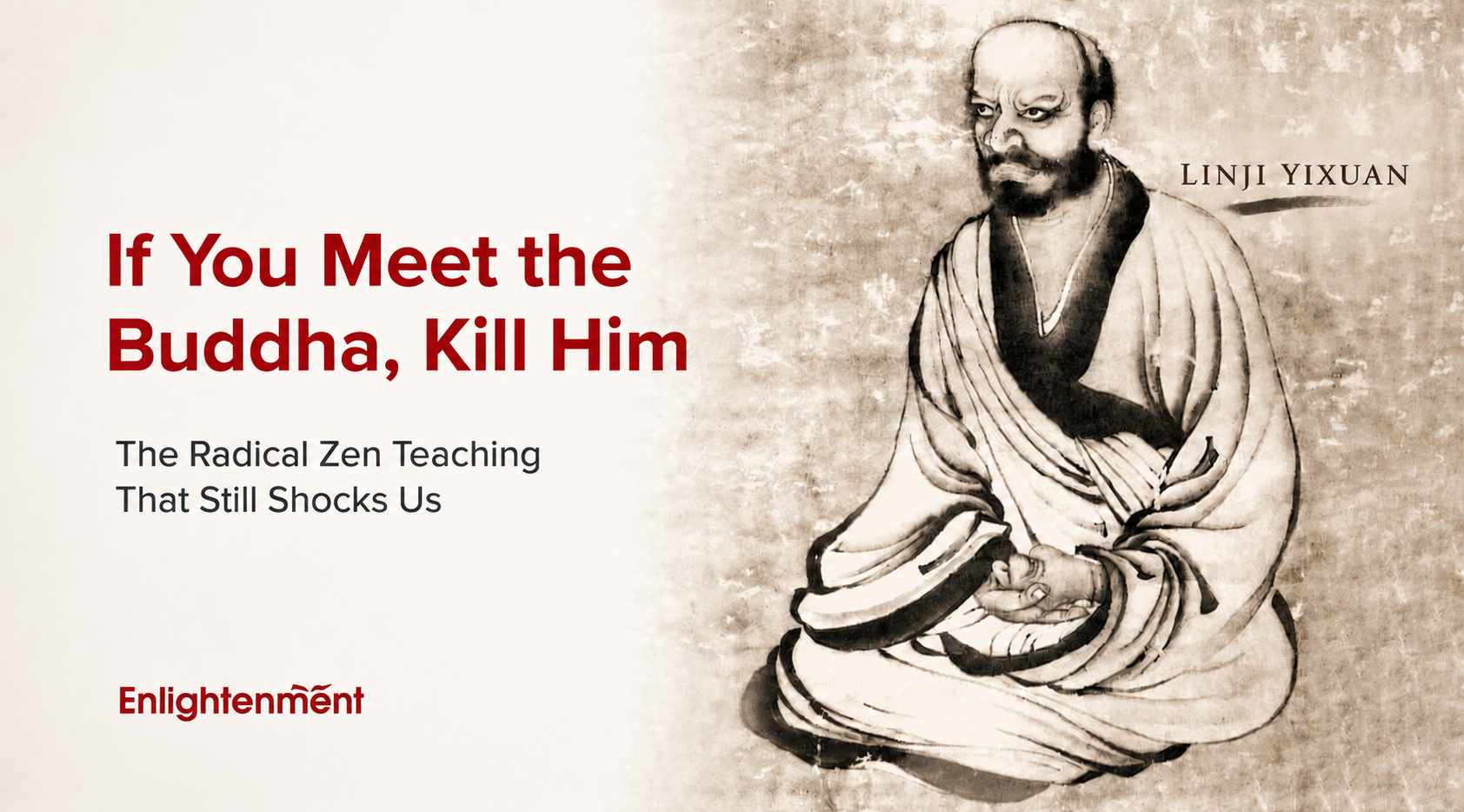
The line comes from a Chan master named Linji Yixuan, who lived in China during the Tang Dynasty and died in the year 886. Chan is the Chinese ancestor of what we now call Zen, which is the Japanese pronunciation of the same word. Linji is one of the most famous teachers in the entire history of this tradition. And the school of Zen most people know today as Rinzai, again a Japanese pronunciation, traces itself directly back to him and his students.
To understand why Linji taught the way he did, it helps to picture the world he lived in. Tang Dynasty China was a huge and busy empire, full of different religious movements, competing monasteries, and no shortage of teachers claiming to hold the secret to enlightenment.
Buddhism itself had already split into many schools by this point, each with its own texts and ideas about the fastest path to awakening. Amid all the noise, Linji built a reputation for cutting straight through the fluff.
He was known for being blunt, and honestly a little wild by the standards of a normal religious teacher. Zen records describe him shouting at his students, sometimes hitting them with a stick, not out of cruelty, but as a kind of shock treatment. His goal was never to hurt anyone. It was to knock students out of their endless overthinking and drop them straight into the present moment, where real understanding could actually happen. A student who came to him with a clever question might get yelled at instead of an answer, because Linji believed chasing clever answers was often just another way of avoiding the real work.
His students wrote down his teachings after he died in a text called The Record of Linji. This is where our famous quote lives, but the popular short version most people repeat today, "If you meet the Buddha, kill him," actually leaves out most of what he originally said.
Here is a fuller version of the passage as it has been translated from the original text.
“Followers of the Way, if you want insight into dharma as it is, just don’t be taken in by the deluded views of others. Whatever you encounter, either within or without, slay it at once. On meeting a buddha, slay the buddha; on meeting a patriarch, slay the patriarch; on meeting an arhat, slay the arhat; on meeting your parents, slay your parents; on meeting your kinsman, slay your kinsman, and you attain emancipation. By not cleaving to things, you freely pass through.” ~By Linji Yixuan
Notice how long that list is. Linji was not only talking about the Shakyamuni Buddha. He named patriarchs, arhats, even parents and kinfolk, saying that any of these, if turned into an object of blind worship, needed to be seen through. He was talking about anything on your spiritual path that you might be tempted to worship instead of understand. And notice the payoff at the end. He is not describing loss. He is describing freedom, the kind that lets you move through life without getting stuck on anything.
This is why chopping the quote down to just "kill the Buddha" causes so much confusion. The full teaching is about not being misled by anyone, including your own mind's tendency to turn ideas into idols.
What the Quote "Kill the Buddha..." Is Not Saying
Before we can understand what Linji meant, we need to clear away the most common and dangerous misreadings.
-
It is not a call to literal violence or murder. Nobody in the history of Zen has ever taken this as an instruction to hurt anyone physically. The "killing" here is symbolic, aimed at ideas, not bodies. Some people online bring this quote up in arguments about violence in religion, as if it proves Buddhism has a hidden dark side, but that reading falls apart the moment you look at the actual context.
-
It is not anti-Buddha or anti-Buddhism. Linji spent his whole life teaching Buddhist practice inside a Buddhist monastery, to Buddhist students, using Buddhist language. He was not trying to tear down the religion he devoted his life to. He was trying to protect it from becoming empty worship, which is a very different thing.
-
It is not permission to reject all teachers, ethics, or practice. This line does not mean "ignore your teacher" or "morality does not matter anymore." Zen still values discipline, guidance, and community life. The point of the teaching is not to blindly follow anyone, but it is also not to throw everything out and do whatever you feel like.
-
It is not a slogan for spiritual rebellion or nihilism. Some people quote this line to sound edgy, as if it means nothing matters or every rule can be broken. That reading is basically the opposite of what Linji was teaching, which was about deep respect for truth, not disrespect for everything around you.
Once these misunderstandings are set aside, the real teaching becomes much sharper and far more useful.
Kill the Buddha, Conceptual Core Meaning:
The Buddha You Meet Is an Illusion

Here is the key idea. Any Buddha you could actually "meet", whether that is a statue, a vision, an idealized teacher, or your own mental picture of what enlightenment should look like, is not the real thing. Traditional images of the historical Buddha, such as the Shakyamuni Buddha Thangka, point toward this same realization. It is a mental image your mind built out of expectations and hopes about what spiritual success should feel like. The moment you treat that image as the actual goal, you have started chasing a shadow instead of the real sun.
Think about how this shows up outside of religion too. People do this with the idea of "success," picturing a very specific image of a successful life and then spending years chasing that picture instead of figuring out what actually matters to them. The picture becomes more real to them than their own life. Linji is warning against that same kind of trap, but applied to spiritual life. So when he says to kill the Buddha you meet, he means kill that mental picture. Get rid of the idea that enlightenment is some far-off person or thing you need to bump into on the road one day. That "Buddha" is a projection, and projections, no matter how beautiful, cannot actually save you.
Buddha Nature Is Already Yours

This connects to a core idea in Mahayana Buddhism, which is the larger branch of Buddhism that Zen grew out of, called Buddha nature. The belief is that every single person already carries the seed of enlightenment inside them, right now, exactly as they are. It is not something you earn from outside yourself through years of collecting merit points or perfect behavior. It is something you uncover, the way clouds part to reveal a sky that was always there.
This understanding is closely related to the path of the Bodhisattva, beings who choose to remain in the world to help others awaken. If Buddha nature is already present in everyone, then searching for the Buddha somewhere out there, in a temple, in a guru, or in a book, actually creates a problem instead of solving one. It sets up a split between "me" and "enlightenment," as if they are two separate things waiting for you to close the distance. Linji wanted his students to stop creating that split and stop looking outward for what was already inward the whole time. The harder you search outside yourself for the Buddha, the further you push the real thing away.
Attachment to Insights Becomes a New Cage

Here is the part people often miss, and it might be the most important piece of the whole teaching. This teaching is not just for beginners chasing gurus around. It also applies directly to advanced practitioners who have already had real breakthroughs.
Say someone meditates seriously for years and finally has a powerful moment of clarity, a genuine shift in how they see themselves and the world. That moment is real, and it matters. But if they cling to that experience, if they start quietly thinking of themselves as "the person who gets it now" compared to everyone else who does not, that identity becomes its own trap. The insight turns into a badge they wear, and the badge becomes something new to defend and hold onto. Even that has to be let go of eventually. Even your best, most profound spiritual moments can turn into a cage if you build your whole sense of self around them.
How Later Teachers Have Interpreted "Kill the Buddha"
This teaching did not stay locked in the ninth century. Later Zen teachers picked it up and passed it forward across hundreds of years and thousands of miles, each one shaping it a little for their own students and their own time.

~Shunryu Suzuki
The Japanese Zen teacher who helped bring Zen practice to the West and wrote the beloved book Zen Mind, Beginner's Mind, used this same phrase:
"Kill the Buddha!" Kill the Buddha if the Buddha exists somewhere else. Kill the Buddha, because you should resume your own Buddha nature."
to point students back toward their own natural awareness rather than an image of what a "Zen master" should be. He wanted his American students, many of whom had come to Zen with big romantic ideas about enlightened masters and mystical secrets, to drop those fantasies and just sit with their own ordinary, present minds instead.
The Vietnamese Zen teacher Thich Nhat Hanh also wrote about this line directly, describing it as one of the "skillful means" a teacher can use to free students from what he called their prison of knowledge and prejudice. He pointed out that people become deeply attached to their own knowledge, habits, and assumptions, and sometimes it takes a shock like this teaching to loosen that grip enough for something new to get in.
In the Rinzai school of Zen that Linji founded, sayings like this are often used the way a koan is used, as a puzzle that is not meant to be solved with ordinary logic. A koan is not really a question with a neat answer waiting at the end. It is meant to jolt the thinking mind loose from its usual grooves, the same way Linji's shouting and hitting were meant to interrupt a student's habitual thinking. This line functions less like a rule you memorize and more like a splash of cold water to the face. It is shock therapy for the mind, not a doctrine to recite.
Practical Ways to "Kill the Buddha" in Daily Life
You do not need to be a Zen monk sitting in a cold monastery to use this idea. It shows up in plenty of very ordinary, very human situations. Here are a few ways to actually put it into practice.
Let go of the need for a perfect teacher or system. No single book, app, coach, or guru has the complete answer for your life waiting in their back pocket. It is fine to learn from people, but at some point you have to take what genuinely helps, leave the rest behind, and keep moving on your own two feet.
Drop the spiritual identity and the "I get it now" moments. It is tempting, once you have had a real breakthrough, to quietly build an identity around being the person who finally has it figured out. That identity, no matter how good it feels, is just another mask.
Stay in beginner's mind instead of collecting concepts like trophies. The real work is staying curious and humble, treating even the ideas you love most as tools rather than trophies. Sacred images such as Manjushri, the Bodhisattva of Wisdom, have long been used as reminders to cut through conceptual thinking rather than collecting it.

Check Out Our Manjushri Thangka, the Bodhisattva of Wisdom
Treat even profound experiences as temporary weather, not the final destination. A powerful realization or a great therapy session is real and valuable, but it passes through you as weather passes over a landscape. It is not a final stop where you get to plant a flag and declare the journey finished.
Question the images you have built of the people you admire. Whether it is a parent, a mentor, or a public figure, it helps to notice when you have quietly turned a real, flawed human being into a flawless idea in your head. Seeing them clearly, mistakes and all, is closer to the truth than worshipping the polished version you invented.
Conclusion
Here is the paradox sitting at the heart of this whole teaching. Only by killing the Buddha you meet on the road do you discover that you already are what you were searching for the entire time. The image had to go so the real thing could finally show up.
There is something quietly freeing about that once it clicks. You do not have to keep chasing an idealized picture of who you are supposed to become someday. You do not have to keep looking outside yourself for permission to be whole, worthy, or enough. Freedom, in this teaching, comes from letting go, not from grabbing tighter.
So here is a question worth sitting with for a while. Where in your own life are you still meeting the Buddha on the road? Maybe it is a mentor you have quietly put on too high a pedestal. Maybe it is an old version of "success" you are still chasing without stopping to ask if it fits you. Maybe it is your own past insight or achievement that you have turned into something to defend rather than something to keep growing past. Whatever it is, Linji's old advice still stands, reminding you to look again instead of settling for the first comfortable answer that comes along.