Purity Rising from the Mud: How the Lotus Embodies in Sacred Thangka Paintings
The lotus, called padma or pema in Tibetan Buddhism, is the most common and powerful natural symbol in Tibetan thangka art. It stands for purity that rises unstained from the mud of samsara, the cycle of ordinary suffering and rebirth.

Check Out Our Bodhisattva Thangka Collection
Look closely at almost any thangka, and you will find one. A Buddha sits on it. A bodhisattva holds it. A pond of them floats in the corner, and a ring of petals holds up the walls of a mandala. Few symbols in sacred art appear so often.
There is a reason for that. The lotus does four jobs at once. It carries doctrine, because it explains the path from confusion to awakening. It shapes composition, because it gives figures a base and a frame. It supports meditation, because a practitioner can imagine it opening in the heart. And it works as a visual threshold, marking the point where the ordinary world ends and a sacred space begins.
Its roots in Buddhist art go back to India, where the lotus was already a sign of divine birth and purity long before Buddhism spread. Indian artists carried it into early Buddhist images. As Buddhism traveled north, painters in Nepal and Tibet kept the symbol and gave it new forms, colors, and rules.
Imagine a pilgrim standing before a thangka in a dim monastery hall. The lamps flicker, and the large flower beneath the central figure seems to glow. The pilgrim may not read a single text, yet the message is clear: something pure can grow from hard ground.
Core Symbolism of the Lotus: Rising Unstained from the Mud
The lotus in Buddhism symbolizes a mind that grows from difficult conditions yet stays pure. This idea goes back to the Buddha himself, who compared his own awakening to a lotus. It grows in muddy water, rises above the surface, and stands clean, with no drop of dirt clinging to its petals.
Most people have seen water roll off a leaf and wondered why it never soaks in. The lotus leaf does exactly that. Mud and water touch the plant all its life, but the bloom comes up bright and dry. Buddhist teachers saw a lesson in this. A person can live in the world, with its trouble and confusion, without being ruled by it.
The stages of growth match the stages of the path:
-
The mud stands for ordinary life, with its cravings, fears, and habits.
-
The water stands for the work of practice, where a person begins to see clearly.
-
The open blossom stands for awakening, where the mind is free and clear.
A thangka painter often places the flower so that all three stages are hinted at, with a stem rising from below and the bloom fully open at the top.
The lotus also carries other meanings. It signals divine birth, since many sacred beings are described as appearing on a lotus rather than being born in the usual way. It stands for the purity of body, speech, and mind, which Buddhists work to clear of harmful habits. And it points to non-attachment, the skill of touching the world without being stained by it.
In tantric Buddhism, the lotus also relates to the feminine principle. It often represents wisdom and the receptive, creative side of practice. In many images, the lotus and the figure it supports express a union of qualities, such as compassion and insight, that cannot be separated.
So why does it appear so often in thangkas? Because a thangka is a teaching in color. Words need to be read. A lotus can be understood at a glance by a child, a farmer, or a scholar. Painters have used it for centuries because it carries a complete lesson in a single shape.
The Language of Lotus Colors and Forms in Thangka Painting
Each color of lotus in a thangka carries its own meaning, and painters choose them with care. A viewer who knows the code can read a figure’s qualities before looking at anything else. Here are the main ones:

-
White lotus (pundarika): This is the lotus of spiritual perfection and complete mental purity. It is linked with White Tara and with the heart of the Buddhas, and it suggests a mind that has been fully cleared.
-
Pink lotus (padma): Considered the supreme lotus, it is generally kept for the historical Buddha and the highest deities. Its soft color suggests the highest honor and the fullest blossom of awakening.
-
Red lotus (kamala): This one stands for love, compassion, and the pure nature of the heart. It is closely tied to Avalokiteshvara, the bodhisattva of compassion.
-
Blue lotus (utpala): It stands for wisdom and for the victory of the spirit over the senses. It is usually shown partly open, since it blooms at night in many traditions. Manjushri, the bodhisattva of wisdom, is linked with it.
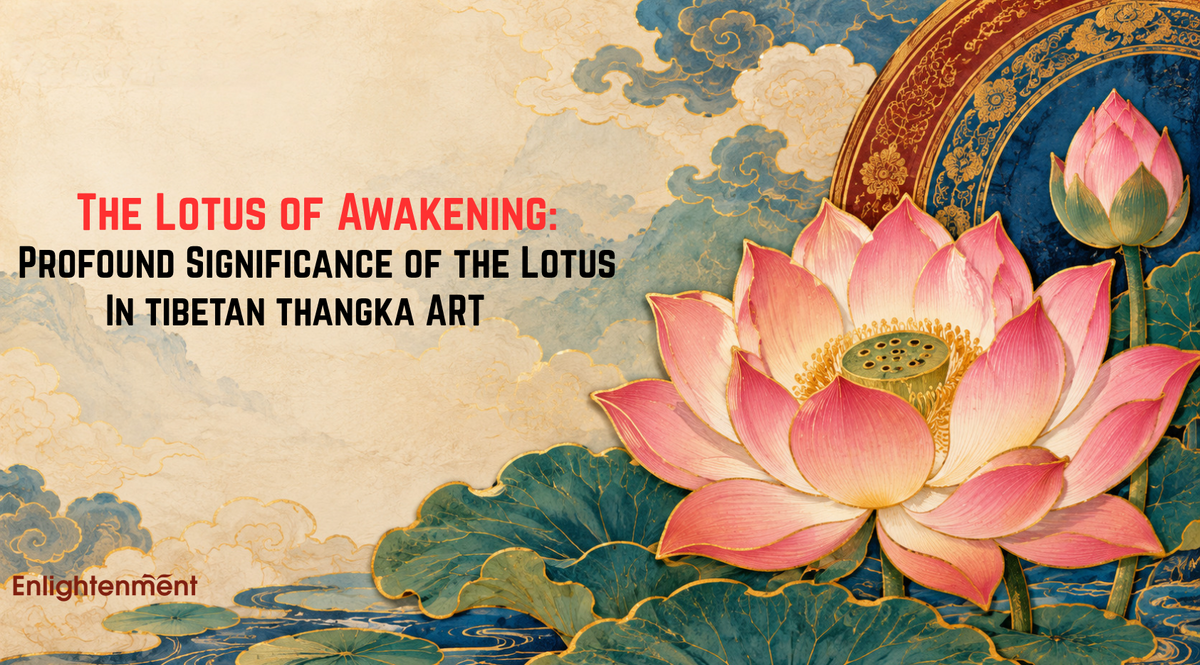
Beyond color, the form of the flower matters too. A closed bud points to potential, a path not yet complete. A half-open flower suggests growth in progress. A fully open flower shows completion. Painters decide which stage to show based on the deity and the message.
Petal numbers carry meaning as well. Thrones often have many layers of petals, and in mandalas the count is set by the design. Eight petals are common, matching the eight directions or eight aspects of a teaching. Rarer lotuses in purple or gold also appear. Purple is sometimes used for more mystical or secret teachings, and gold shows the highest dignity or a finish added with real gold.
Making these differences visible takes skill. Thangka painters use mineral pigments ground into fine powder, so each color has depth and holds its strength for centuries. They draw the flower with precise geometry, setting the curve of each petal with guide lines so both sides match. Then they build the color in thin layers, from pale edges to deeper centers, so the petals seem to glow. The result is a flower that looks soft yet is built on exact measurements.
The Lotus as Throne, Attribute, and Compositional Anchor
The lotus plays more than one part in a thangka. It lifts a figure, fills their hand, and fills the space around them. A single painting can use all three roles at once.

The Lotus Throne (Padmasana)
The lotus throne, known as padmasana, is the base on which nearly every major Buddha and bodhisattva sits or stands. A fully opened flower sits beneath them, often layered with petals that point up and down.
The meaning is simple and strong. A being seated on a lotus is free of the world’s stain, even when the world is all around. The figure rests above it, not in it. The throne also tells the viewer that the figure is a fully realized being and not an ordinary person.
Small variations carry extra meaning. Green Tara, for example, is often painted with one foot extended and resting on a second small lotus. This shows her readiness to step into the world and help those who call on her. One leg rests in meditation, the other is prepared to act.
The Lotus Held as Attribute
Many deities also carry a lotus in their hands. The flower is held by its stem, and the bloom opens near the shoulder or ear.
Avalokiteshvara is called Padmapani, meaning “Holder of the Lotus.” In his hand, the flower shows pure compassion. Tara carries a lotus, often in the form of a blue or pink flower, to show her active care. Manjushri holds a lotus that supports his sword and book, linking clear wisdom with sharp insight.
A lotus in the hand does something a throne cannot. It shows what the deity offers. The viewer sees not only where the figure rests but what the figure brings.
Lotus Motifs in Backgrounds, Mandalas, and Borders
The lotus also fills the rest of the painting. Painters draw ponds in the lower corners, with flowers and leaves floating on still water. They scatter blossoms across the sky as offerings. They build mandalas on eight-petaled forms, where each petal holds a deity or a quality. The lotus is also one of the Eight Auspicious Symbols, a set of signs that bring blessing and good fortune.
This is where a thangka feels most like a living world. Water, mountains, clouds, and flowers are not just scenery. They carry teaching, which is why the symbolism of nature in Thangka art deserves to be read as carefully as the main figure. A pond at the bottom of a painting, for example, reminds the viewer of the mud from which the whole path begins.
Borders often repeat the flower in small, regular patterns. They frame the scene and keep the eye moving around the painting. In this way, the lotus holds the composition together from the center to the edge.
The Lotus and Key Deities: Padmasambhava, Tara, Avalokiteshvara, and the Buddha
Some figures are tied to the lotus so closely that the flower is part of their story. Understanding these links makes a thangka much easier to read.

Check out our Padmasambhava Thangka Collection
Padmasambhava is the clearest case. His name means “Lotus-Born.” Tradition tells that he appeared as a child on a lotus blossom in a lake in the land of Oddiyana, not born from a mother in the usual way. The story shows a being of pure origin, free of ordinary conditions. Tibetans honor him as Guru Rinpoche, the teacher who helped establish Buddhism in Tibet. In thangkas, he sits on a lotus throne, and the flower often appears in his crown and his hand, a constant reminder of his birth.
Green Tara and White Tara also sit on lotus thrones. Green Tara is known for quick action and often has one foot ready to rise. White Tara is linked with long life, calm, and compassion, and she is shown with seven eyes, including those in her hands and feet, to see the suffering of the world. The lotus beneath each of them shows that their kindness comes from a pure base.
Avalokiteshvara holds the lotus of compassion. In one form, he has a thousand arms and eleven heads, each arm ready to help. In a simpler form, he is shown with a single lotus held at his chest. The message is the same: compassion that is open and unstained.
Shakyamuni Buddha, the historical Buddha, is connected to the flower from his very beginning. Stories of his birth tell that when he took his first steps, lotuses sprang up under his feet. Painters show this in narrative scenes of his life, with small blossoms marking each step. Later, at the moment of his awakening, he sits on a lotus seat, a sign that his journey from the world’s mud to complete clarity has been fulfilled.
Together, these figures show how widely the lotus runs through Buddhist art. In each case, it tells the viewer something about who the figure is and how they came to be.
Artistic Execution, Transmission, and Living Relevance Today
Painting a lotus well takes patience. The artist starts with a drawing based on a grid of set proportions. These rules decide the width of the throne, the height of the petals, and the spacing between layers. Nothing is left to chance, because a sacred image must match the descriptions in the texts.

Check Out Out Handcarved Lotus Flower Silver Locket
Next come the pigments. Painters prepare them from minerals, grinding each one by hand and mixing it with a natural binder. Reds, blues, and whites are applied in thin washes, then built up. Shading is done by laying down softer tones near the petal tips and darker ones near the center, so the flower seems to curve. Fine gold lines may trace the edges of petals, catching the light when the painting moves.
When the painting is complete, it is consecrated. The final steps include a ritual in which the eyes of the main deity are finished, and prayers are said. From that moment, the lotus and every other part of the thangka are treated with respect, not just as art but as a support for practice.
The symbol itself came from India, where lotus imagery was part of early Buddhist art. It passed into Nepal, where Newar painters refined its shapes and added graceful detail. From Nepal it entered Tibet, and the great painting schools there adopted it into their own styles. Some made the flowers bold and rich in color. Others drew them lightly and with open space. The meaning stayed the same even as the brushwork changed.
Today the lotus is still alive in monasteries, homes, and meditation centers around the world. Practitioners use lotus thangkas as supports for visualization, imagining the flower opening in the heart as they recite prayers. Teachers use them to explain the path in clear pictures. And the flower has become a broader cultural emblem, seen on jewelry, logos, and gardens far from Tibet.
For anyone who looks at a thangka now, the lotus offers a simple invitation. Notice where the flower grows, how it opens, and what it holds. Each detail points back to the same idea: awakening is possible, and it begins exactly where one stands.
Conclusion
The lotus is more than a pretty flower in Tibetan thangka art. It is a living metaphor that rises from mud, opens in clear water, and stands unstained. It has a color language that tells a viewer who a deity is and what qualities they hold. It works as a throne, a hand-held attribute, and a frame that holds the whole composition together.
It is also tied closely to the great figures of the tradition, from the lotus-born teacher to the compassionate bodhisattva and the Buddha who walked on blossoms. Painters build it with exact proportions and careful pigments, then consecrate it so it can serve as a real support for practice.
What makes the symbol last is its honesty. It does not pretend that life is free of mud. It shows that clarity and compassion can grow right out of difficult ground.
In every carefully painted petal, Thangka art reaffirms that the mind, like the lotus, can rise pure and radiant from the conditions of ordinary life.