
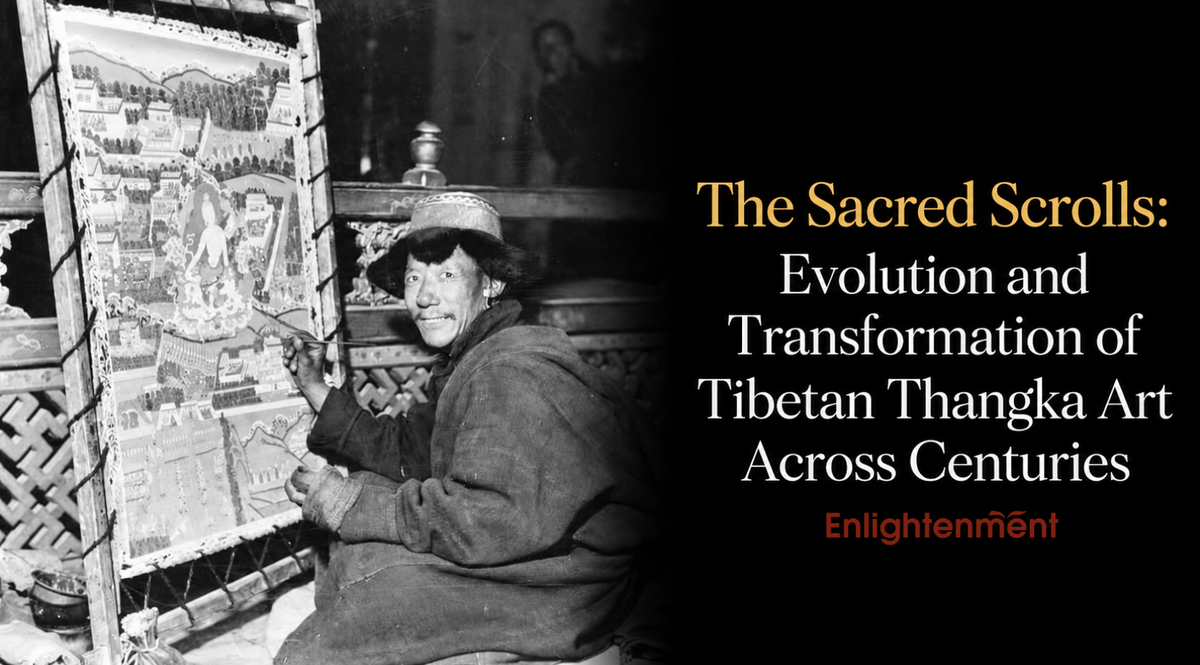
How a portable painting carried faith, style, and memory from the 7th century to today
A thangka is a portable scroll painting made on cotton or silk, showing a Buddhist deity, a teacher, a mandala, or a sacred story. The word means “something that is rolled up,” and that is exactly how these paintings travel. They are mounted in brocade, hung during teachings and rituals, then rolled and carried to the next valley.

Check Out Our Manjushri Hand-painted Thangka
Picture a teacher crossing a high pass on horseback, a thangka tucked safely among his belongings. When he reaches a village, he unrolls it, and the whole teaching hangs in front of the crowd. That simple image explains why this art form lasted so long.
Thangka art was never frozen in time. It grew through waves of influence from India, Nepal, Kashmir, and China. It settled into distinct Tibetan schools. After 1959, it changed again as artists left Tibet and carried their skills across the world.
Through all of it, the thangka kept three jobs. It teaches, because each figure and symbol holds a lesson. It supports meditation, because a practitioner can visualize the deity by looking at it. And it works as a portable shrine, because once it is consecrated, it is treated as a living presence.
We will begin with the origins, then look at the outside influences, the great schools, the later transformations, and the meaning thangkas hold today.
Historical Origins of Tibetan Thangka Art: From Wall Paintings to Portable Scrolls
Tibetan thangka art began in the 7th century, when King Songtsen Gampo brought Buddhism into Tibet and with it the artists who knew how to paint its images.

The king married two foreign princesses. Bhrikuti came from Nepal, and Wencheng came from China. Both are remembered as bringing sacred images and devotion to the Tibetan court. Their arrival opened the door to new religion, new craft, and new ideas about how holy figures should look.
At first, most Buddhist painting was fixed in place. Artists worked on temple walls, shrine rooms, and cave interiors. These murals were large and beautiful, but they could not move. A mural cannot follow a teacher across the mountains.
Portable art also faced a practical problem. Early materials were not always suited to rolling and travel. Painters needed a strong, flexible surface and pigments that would not crack every time the cloth was folded.
True portable thangkas appear to have taken shape in the 10th and 11th centuries. This period is called the “second diffusion” of Buddhism, when Tibetan teachers and translators revived the religion after a time of weakness. Monasteries were rebuilt, texts were translated, and lineage trees were reestablished.
One figure stands out in this story. The Indian master Atisha arrived in Tibet in the 1040s, traveling by way of Nepal. He came from a Buddhist world shaped by the Pala dynasty of eastern India, where sculpture and painting followed clear, elegant models. Those models traveled with the teachers who followed him, and they became a base for early Tibetan scroll painting.
The need for scrolls was real. Many practitioners were nomadic or constantly on the move. Monks went on long teaching journeys, and families often lived in tents. A rollable image let a community have a sacred focus wherever it camped.
Then there is the question of what makes a thangka sacred. A finished painting is not just art. It is consecrated in a ceremony, often including the ritual painting of the deity’s eyes, after which it is treated with great respect. Many Tibetans see a consecrated thangka as a support for real spiritual presence, not a decoration.
Very few early scrolls survive today, partly because cloth ages faster than stone. Still, the surviving examples show a clear pattern. The first thangkas drew heavily on foreign styles, which leads us to the sources that shaped them.
Key Influences That Shaped Early Thangka Development
Early thangkas did not appear from nothing. Painters in Tibet learned from several neighboring traditions, and each left a visible mark. Here are the main streams:
-
Indian Pala and eastern Indian traditions (8th to 12th centuries): These gave Tibetan artists multi-armed deities, clear body proportions, and strong storytelling. The idea of iconometry, where each figure is built on exact measurements, grew from this base.
-
Nepalese Newari tradition (Paubha): Newar artists were famous for rich ornament and fine line work. They worked in Tibet for generations, and their style shaped many early scrolls. The exchange ran both ways, and the story of Buddhist art in Nepal shows how closely the two cultures shared methods, patrons, and even families of painters.
-
Kashmiri influence in western Tibet: In the 11th century, the translator Rinchen Zangpo brought Kashmiri artists to western Tibet. Their work added softer modeling and distinct color tastes, which can still be seen in old monasteries of the region.
-
Chinese elements (later but formative): Blue and green landscapes, hazy distance, and silk techniques arrived through the Yuan and Ming courts. Tibetan painters later used these in backgrounds, clouds, and flowing water.
-
Indigenous Tibetan synthesis: Tibetans did not simply copy. They adapted every foreign style to match their own religious needs. Echoes of earlier Bon motifs also lingered in the early phases.
That last point matters most. Tibetan tradition values accuracy in sacred images. A painter was expected to follow texts and proportions, not to invent new forms. That protective attitude made Tibetan art conservative in a good sense, because it guarded meaning.
Once these foreign streams were absorbed, they stayed fairly steady for centuries. A Tibetan painter in the 13th century and one in the 14th century were working within a familiar vocabulary.
This long stability set the stage for something new. When artists were ready to give those mixed influences a Tibetan face, distinct schools began to form.
The Rise of Distinct Tibetan Painting Schools and Styles
By the 15th and 16th centuries, Tibetan painters had settled into recognizable schools. Earlier work had leaned heavily on Nepalese models, often called the Bal-ris or Beri style. Now Tibetan artists gave the art its own identity, and three great traditions took shape.
Menri (the Medicine Style)
The Menri school was founded in the mid-15th century by the painter Menla Dondrup, whose name gave the style its title. His approach became the classical standard in Central Tibet.
Menri paintings feel balanced and orderly. The colors are rich, like jewels. Gold lines trace the robes and ornaments. Landscapes in the background show a gentle Chinese influence, with soft clouds and flowing streams.
Above all, Menri formalized iconography. Figures follow strict rules, and the central deity sits calmly at the heart of the picture. For many viewers, this is what a “traditional” thangka looks like.
Khyenri (the Khyentse Style)
Khyenri grew in the same era, developed by the painter Khyentse Chenmo. It shares many themes with Menri, but the feeling is different.
Outlines are thicker and more energetic. Reds and greens sit side by side with bold contrast. Figures often look more solid, almost sculpted. If Menri is calm and refined, Khyenri is strong and direct.
Karma Gadri (the Encampment Style)
Karma Gadri appeared in the 16th century and is closely tied to the Karma Kagyu school. The name points to the traveling camp of the Karmapa, around which many artists gathered.
Painters such as Namkha Tashi shaped it, and later masters, including Situ Panchen, refined it.
This style loves open space. Lines are thin and fluid, washes of color are soft, and landscapes feel natural and airy, strongly inspired by Chinese painting. Where Menri fills the cloth with order, Karma Gadri lets it breathe.
Later Developments: Mensar, New Menri, and Regional Variants
The 17th century brought a fresh move. The painter Choying Gyatso developed Mensar, meaning “new Menri,” which kept the classical base but added brighter colors and lively detail. Some painters worked in the time of the Fifth Dalai Lama, when Lhasa had a strong demand for large, refined projects.
In the 20th century, artists blended these ideas again and produced what is often called New Menri. It combines classic structure with a warmer palette and a more modern polish.
Regional traditions also kept their own character. Painters in Rebkong in Amdo, in Chamdo in eastern Tibet, and in Bhutan each adapted older models to local taste and local monasteries. Today, many commercial studios blend these schools freely, so a single painting may borrow from more than one tradition.
Transformation Through Later Centuries: Silk, Appliqué, Political Change, and Diaspora
Painting on cotton was only one path. In the 13th and 14th centuries, Tibetans also admired the woven silk and embroidery of the Chinese court, especially the fine technique known as kesi. These textiles inspired Tibetan craftspeople to make thangkas from fabric itself.
Fabric thangkas fall into two main groups. Some are woven or embroidered. Others use appliqué, where pieces of colored silk are cut, arranged, and stitched into a picture. The effect is rich and slightly three-dimensional.
The most dramatic examples are the giant processional thangkas. These huge cloth images, sometimes many meters tall, are unrolled on hillsides or monastery walls during festivals. Crowds gather to see them. For a few hours, a whole mountain slope becomes a shrine.
The Ming and Qing courts added another layer. Emperors sent gifts to Tibetan teachers and ordered works from Tibetan artists. Styles moved both ways. Chinese motifs entered Tibetan scrolls, and Tibetan Buddhist imagery appeared in imperial workshops.
Then came 1959. After the Chinese takeover and the flight of the Dalai Lama, thousands of Tibetans went into exile. Many masters, monks, and painters settled in India, in places like Dharamshala and Mysore. Others made new homes in Nepal, especially in the Kathmandu Valley and around Boudhanath.
Exile created a serious worry. If the teachers were scattered, who would train the next generation? Communities answered by founding schools where students could learn strict iconometry, pigment preparation, and the long discipline of the craft. In many cases, these centers kept the old rules alive with extra care, because the whole community felt the risk of loss.
At the same time, a second path opened. Demand grew from travelers, collectors, and new devotees around the world. Workshops in Nepal and elsewhere began producing thangkas in larger numbers, often mixing styles and sometimes using modern materials. Some of this work is excellent. Some is rushed, and the gap between careful sacred painting and fast decorative production can be wide.
The modern age brings other questions too. Old scrolls need careful conservation, because humidity, smoke from butter lamps, and rough handling damage fragile cloth and pigment. Artists also debate how much change is acceptable. Some argue that every line must follow the old measurements. Others say a living art must adapt to survive.
What is clear is that thangkas continue to carry Vajrayana Buddhism far beyond Tibet. They hang in monasteries in Mongolia, Bhutan, and Ladakh, and in homes and meditation centers across Europe, North America, and Asia. The scroll that once crossed a mountain pass now crosses oceans.
Iconography, Symbolism, and the Living Role of Thangka Today
A thangka is best understood as visual dharma. It presents the teaching in colors and shapes, so a viewer can read it with the eyes. Practitioners use it to support meditation, teachers use it to explain a path, and families keep it as a blessed presence in the home.

Check Out Our Green Tara Himalayan Thangka
Every part of the picture has a purpose. The deity’s posture shows a quality of mind. The hand gestures mean specific things. The colors carry meaning, and the objects held in the hands point to qualities like compassion or wisdom.
Large compositions can look overwhelming at first. A single thangka may hold dozens of figures, and it helps to know how to read them. Anyone studying a complex thangka learns that the arrangement follows a clear logic rather than a random crowd.
The usual layout works like this:
-
The central deity sits in the middle or at the top, and everything else relates to this figure.
-
The surrounding retinue forms a circle or frame around the center, supporting the main figure.
-
Lineage teachers often appear above or along the sides, showing the chain of transmission.
-
Protectors guard the lower area, usually in fierce forms.
-
Landscape and offerings fill the remaining space with mountains, water, clouds, and ritual gifts.
Once a viewer knows this order, a busy painting becomes readable. The eye moves from the center outward, and the story unfolds.
The way thangkas are made also shows how much stays constant. Painters still use mineral pigments ground into powder, mixed with a natural binder, and applied in careful layers. Gold is applied for fine details. The figures are drawn on a grid of strict proportions, so a Buddha made today follows the same measurements as one made centuries ago.
The final step is the eye-opening ritual, when the painting is consecrated and the eyes are completed. Before that moment, it is a prepared work of art. After it, many see it as a sacred object.
Today, thangkas serve many people at once. Monasteries use them in daily ritual. Tourists admire them in galleries and shops. Western collectors study and preserve them. Museums catalog old examples, and some training centers record the methods of living masters before they are lost.
Through all of it, the older purpose remains. For a monk in a mountain temple and a student in a city apartment, a thangka still serves as a support for attention, devotion, and understanding.
Conclusion
The story of Tibetan thangka art is a story of movement. It began in the 7th century with the arrival of Buddhism and its artists. It took early form through a blend of Indian and Nepalese models, with Kashmiri and Chinese touches added along the way. Then, in the 15th and 16th centuries, Tibetan painters shaped these inputs into schools such as Menri, Khyenri, and Karma Gadri.
Silk and appliqué widened the art further. Imperial exchange brought new ideas. After 1959, exile scattered the masters, yet it also spread the tradition across continents and sparked new teaching centers.
Through every stage, the core purpose held steady. A thangka is meant to guide the mind, honor a lineage, and bring a sacred presence into daily life. Style changed, but meaning did not.
The future depends on care. Authentic training centers, careful conservation, and informed buyers all help protect the tradition. Knowing the history makes that care easier, because each layer of style and each school tells us what a painter was trying to preserve.
Thangka art remains a living tradition precisely because it has continually transformed while guarding its iconographic and spiritual integrity.
