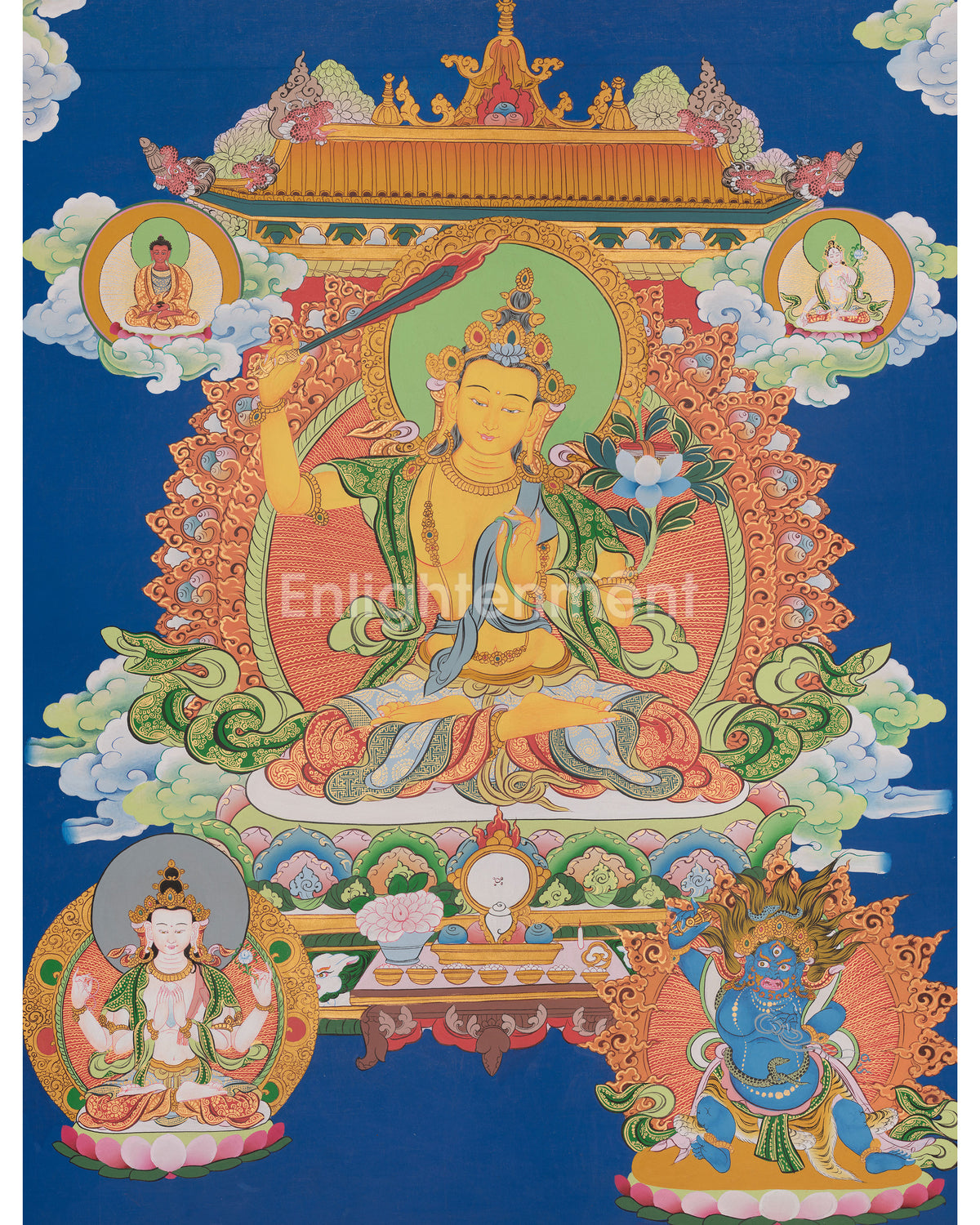
Manjushri, also known as Manjushree and Manjughosha, is venerated as the deity of wisdom or clear insight and understanding, which cuts through confusion and ignorance. His appearance is frequently represented in a composed and youthful manner, that is, in the fresh and clear nature of an awakened mind. His sword symbolizes the ability of wisdom to slice through illusion, and the signs of the lotus and sacred text are symbols of knowledge and education. Manjushri guides those seeking understanding and can clarify spiritual and everyday issues. Above him, Amitabha Buddha appears in the upper right, seated in meditation and representing infinite light, wisdom, and liberation. White Tara occupies the upper left, embodying compassion, longevity, and the nurturing qualities of enlightened awareness. Their peaceful presence complements the central figure, emphasizing the connection between spiritual wisdom and compassionate activity. Below the central figure, Chenrezig appears on the lower right, seated upon a lotus throne with a peaceful expression and adorned with traditional ornaments. As the Bodhisattva of Compassion, he represents unconditional loving-kindness and the aspiration to relieve the suffering of all sentient beings. On the lower left, Vajrapani appears in a dynamic, wrathful form, surrounded by blazing flames and holding a vajra, symbolizing the indestructible power of enlightened awareness. Together, Manjushri, Chenrezig, and Vajrapani form the revered triad of wisdom, compassion, and enlightened power in Tibetan Buddhism. The inclusion of Amitabha Buddha and White Tara further enriches the composition, creating a meaningful representation of the qualities cultivated through Buddhist practice.