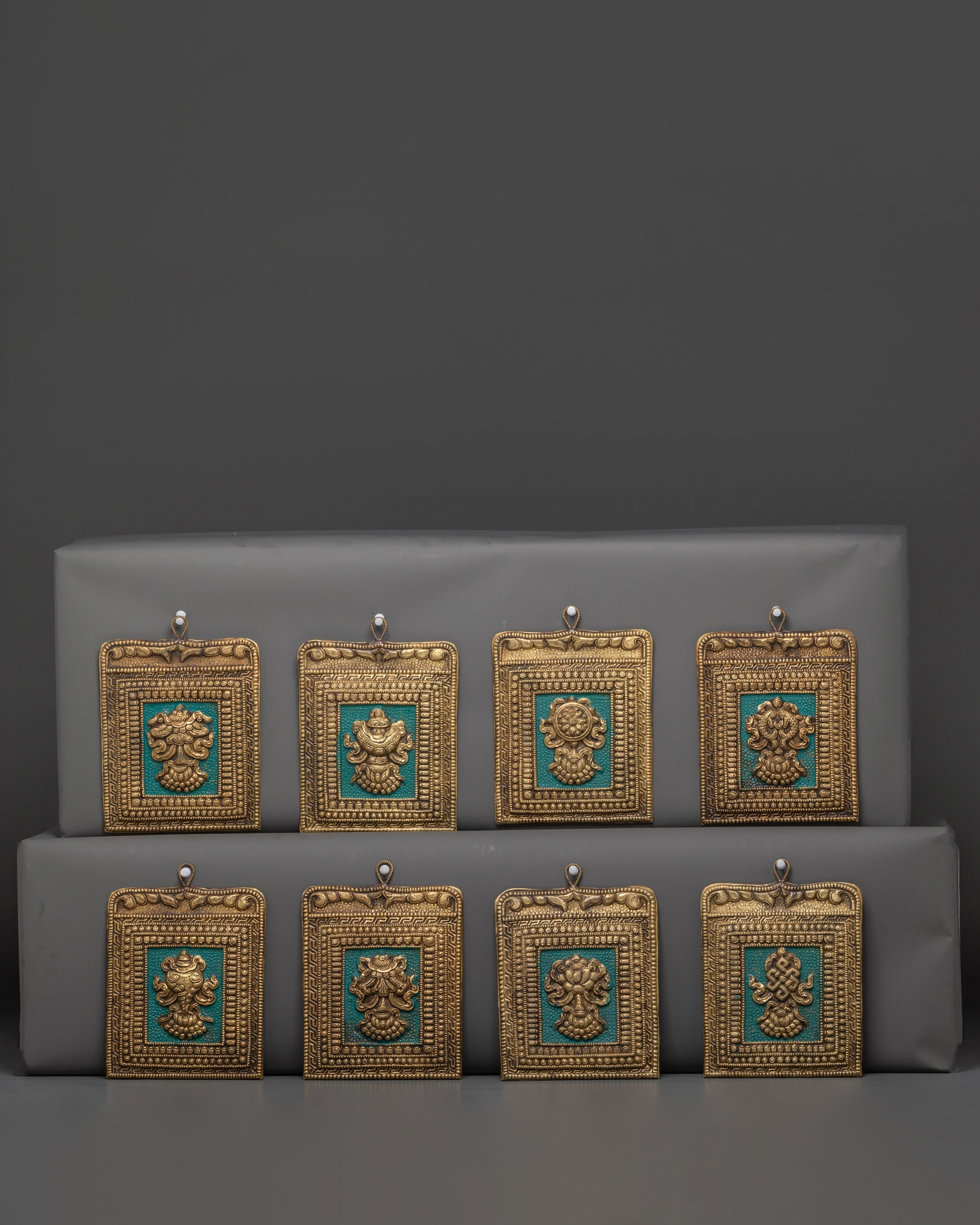
Eight Auspicious Symbols in Tibetan Buddhism
-----------------------------------------
Size: 21cm (Height) x 15.5cm (Width)
Single Weight: 0.26kg
Total Weight: 2.10kg
Materials: Brass
-----------------------------------------
About 8 Auspicious Symbols:
This Traditional Tibetan Eight Auspicious Symbols Set features eight individual brass plaques representing the Astamangala of Buddhism, a group of symbols traditionally associated with qualities of the Buddhist path, good fortune, wisdom, and spiritual awakening. Each plaque is presented in a rectangular decorative frame with a turquoise-colored central panel and a raised symbolic motif. The complete set has a single weight of 0.26 kg and a total weight of 2.10 kg, and is crafted from brass.
The set includes the Endless Knot, Lotus, Conch Shell, Treasure Vase, Victory Banner, Dharma Wheel, Parasol, and Pair of Golden Fish. Each symbol carries its own meaning within Buddhist tradition: the Endless Knot represents interdependence, the Lotus purity and spiritual awakening, the Conch the spreading of the Dharma, the Treasure Vase abundance, the Victory Banner the triumph of wisdom over obstacles, the Dharma Wheel the Buddha's teachings, the Parasol protection, and the Golden Fish freedom and liberation.
Each plaque is richly decorated with beaded borders and raised ornamental details surrounding the central emblem. Small hanging loops at the top allow the pieces to be displayed individually or arranged together as a complete set. The combination of brass detailing and turquoise-colored backgrounds gives the collection a distinctive traditional Himalayan appearance.
Introduction To The 8 Auspicious Symbols :
The eight auspicious symbols are identified as framing the body of the Buddha in Tibetan tradition, with the parasol representing his head, the golden fishes his eyes, the lotus his tongue, the treasure vase his neck, the wheel his feet, the victory banner his body, the conch his speck, and the endless knot his mind.
In Hinduism, they are known as Ashthamangala, which also holds significant spiritual significance. Ashthamangala is widely used at the entryway above the door by Hindu practitioners to ward off harmful spirits and attract positive energy at home, as well as for the same purpose in work or office spaces.
Why choose Evamratna?
To give your space a peaceful, powerful, and attractive feel, we are introducing Buddhism-inspired home décor items to enliven your space with zen vibes, in the form of decoration, an art form, or inspiration.